Topic 12.4 Notes – Ampère’s Law
1. What Ampère’s Law Says
Integral form
- The left side is a line integral around a closed loop (an Amperian loop).
- is the net current passing through the surface bounded by that loop.
- .
Only current that actually pierces the loop counts. Current outside the loop does not contribute.
Physical meaning
- A moving charge (current) creates a magnetic field.
- That field forms circles around the current.
- Ampère’s law says the total “circulation” of B around a closed path is proportional to the enclosed current.
For a long straight wire, the magnetic field forms concentric circles around the wire, as shown below.

Magnetic field around a long straight current-carrying wire
Use the right-hand rule to determine the direction. Point your thumb in the direction of the current, and your fingers curl in the direction of B. On one side of the wire the field points out of the page, and on the other side it points into the page.
When this works on the AP exam
You only use it quantitatively when symmetry makes life easy:
- Long straight wire
- Very long solenoid
- Cylindrical conductor or slab with uniform current density
If symmetry doesn’t let you treat B as constant along part of the loop, the integral won’t simplify.
2. Choosing and Using an Amperian Loop
An Amperian loop is just an imaginary closed path you invent to evaluate the integral.
The whole trick is choosing it to match the symmetry of the situation.
How you apply it
- Identify symmetry (cylindrical for wires, rectangular for solenoids).
- Choose a loop where B has constant magnitude along part of the path.
- Check dot products:
- B parallel to → contributes.
- B perpendicular to → zero.
- Compute .
- Solve for .
In good cases, the integral becomes:
That simplification is the entire goal.
3. Magnetic Fields from Symmetric Current Distributions
Long straight wire
Use a circular loop of radius .
- Field decreases as .
- Same result you got earlier from Biot-Savart.
- Direction from right-hand rule.
If two wires carry opposite currents, expect cancellation somewhere. That’s a common MC question twist.
Long solenoid
Assume it’s very long.
- Uniform field inside.
- Negligible field outside.
Use a rectangular Amperian loop that runs partly inside the solenoid and partly outside.
- is turns per unit length.
- Field is parallel to the axis.
- Independent of radius (inside).
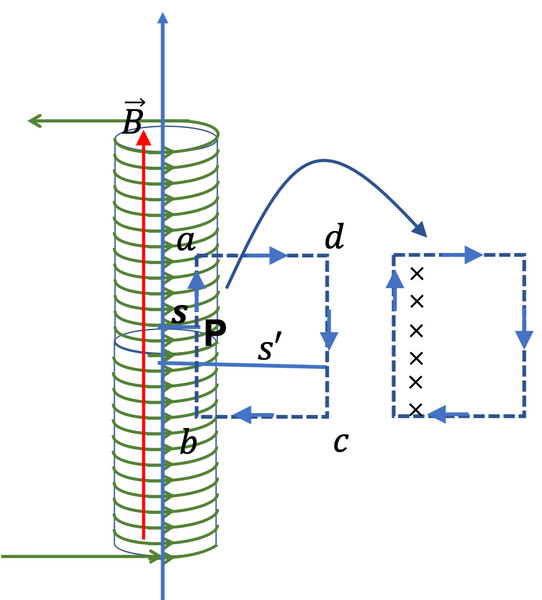
Amperian loop for a long solenoid
Only the segment inside the solenoid contributes to the integral because is parallel to there and negligible outside.
If they don’t say “very long,” still assume it unless clearly stated otherwise.
Solid cylindrical conductor (uniform current density)
Let total current , radius .
Outside
Same as a wire.
Inside
Current density:
Enclosed current:
Plug into Ampère’s law:
Inside, B increases linearly with r. Outside, it falls as .
Students often forget that inside behavior is linear. That shows up in graph interpretation questions.
4. Superposition of Magnetic Fields
Magnetic fields add as vectors:
Typical setup:
- Find each field separately.
- Use right-hand rule for direction.
- Add carefully.
If two wires carry equal currents in opposite directions, there will be points where the fields cancel exactly. The direction logic matters more than the algebra.
5. Ampère’s Law in Maxwell’s Equations
Original form:
Maxwell corrected it:
A changing electric field also produces a magnetic field.
You are not expected to calculate with the displacement current term on the AP exam. You just need to know the idea: changing creates , which leads to electromagnetic waves.
