Topic 11.6 Notes – Kirchhoff’s Loop Rule
1. What Kirchhoff’s Loop Rule Says
The rule is written as:
That means: add up every voltage rise and drop around a closed loop, and the total is zero.
Why? Because of conservation of energy.
If a charge goes all the way around a loop and comes back to where it started, its electric potential energy must be the same as when it began. Energy can be transferred (battery → charge, charge → resistor as heat), but it can’t magically appear or disappear.
Energy view of a circuit
When a charge moves through a potential difference ,
- Through a battery (from − to +): , so electric potential energy increases.
- Through a resistor (in the direction of current): , so electric potential energy decreases and becomes thermal energy.
- Around a full loop:
So Kirchhoff’s Loop Rule is just energy conservation written in voltage language.
On tests, when they ask you to “describe the circuit using Kirchhoff’s loop rule,” they want this energy story, not just the equation.
2. Voltage changes across circuit elements
To apply the rule correctly, you need clean sign conventions.
Battery (emf )
- Moving from negative → positive terminal: (voltage rise)
- Moving from positive → negative:
The battery increases electric potential energy per unit charge.
Resistor
Using Ohm’s law :
- Move with the current → (voltage drop)
- Move against the current →
The resistor converts electric energy into thermal energy.
Putting it together in a loop
As you travel around a loop, write each term in order and set the sum equal to zero.
Example: one battery and two resistors in series with current , traversing with the current:
That simplifies to , which matches what you already know about series circuits.
If you guess a current direction and solve, a negative result just means the real current goes the opposite way. That’s normal in multi-loop problems.
3. Electric potential graphs around a loop
Sometimes they show you a graph of electric potential vs. position around the loop. You need to connect that picture to the loop rule.
Here’s the basic shape for a simple loop with one battery and two resistors:
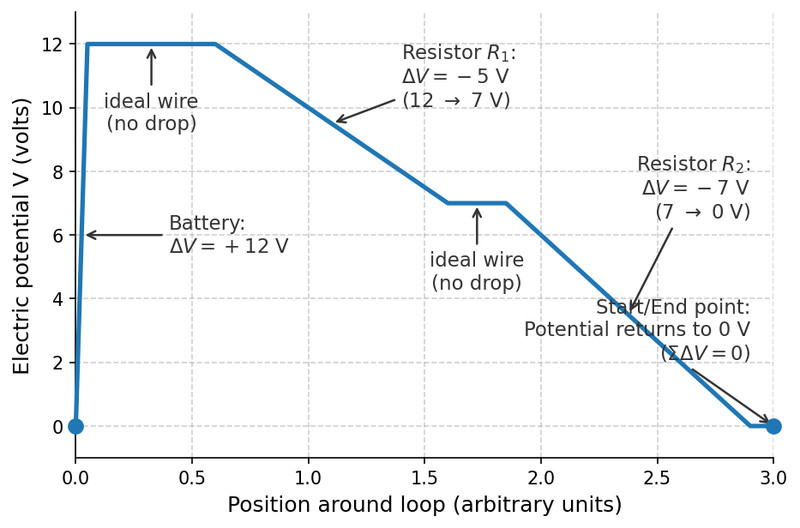
Electric potential vs. position for a single-loop circuit
Notice how the potential jumps up at the battery, drops linearly across each resistor, and stays flat along ideal wires. The graph literally tracks the energy changes a charge experiences as it moves around the loop.
How to read it:
- Vertical jump up → battery (voltage rise).
- Downward slope → resistor (voltage drop).
- Steeper slope → larger .
- Flat section → ideal wire (no drop).
The most important feature: after going all the way around, the graph returns to its starting potential. If it didn’t, energy wouldn’t be conserved.
On the AP exam, they love asking you to interpret one of these graphs and identify where the battery is or which resistor has the larger resistance. The bigger drop in potential corresponds to the larger .
4. Describing a circuit using the loop rule
When you’re asked to describe what’s happening physically:
- Charges gain energy inside the battery.
- Charges lose energy in resistors.
- The total energy gained equals the total energy lost.
- Therefore, the algebraic sum of potential differences in the loop is zero.
In multi-loop circuits, you write one loop equation per independent loop and combine with the junction rule. Every equation you write is just an energy bookkeeping statement.
Keep that mindset. If your equation doesn’t tell a clear energy story, something is off.
