Topic 10.4 Notes – Dielectrics
What a dielectric is
A dielectric is an insulator placed in an electric field. Charges inside it are bound to atoms or molecules, so they cannot move freely across the material.
In an external electric field:
- Positive charges shift slightly in the direction of the field.
- Negative charges shift slightly opposite the field.
- The material develops many tiny electric dipoles.
This shift is small, but across billions of atoms it adds up to something measurable.
Polarization
That alignment of tiny dipoles is called polarization.
Polarization causes:
- Bound surface charges to appear on the faces of the dielectric.
- An induced electric field created by those bound charges.
- That induced field points opposite the external field.
Here’s the picture you should have in your head when a dielectric sits between capacitor plates:
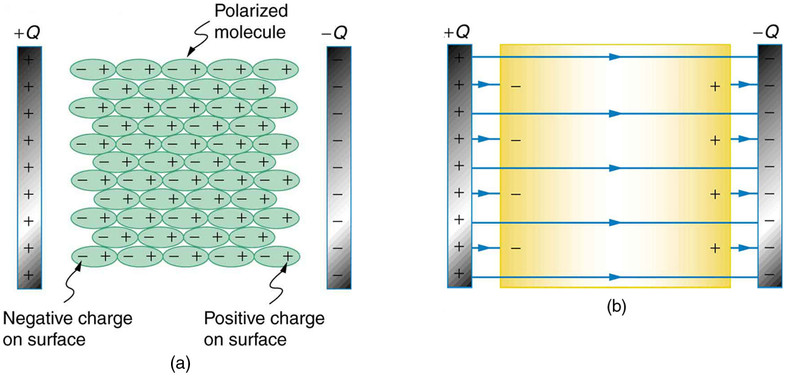
Polarization of a dielectric between capacitor plates
On the left, the individual molecules become slightly polarized. Notice the negative bound charge on the surface near the +Q plate and the positive bound charge near the −Q plate. On the right, those bound charges create an induced field inside the slab that opposes the field from the plates.
Contrast this with a conductor:
- Conductor → free charges move until internal .
- Dielectric → charges only shift slightly → internal is reduced but not zero.
That “reduced but not zero” idea shows up again when we quantify the effect.
Dielectric constant and permittivity
The strength of a dielectric’s effect is described by the dielectric constant, .
- is the permittivity of the material.
- is the permittivity of free space.
- is dimensionless.
- Vacuum has . All real materials have .
Bigger means stronger polarization and a bigger reduction in the electric field inside.
If a problem gives you instead of , just remember they’re related through . Same physics, different packaging.
How a dielectric changes the electric field
Take a parallel-plate capacitor with fixed charge on the plates. This means it’s isolated (not connected to a battery).
Without a dielectric:
Insert a dielectric fully between the plates:
So the field is reduced by a factor of , not by subtraction.
What’s happening physically:
- Plates create .
- Dielectric polarizes.
- Bound charges create an opposing field.
- Net field becomes .
Important detail: the reduction happens inside the dielectric material.
Since , if decreases and stays the same:
- In an isolated capacitor, decreases.
- stays the same.
Students often forget which quantity is held fixed. On tests, that’s usually the whole point of the question.
How a dielectric changes capacitance
For a parallel-plate capacitor without a dielectric:
With a dielectric filling the space:
So capacitance increases by a factor of .
Remember the definition:
In an isolated capacitor:
- stays constant.
- decreases.
- So must increase.
Physically, the dielectric weakens the field, which lowers the voltage for the same charge. That means the capacitor can store more charge per volt.
Isolated vs battery connected capacitor
This distinction gets tested constantly.
| Isolated (Q fixed) | Battery Connected (V fixed) | |
|---|---|---|
| Charge Q | Constant | Increases (since ) |
| Electric Field E | Decreases to | Stays the same (because ) |
| Voltage V | Decreases | Constant |
| Capacitance C | Increases to | Increases to |
For battery-connected capacitors, the battery pushes extra charge onto the plates to keep constant. That’s why increases instead of dropping.
On FRQs, they love asking you to explain energy changes. If is fixed and increases, the stored energy increases. The battery supplies that energy.
