Topic 8.3 Notes – Electric Fields
1. What an Electric Field Is
An electric field tells you the force per unit charge at a point in space.
- is the electric field at a point.
- is the force on a test charge placed there.
- is the test charge.
A test charge is:
- A tiny positive point charge
- Small enough that it doesn’t disturb the existing field
Units: N/C, which is equivalent to V/m (you’ll connect those later with potential).
Direction rules
- Field points away from positive charges
- Field points toward negative charges
- A positive charge feels force in the same direction as
- A negative charge feels force opposite
For a single point charge :
- Radial (along the line from the charge)
- Inverse-square dependence
- Direction set by the sign of
Here’s the standard picture for isolated charges. Notice how the field lines radiate outward from a positive charge and inward toward a negative charge. The rightmost case shows a larger-magnitude negative charge, represented by more densely packed field lines.
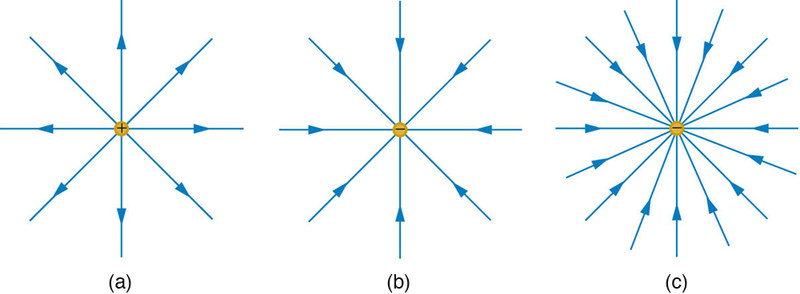
Electric field lines for isolated point charges
On FRQs, they love asking you to explain direction. Always reference the sign of the source charge and the fact that the field direction is defined using a positive test charge.
2. Superposition and Electric Field Maps
Superposition principle
If multiple charges are present, the net field is the vector sum:
Fields add even if charges are different signs.
Typical multi-charge process:
- Find distance from each charge to the point.
- Compute each .
- Assign direction using geometry.
- Break into x and y components.
- Add components.
- Recombine for magnitude and angle if needed.
Most AP problems keep it to four charges or fewer unless symmetry simplifies things.
A very common mistake is adding magnitudes instead of vectors. If directions differ, you must resolve components.
Vector field maps
A vector field map shows arrows at many points. In the diagram below, focus on panel (a), where the arrows get shorter as you move away from the positive charge.

Vector field map for a positive point charge
- Arrow direction → direction of
- Arrow length → magnitude of
- Net field at a point = vector sum of contributions
These maps give both direction and relative magnitude at specific points in space.
Electric field line diagrams
These are simplified versions of vector maps.
Rules:
- Start on positive, end on negative (or infinity)
- Density of lines ∝ field strength
- Field direction is tangent to the line
- Lines never cross
If lines crossed, that point would have two directions for , which is impossible.
Field lines are qualitative. You cannot calculate exact magnitudes from them, only compare relative strength.
3. Electric Fields of Conductors in Electrostatic Equilibrium
Electrostatic equilibrium means charges are not moving.
For conductors:
- Excess charge resides on the surface
- Electric field inside = 0
- Field at the surface is perpendicular
- Sharper curvature → higher surface charge density
Why is inside?
If there were a field, free charges would move. Equilibrium requires no motion.
Isolated conducting sphere
For a sphere of radius and total charge :
- Inside ():
- Outside ():
Outside, it behaves exactly like a point charge at the center, producing a radial field.
Notice that the field lines are perpendicular to the surface and spread out as you move away, consistent with the decrease in magnitude.
On conceptual questions, they often place a point inside a hollow conductor and ask about the field. If it’s in equilibrium and no internal charge is present, the answer is zero.
4. Electric Fields of Insulators
In an insulator, charges are not free to move.
In electrostatic equilibrium:
- Excess charge can be in the volume and on the surface
- The electric field inside can be nonzero
- Distribution depends on geometry and how charge was placed
Conductor vs Insulator
| Property | Conductor | Insulator |
|---|---|---|
| Charges mobile? | Yes | No |
| Excess charge location | Surface only | Surface + interior |
| E inside (equilibrium) | 0 | May be nonzero |
| Surface field direction | Perpendicular | Not required |
Students often overgeneralize “E inside = 0.” That is only true for conductors in electrostatic equilibrium.
