Topic 11.3 Notes – Resistance, Resistivity, and Ohm’s Law
1. What Resistance Is
Resistance tells you how much an object opposes the motion of electric charge.
Macroscopic definition:
Units are ohms (Ω), where .
So if a device needs a large voltage to push a small current, it has a large resistance.
Microscopic picture (which FRQs love):
- In a metal, free electrons drift through a lattice of positive ions.
- They constantly collide with atoms.
- Each collision transfers energy to the lattice → thermal energy.
- More collisions → harder for current to flow → larger .
The key idea is that resistance depends on both the material and the shape of the object. That’s where resistivity comes in.
2. Resistivity and What Resistance Depends On
Resistivity as a material property
Resistivity measures how strongly a material resists current.
- Units:
- Set by atomic structure.
- Low : good conductor (like copper).
- High : poor conductor (like glass).
For ohmic materials, is constant \u2014 that is what makes them ohmic.
In real conductors:
- Increasing temperature → more lattice vibration → more collisions
- So typically increases with temperature
That’s why a hot filament has a higher resistance than when it’s cold.
Resistance of a uniform conductor
For a wire with uniform cross-sectional area:
- = length
- = cross-sectional area
Memorize the proportional reasoning:
- (longer wire → more collisions)
- (material matters directly)
- (thicker wire → more parallel paths → lower )
Quick example thinking:
- Double the length → resistance doubles.
- Double the radius → area increases by 4 → resistance becomes one-fourth.
That radius-area connection is a classic trap.
When resistivity varies along the wire
If the material’s resistivity changes with position, treat the wire as many tiny resistors in series:
Each tiny segment has
On an FRQ, this usually means:
- Write .
- Integrate over the length.
- Keep geometry constant unless told otherwise.
3. Ohm’s Law and Circuit Element Behavior
Ohm’s Law
This relates the potential difference across an element to the current through it.
Rearrangements:
Ohm’s law describes behavior of a circuit element. It does not say all materials are ohmic.
Ohmic vs Non-Ohmic materials
| Feature | Ohmic | Non-Ohmic |
|---|---|---|
| Resistance | Constant | Changes with or |
| V-I graph | Straight line through origin | Curved |
| Example | Metal wire at constant temperature | Diode, light bulb filament |
If doubling doubles , resistance is constant → ohmic.
If the graph curves upward or downward, resistance depends on operating conditions.
Determining resistance from a graph
For an ohmic material, the current-voltage graph is a straight line through the origin. In this case, the slope tells you about the resistance.
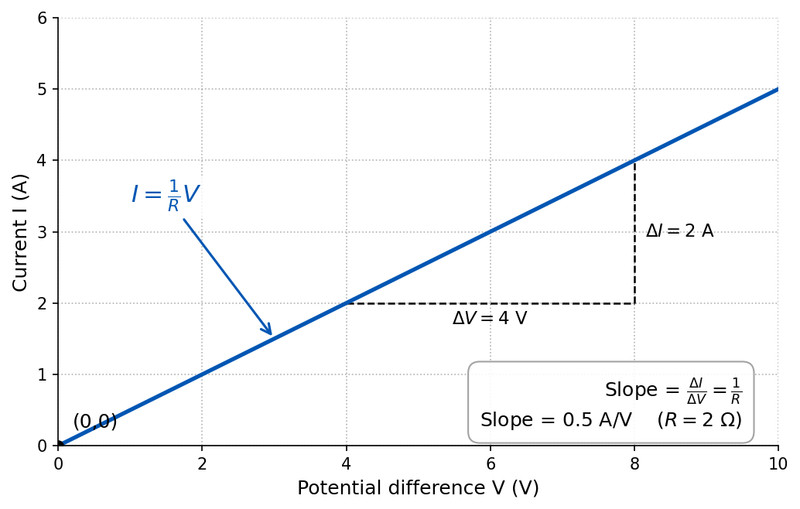
I vs. V graph for an ohmic resistor
If the graph is I vs V:
If the graph is V vs I:
Students lose points here by grabbing the wrong reciprocal. Always check which variable is on which axis.
4. Energy and Power in Resistors
When current flows through a resistor, electrical energy becomes thermal energy (Joule heating).
Power formulas:
Use whichever form matches what you’re given.
Important physical meaning:
- Power depends on .
- Small increases in current cause large increases in heating.
Energy over time:
In derivations, you might combine this with energy conservation in a full circuit analysis.
