Topic 12.1 Notes – Magnetic Fields
1. What a Magnetic Field Is
A magnetic field is a vector field. At every point in space, it has:
- A magnitude (how strong the field is)
- A direction (which way a north pole would point)
Units are tesla (T).
You use to determine the magnetic force on:
- Moving charges
- Current-carrying wires
- Magnetic materials
Later you’ll use , but for now just remember that tells you how magnetism acts in space.
Dipoles, Not Monopoles
Magnetic fields are produced by magnetic dipoles or combinations of dipoles. A dipole has:
- A north pole
- A south pole
You never get a single isolated pole. If you break a bar magnet in half, each piece becomes a smaller dipole with its own north and south. That’s a direct consequence of how magnetic fields are structured.
Field Lines and Gauss’s Law for Magnetism
Magnetic field lines:
- Form closed loops
- Never start or end
- Outside a bar magnet: point away from north and toward south
- Inside the magnet: loop from south back to north
This standard bar-magnet diagram shows the pattern you should picture:
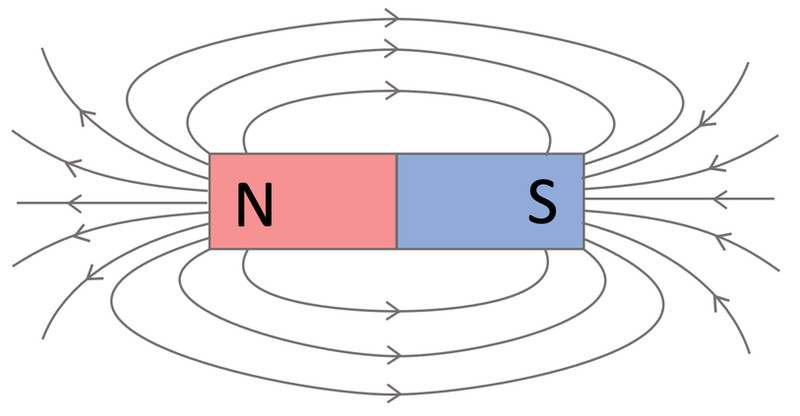
Magnetic field lines around a bar magnet
This closed-loop behavior is captured mathematically by Gauss’s law for magnetism:
The net magnetic flux through any closed surface is zero. No magnetic “charge” exists. Compare that to electric fields, where flux can be nonzero if charge is enclosed.
On tests, if you’re asked about flux through a closed surface around part of a magnet, the answer is always zero.
2. Magnetic Dipoles and Their Behavior
Where Dipoles Come From
Magnetic dipoles arise from moving electric charges:
- Electrons orbiting nuclei
- Electron spin
- Any circular current loop
A current loop acts like a tiny bar magnet. At the atomic level, materials are full of these tiny dipoles.
The magnetic field from a dipole decreases with distance as:
That’s faster than the electric field from a point charge . This difference matters when comparing field strengths far away.
Interactions Between Poles
- Like poles repel
- Opposite poles attract
This shows up constantly in conceptual questions.
Dipole in an External Magnetic Field
Place a dipole in an external field and it experiences a torque that tries to align it with .
- Lowest potential energy → aligned with the field
- Example: a compass needle aligning with Earth’s field
If you see a question asking about orientation over time, the dipole rotates until aligned.
Permanent magnetism and induced magnetism both come from alignment of dipoles within a material.
3. Types of Magnetic Materials
All materials contain dipoles. What changes is how they respond to an external field.
Comparison of Magnetic Materials
| Type | Dipole Behavior | Strength of Response | Permanent? | Relative Permeability |
|---|---|---|---|---|
| Ferromagnetic (iron, nickel, cobalt) |
Domains of aligned dipoles form and grow in field | Very strong attraction | Yes, can remain magnetized | ≫ 1 |
| Paramagnetic (aluminum, titanium) |
Dipoles weakly align with field | Weak attraction | No | Slightly > 1 |
| Diamagnetic (copper, gold, water) |
Induced dipoles oppose applied field | Weak repulsion | No | Slightly < 1 |
Key points students miss:
- All materials are diamagnetic, but it’s usually overwhelmed by other effects.
- Ferromagnetism comes from magnetic domains aligning.
- Paramagnets do not stay magnetized after the field is removed.
4. Earth’s Magnetic Field
Earth behaves approximately like a magnetic dipole tilted about 11° from its rotational axis.
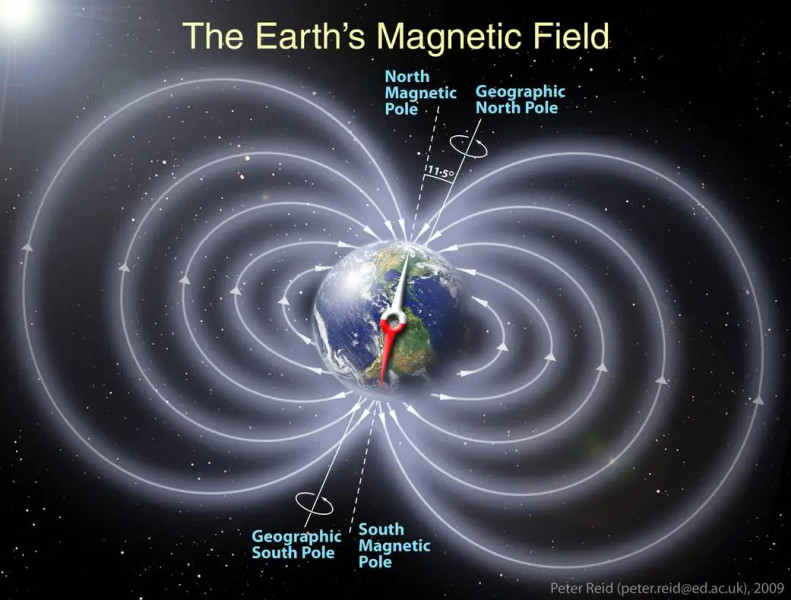
Earth modeled as a tilted magnetic dipole
The magnetic axis shown here is slightly offset from the geographic (rotational) axis, which is why the magnetic poles are not located exactly at the geographic poles.
A compass’s north end points toward geographic North, which means that region is actually a magnetic south pole.
For AP problems, treat Earth like a giant bar magnet when reasoning about field direction and compass behavior.
5. Magnetic Permeability
What Permeability Means
Magnetic permeability measures how much a material becomes magnetized in response to an external field.
Higher → stronger internal magnetic field for the same applied field.
Vacuum Permeability
This constant appears everywhere in magnetism equations.
Relative Permeability
- Vacuum:
- Ferromagnets:
- Paramagnets: slightly > 1
- Diamagnets: slightly < 1
Permeability is not truly constant for a material. It depends on temperature, field strength, and orientation, especially in ferromagnets. That variability explains hysteresis and nonlinear behavior later in the course.
