Topic 10.3 Notes – Capacitors
1. What a Capacitor Is
A capacitor has two conducting surfaces separated by an insulator (a dielectric). When connected to a battery:
- One plate gets +Q
- The other gets −Q
- A potential difference builds between them
The insulator prevents charge from jumping directly across, so the charges stay separated.
Capacitance
Capacitance measures how much charge the device stores per volt:
- Units: farads (F) = C/V
- depends only on geometry and materials, not on or
Think of capacitance as a built-in property of the setup, like resistance for a resistor.
2. Geometries of Capacitors
AP Physics C only expects three shapes. All of them follow the same strategy:
- Use Gauss’s law to find
- Integrate to find
- Use
Parallel-Plate Capacitor
Two large plates, area , separation , connected to a battery that maintains a potential difference.
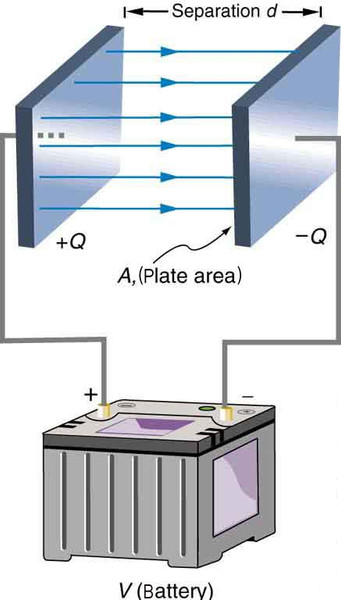
Parallel-plate capacitor connected to a battery
Capacitance:
Here is the dielectric constant and is the permittivity of free space.
This formula is heavily tested. You should instantly see how changing geometry affects .
Concentric Spherical Capacitor
Two conducting spheres, inner radius , outer radius .
Special case: if the outer sphere is very far away, it behaves like an isolated sphere:
Students often forget this limit. It shows up in conceptual questions.
Coaxial Cylindrical Capacitor
Two long cylinders, inner radius , outer radius , length .
Notice the logarithm. That comes from integrating when using Gauss’s law.
3. Electric Field Between Parallel Plates
For large plates where is much smaller than plate dimensions, the field is uniform between them.
Using Gauss’s law:
- Surface charge density
- Field from one sheet:
- Between two plates (fields add):
Key connection:
Combining these gives (no dielectric).
With a dielectric inserted:
So the dielectric reduces the field and increases capacitance.
Charged Particle Between Plates
Uniform field → constant force:
That means the motion is mathematically identical to projectile motion.
| Gravity | Electric Field |
|---|---|
| Parabolic path | Parabolic path |
If a problem mixes horizontal velocity with vertical electric acceleration, treat it exactly like projectile motion.
4. Energy Stored in a Capacitor
As charge builds up, the voltage increases linearly. The average voltage during charging is .
Energy stored:
Equivalent forms:
Pick the version that matches what you’re given so you avoid extra algebra.
Energy Density
For parallel plates, the energy is stored in the electric field:
With dielectric: .
This idea is important on conceptual questions. The energy is in the field between the plates, not sitting on the charges themselves.
