Topic 9.1 Notes – Electric Potential Energy
1. What Electric Potential Energy Is
Think about gravity. Lifting a mass stores gravitational potential energy because you did work against gravity. Electric potential energy is the same idea, but with electric forces between charges.
Electric potential energy is the work required by an external force to assemble a system of charges from infinitely far apart (where we define ) to their final positions.
A few core facts:
- It comes from Coulomb’s law, an inverse-square, conservative force.
- Because the electric force is conservative:
- Energy can move between electric potential energy and kinetic energy.
- Reference point for AP Physics C:
- as
The most important mindset shift:
Potential energy belongs to the system of charges, not to a single charge.
2. Electric Potential Energy Between Two Point Charges
For two point charges, the expression is clean and must be automatic for you.
- in coulombs
- = separation distance
- Units: joules
How the Sign Works
The sign tells you everything about the interaction.
- Like charges ( or )
- Repulsive interaction
- You must do positive work to push them together.
- Unlike charges ()
- Attractive interaction
- The system releases energy as they come together.
The electric potential energy behaves differently in the two cases: for like charges it is positive and decreases toward 0 as increases, and for unlike charges it is negative and increases toward 0 (from below) as increases.
Notice:
- Force depends on
Students mix this up constantly. Energy falls off more slowly than force.
As , in both cases. That’s why infinity is our reference.
3. Electric Potential Energy of a System of Multiple Charges
Now extend the idea. If you have more than two charges, nothing new conceptually happens. You just account for every pair interaction.
\[
U_{E,\text{total}} = \sum_{i What that means in practice: Key reminders: Here’s a simple three-charge setup where each pair contributes to the total energy: Three point charges forming three pairwise interactions Even though the forces are vectors, the potential energies just add as numbers. On free-response questions, symmetry often makes several equal. That’s usually your algebra simplifier. Since the electric force is conservative: This lets you switch to energy methods instead of force analysis. Energy conservation form: Common physical situations: On tests, they love giving you a charge released from rest and asking for its speed at some distance. Skip forces. Write conservation immediately.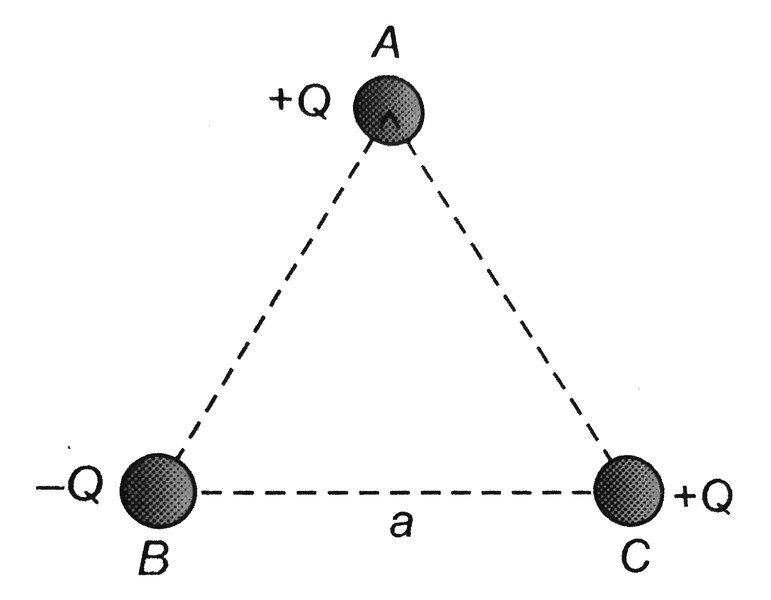
4. Work and Energy in Charge Systems
