Topic 11.4 Notes – Electric Power
1. What Electric Power Is
Power is the rate of energy transfer:
Units: watts (W), where .
For a circuit element, the key relationship is:
- = current through the element
- = potential difference across it
This equation comes straight from the idea that each charge gains or loses energy , and current is charge per time.
What this physically means
- Larger current → more charge flowing each second → more energy per second.
- Larger voltage → more energy per charge.
- If either or , then .
Sign of Power (this matters)
Power tells you the direction of energy flow.
- If current enters the higher-potential side, the element absorbs power (energy goes into it).
- If current enters the lower-potential side, the element supplies power (energy leaves it).
On free-response questions, this is how you justify whether a device is acting like a load (motor, resistor) or a source (battery, generator).
Boundary note: the course focuses on electrical ↔ mechanical energy transfer, but remember electrical energy can also become thermal energy in resistors.
2. Equivalent Forms of the Power Equation
Using Ohm’s law , you can rewrite power in two very useful forms.
In terms of current and resistance
Use this when you know current.
- Power increases with . Doubling current → four times the power.
- For the same current, larger → more energy dissipated.
In terms of voltage and resistance
Use this when you know voltage.
- Power increases with .
- For fixed voltage, smaller → larger power.
Choosing the right equation
| What you know | Use |
|---|---|
| and | |
| and | |
| and |
Match the equation to the quantities that are easiest to find from the circuit.
3. Power and Energy Flow in Circuit Elements
Resistors
Resistors convert electrical energy into thermal energy.
Use:
Energy over time:
Physically, drifting charges collide with atoms in the lattice, increasing internal energy.
Resistors always absorb power.
Batteries and Sources
An ideal battery converts chemical energy → electrical energy.
For a battery with emf :
If current leaves the positive terminal, the battery is supplying power to the circuit.
If there’s internal resistance, some power is dissipated inside the battery itself. That’s a common twist in test questions.
Mechanical and Electrical Energy Transfer
- Motor: electrical → mechanical
- Generator: mechanical → electrical
You still use . The sign tells you the direction of energy transfer.
On conceptual questions, always ask:
Where is the energy coming from? Where is it going?
4. Lightbulb Brightness and Power
Brightness is directly related to power dissipated.
More power:
- Hotter filament
- More light (and heat)
- Brighter bulb
So brightness comparisons are power comparisons.
Identical Bulbs
The diagram below shows two identical bulbs in series and two identical bulbs in parallel with the same ideal battery.
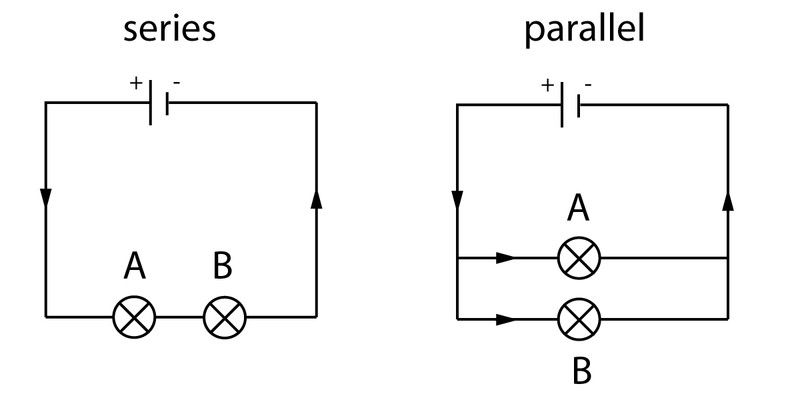
Identical bulbs in series and in parallel
Series (identical bulbs):
- Same current
- Same power → same brightness
- Dimmer than a single bulb alone (total resistance increases)
Parallel (identical bulbs):
- Same voltage
- Same power → same brightness
- Same brightness as a single bulb (ideal battery)
Different Resistances
This is where students flip things.
Parallel (same voltage):
Smaller → larger power → brighter.
Series (same current):
Larger → larger power → brighter.
That reversal shows up constantly in MCQs.
