Topic 13.3 Notes – Induced Currents and Magnetic Forces
1. Magnetic Force on an Induced Current
When flux changes, charges in the conductor start moving. Those moving charges are currents, and currents in a magnetic field feel a force.
The general expression is:
For a straight segment of length in a uniform field:
- = induced current
- = length of wire inside the field
- = angle between current direction and
Direction
- Use Lenz’s law to determine the direction of the induced current.
- Then apply the right-hand rule to to get the force.
Here’s the standard right-hand rule picture you should have in your head for a straight current-carrying wire:
Thumb in the direction of the current , fingers curl in the direction of the magnetic field . For force problems, you use the cross product to determine the direction of the magnetic force on the wire segment.
Only the Part Inside the Field Matters
Magnetic forces act only on segments inside the external magnetic field.
If half the loop is in the field and half is outside:
- Only the portion in the field feels .
- This is a common AP trap. Students apply the length of the whole loop.
Depending on how those forces add up, the loop can:
- Translate (net force ≠ 0)
- Rotate (net torque ≠ 0)
- Or both
2. How Induced Current Determines the Force
The magnetic force depends on the induced current. So you trace everything back to flux.
From Flux to Current
Faraday’s law:
For uniform :
Then Ohm’s law:
So the chain is:
- Faster change in flux → larger
- Smaller resistance → larger
- Larger → larger magnetic force
That proportionality is explicitly testable. If resistance doubles, the force is cut in half.
Motional EMF Example
If a rod of length moves at speed perpendicular to a uniform field:
Then:
Plug into :
This is huge conceptually. The force is proportional to velocity.
So:
- Faster motion → bigger induced current
- Bigger current → stronger magnetic force
- That force opposes the motion (Lenz’s law)
This creates magnetic damping.
3. What the Magnetic Force Does to the Loop
Once you know the forces, it’s just mechanics.
Translational Acceleration
If there is a net force:
Consider the loop partially entering a uniform magnetic field:
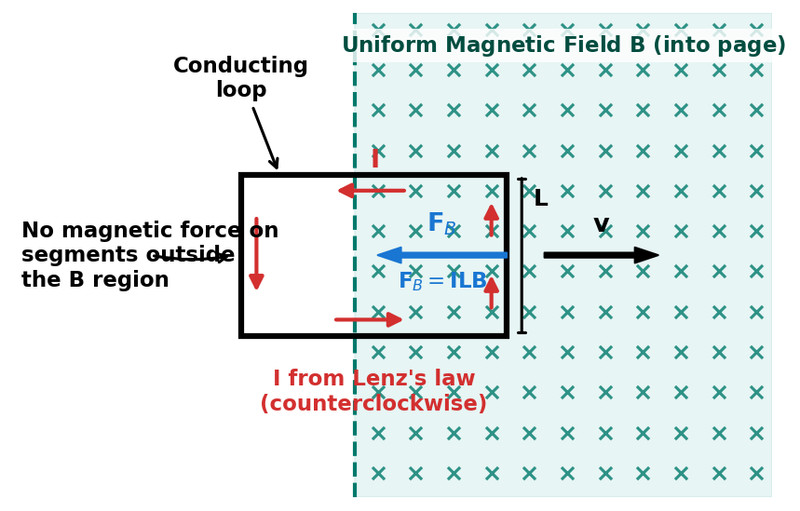
As the loop enters the region with X’s (field into the page):
- Flux increases.
- An induced current appears (counterclockwise by Lenz’s law).
- The magnetic force on the right vertical segment points left, opposing the motion.
That leftward magnetic force is the net horizontal force on the loop, so it produces a horizontal acceleration according to .
Students often forget the force disappears once the loop is fully inside a uniform field. If flux is no longer changing, , so .
Rotational Acceleration
If opposite sides feel forces in opposite directions, you get torque.
This is the same idea behind motors:
- One side pushed up.
- Other side pushed down.
- Net torque → rotation.
On an FRQ, they may ask you to explain why it rotates. The key phrase is that magnetic forces on different segments create a nonzero net torque about the axis.
4. Applying Newton’s Second Law to a Conducting Loop
After finding magnetic force, treat the loop like any object.
Include:
- Magnetic force
- Gravity
- Tension
- Friction
Example setup when a loop enters a field:
- Compute
- Find
- Find
- Compute magnetic force on the segment in the field
- Apply
If , then:
Eventually . That gives terminal velocity. Mechanical energy is converted to thermal energy . Energy conservation is enforced through Lenz’s law.
What Affects the Size of the Force
The force ultimately depends on:
- (stronger field → stronger force)
- Length inside field
- Velocity (in motional cases)
- Resistance
- Loop orientation ( in flux)
- Number of turns (multiplies total EMF)
Memorize this causal chain:
Change in flux → EMF → Current → Magnetic force → Acceleration
