Topic 12.2 Notes – Magnetism and Moving Charges
1. The Magnetic Field of a Moving Charge
A charge at rest creates an electric field.
A charge in motion creates both an electric field and a magnetic field.
Current is just moving charge, so this is the microscopic reason currents create magnetic fields.
What the magnetic field depends on
For a single charge moving with velocity , the magnetic field at some point in space:
- Increases with:
- Larger charge
- Greater speed
- Decreases with distance (proportional to )
- Depends on the angle between:
- The velocity
- The position vector from the charge to the point
Key geometry facts:
- Strongest when
- Zero when (along the line of motion)
That “zero along the axis” idea shows up in conceptual questions a lot.
Direction of the magnetic field
At any point:
- is perpendicular to both:
Use the right-hand rule:
- Thumb → direction of
- Fingers curl → direction of circular magnetic field lines
Here’s what that geometry looks like for a positive charge moving to the right.
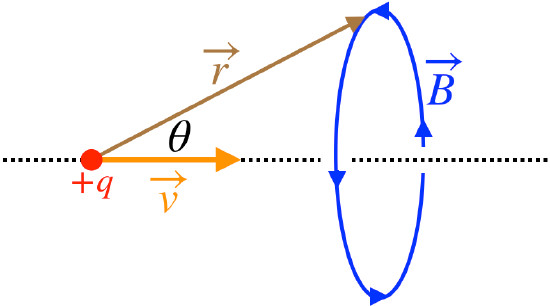
Magnetic field around a moving positive charge
The blue loop represents one circular magnetic field line centered on the line of motion. The field lines form circles around the axis of motion. This 3D perpendicular structure is the big conceptual anchor for this section.
2. Magnetic Force on a Moving Charge
A magnetic field only exerts a force on moving charges.
The magnetic force law is:
Magnitude:
- is the angle between and
- Maximum when
- Zero when or
Direction
Use the right-hand rule for :
- Point fingers along
- Curl toward
- Thumb gives force on a positive charge
If the charge is negative, flip the direction.
Students often get the order wrong. It is always v cross B, not B cross v.
What the perpendicular force means
Because the magnetic force is always perpendicular to velocity:
- It does no work
- Speed stays constant
- Only direction changes
That leads to:
- → circular motion
- → straight-line motion
- Mixed components → helical motion
On FRQs, if you’re asked about kinetic energy in a pure magnetic field, it stays constant. That’s a common reasoning point.
3. Electric and Magnetic Fields Together
When both fields are present, forces add independently:
Think of it as:
- Electric force → along , can change speed
- Magnetic force → perpendicular to motion, bends path
They do different jobs.
Crossed fields and force balance
If:
- Velocity is perpendicular to both
The forces can cancel.
Set magnitudes equal:
This is the velocity selector idea. Only particles with exactly go straight through.
When doing these problems:
- Draw both forces separately.
- Get each direction with the right-hand rule.
- Then combine vectors.
Students lose points by skipping the separate force analysis.
4. The Hall Effect
The Hall effect is magnetic force acting on charge carriers inside a conductor.
Imagine:
- Current to the right
- Magnetic field into or out of the page
What happens step-by-step
- Charges move with drift velocity.
- Magnetic force pushes them sideways.
- Charges accumulate on one side.
- That buildup creates a sideways electric field.
- At equilibrium:
The diagram below shows electrons deflected sideways by the magnetic force until the upward electric force balances it. The separation of charge creates the Hall electric field across the width of the conductor.
The sideways electric field creates a measurable Hall voltage across the width.
What it tells you
From the Hall voltage, you can determine:
- The sign of charge carriers (electrons vs positive carriers)
- The number density of carriers
- The magnetic field strength
Conceptually, it’s just magnetic force causing charge separation until electric force balances it.
