Topic 9.3 Notes – Conservation of Electric Energy
1. Electric Potential Energy and Potential Difference
Electric potential energy is the energy stored in the charge-field system because of position.
Electric potential is energy per unit charge.
The core relationship is:
- in coulombs
- in volts
- in joules
- Remember:
So a potential difference tells you how much energy changes per coulomb.
What the signs tell you
- If and , then (energy increases).
- If and , then .
- The equation already accounts for the charge sign. Don’t manually “flip” anything.
Quick reminder: the electric field points from high potential to low potential, and electrostatic fields are conservative. That means potential difference depends only on the endpoints, not the path taken.
2. Conservation of Energy in an Electric Field
When only electric forces are doing work, mechanical energy is conserved:
So,
Substitute :
And in terms of speed:
This equation is huge on quizzes and FRQs because it lets you skip force and kinematics entirely.
If released from rest
If :
You can go straight from potential difference to final speed.
Interpretation:
- If electric potential energy decreases, kinetic energy increases.
- If electric potential energy increases, kinetic energy decreases.
- The changes are equal in magnitude and opposite in sign.
3. How Charge Sign Affects Motion and Energy
Direction of motion depends on the sign of the charge. The energy story is actually the same underneath.
Positive charge (+q)
- Force is in the direction of the electric field.
- Naturally moves from high to low .
- For that motion, .
- .
- → it speeds up.
The field does positive work. Electric potential energy turns into kinetic energy.
Negative charge (−q)
- Force is opposite the electric field.
- Naturally moves from low to high .
- For that motion, .
- (because is negative).
- → it also speeds up.
Here’s the key idea students mix up:
Both positive and negative charges speed up when moving naturally under the electric force.
They just move in opposite directions relative to the field.
4. Interpreting Potential Difference Physically
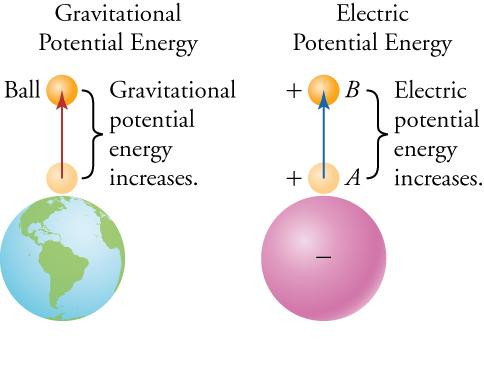
It helps to think gravitationally. Compare lifting a ball in Earth’s gravitational field to moving a positive charge in an electric field.
The analogy
- Gravitational potential energy:
- Electric potential energy:
In the left diagram, lifting the ball increases gravitational potential energy. In the right diagram, moving the positive charge away from the negatively charged sphere increases electric potential energy.
For a positive charge:
- Moving from high to low is like rolling downhill.
- Potential energy decreases.
- Speed increases.
Moving “uphill” electrically requires external work. Kinetic energy would decrease unless something pushes it.
On conceptual MCQs, they often describe motion between two labeled potentials and ask what happens to speed. You do not need field strength. You do not need distance. Just use energy.
5. Using Energy on AP-Style Problems
When you see a potential difference:
- Write .
- Use .
- Connect kinetic energy to speed with .
- Check whether the result makes physical sense.
Example structure (no numbers needed):
If a proton moves to a lower potential, then . Since , , so kinetic energy increases. That reasoning alone can earn credit on a free response.
Common mistakes:
- Forgetting the sign of for electrons.
- Mixing up “direction of motion” with “sign of energy change.”
- Dropping the negative in .
If you stay disciplined with signs, the math takes care of the physics.
