Topic 10.2 Notes – Redistribution of Charge Between Conductors
1. What Happens When Conductors Touch
In a conductor, electrons are free to move. If two conductors at different electric potentials touch, there is a potential difference, and that drives charge motion.
- Electrons move in response to the electric field created by that potential difference.
- They keep moving until every connected conductor has the same electric potential.
- At that point, the system is in electrostatic equilibrium:
- The electric field inside each conductor is zero.
- No more net charge flows.
Here’s the key idea to hold onto:
Contact enforces equal potential, not equal charge.
Charge is still conserved within the isolated system. If two spheres touch and then separate:
Identical Conductors
If the objects have the same shape and size, symmetry helps you.
- Same geometry → same capacitance.
- Equal potential + same capacitance → equal final charge.
So if total charge is , each identical conductor ends up with .
On AP-style problems, when they say “identical metal spheres,” that’s your cue.
Different-Sized Conductors
If the conductors have different sizes, equal potential does not mean equal charge.
Remember the relationship:
At equilibrium:
A larger conductor has a larger capacitance , so it holds more charge at the same potential.
Students often try to split charge evenly even when the spheres are different sizes. Don’t. Always ask: same geometry or not?
Surface Charge Distribution
Even after equilibrium, charge is not spread uniformly across the surface.
- Charge lives on the outer surface of a conductor.
- Regions with smaller radius of curvature (sharp points) have:
- Higher surface charge density
- Stronger electric field just outside
The diagram below shows a positively charged conductor with a sharp tip. Notice how the charge density and electric field lines are most concentrated near the tip.
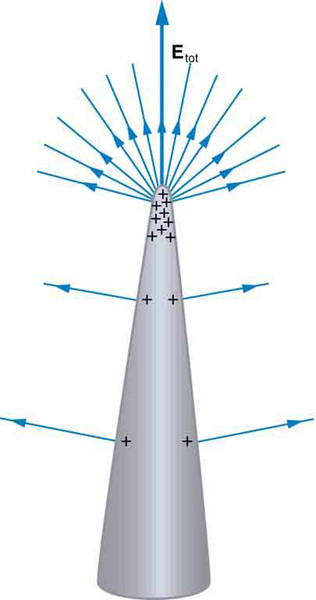
Electric field and charge density near a sharp conductor tip
That concentration of charge at sharp points explains the lightning rod effect. Stronger electric field near the tip makes air more likely to ionize there.
Geometry controls how charge spreads.
2. Ground as Zero Potential
Ground is defined as having electric potential .
It’s modeled as:
- An ideal conductor
- Able to absorb or supply unlimited charge
- Without changing its own potential
When you connect a conductor to ground:
- If the conductor is positive, electrons flow from ground onto it.
- If it’s negative, electrons flow from it into ground.
- Flow stops when the conductor’s potential reaches zero.
The important distinction:
Ground does not “share” charge like another sphere. It forces the conductor’s potential to zero.
That’s why a positively charged isolated sphere connected to ground can end up completely neutral. Ground supplies however many electrons are needed.
After you disconnect the ground wire, whatever charge remains is stuck there.
3. Charging by Induction with Grounding
You can give a conductor net charge without touching it. This is induction with grounding.
Let’s walk through the classic situation shown below.
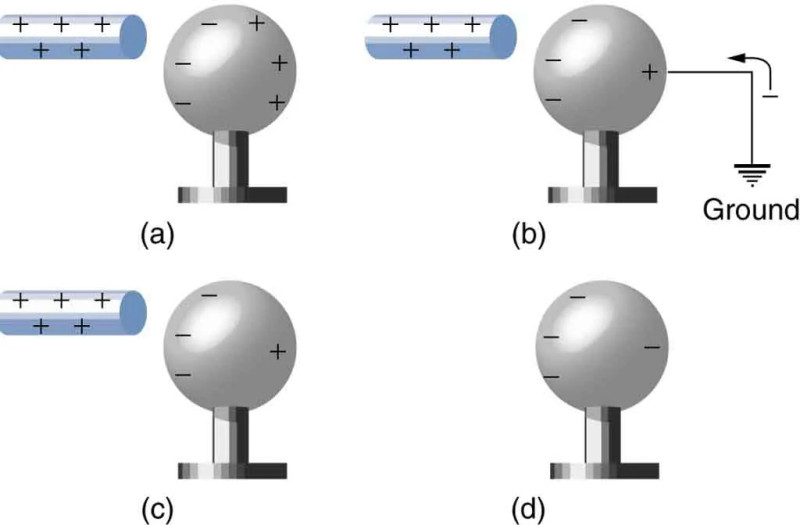
Charging a conductor by induction with grounding
Step-by-step (positive rod example)
Bring a positively charged rod near a neutral conductor.
Electrons inside the conductor shift toward the rod, as in panel (a). The far side becomes relatively positive.Connect the conductor to ground while the rod is still nearby.
As shown in panel (b), electrons flow from ground into the conductor, attracted by the nearby positive charge.Disconnect the ground first.
In panel (c), the extra electrons are now trapped on the conductor.Remove the rod.
In panel (d), the excess electrons spread out evenly. The conductor now has a net negative charge.
Two things to remember:
- No charge ever transfers between the rod and the conductor.
- The order matters. If you remove the rod before disconnecting ground, the conductor won’t end up charged.
The amount of induced charge depends on the strength of the external electric field. Stronger field → more charge separation.
This process shows up in FRQs where you must explain electron motion clearly. Be specific about where electrons move and why. “Charge redistributes” is too vague for full credit.
