Topic 11.8 Notes – Resistor-Capacitor (RC) Circuits
1. Equivalent Capacitance of Multiple Capacitors
A group of capacitors can always be replaced by a single equivalent capacitor that stores the same total charge for the same potential difference.
Capacitors in Series
They are connected end-to-end, so there is only one path for charge to flow.
For two capacitors:
What always happens in series:
- Each capacitor has the same magnitude of charge
(This comes from conservation of charge. The charge that leaves one plate must appear on the next.) - The voltages add:
- is smaller than the smallest capacitor in the group.
Physically, putting capacitors in series increases effective plate separation → lower capacitance.
Capacitors in Parallel
They share the same two nodes, so they all experience the same voltage.
What happens in parallel:
- Voltage is the same across each capacitor.
- Charges add:
- Larger capacitance stores more charge at that shared voltage.
Physically, parallel increases effective plate area → larger capacitance.
Strategy for Mixed Networks
When they mix series and parallel:
- Collapse obvious series or parallel groups.
- Redraw the circuit.
- Repeat until one capacitor remains.
- Then work backward to find individual charges or voltages.
On exams, most mistakes happen when students forget:
Series → same charge. Parallel → same voltage.
That’s the anchor.
2. The Fundamental RC Differential Equation
Now add a resistor. The behavior becomes time-dependent.
For a charging circuit (battery + R + C), apply Kirchhoff’s Loop Rule:
Since current is :
That’s the fundamental first-order differential equation of an RC circuit.
Its solutions are exponential functions describing:
- charge
- current
- capacitor voltage
If you ever see a derivation FRQ, it starts exactly here.
3. The Time Constant
Units: seconds.
It sets the time scale for the circuit.
Meaning of One Time Constant
- Charging:
- Discharging:
After about 5τ, the system is essentially at steady state (over 99% complete).
Large or → slower response.
Small or → faster response.
On conceptual multiple-choice questions, they often change only or only and expect you to reason about how changes.
4. Charging a Capacitor
Maximum charge:
Time-dependent behavior:
These equations produce the characteristic exponential charging curves shown below.
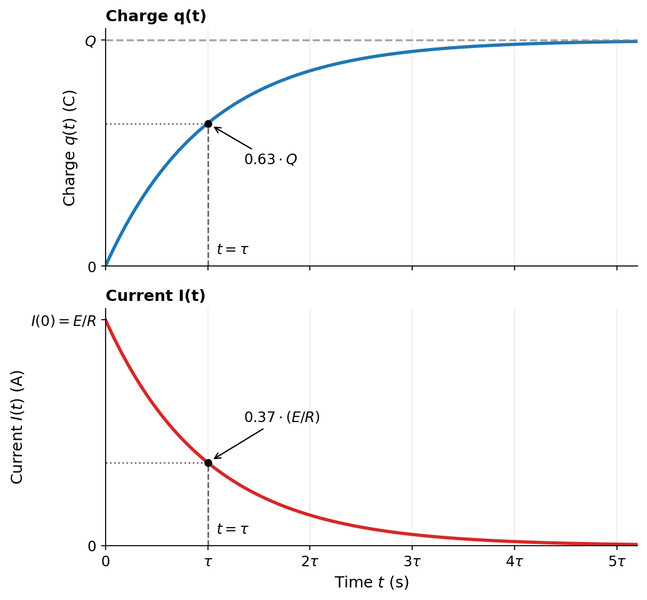
RC charging: and vs. time
At one time constant , the charge has reached about , and the current has dropped to about . After about , the capacitor is essentially fully charged.
What happens physically
- At
- Capacitor acts like a wire.
- Current is maximum
- As time passes
- Charge builds up.
- increases.
- Current decreases.
- Energy stored increases.
- Long time
- Capacitor behaves like an open circuit.
Students often forget that “steady state” in DC means no current through the capacitor branch.
5. Discharging a Capacitor
Now remove the battery and let it discharge through a resistor.
The charge, voltage, and current all follow the same exponential decay. The graph below shows how the charge drops from toward zero over several time constants.

Exponential decay of charge in an RC discharge
At , the charge has dropped to about . By around , it is effectively zero.
What happens physically
- Right after connection
- Maximum current
- Energy begins decreasing immediately.
- As it discharges
- Charge, voltage, and current all decrease exponentially.
- Stored energy becomes thermal energy in the resistor.
- Long time
- Steady state reached.
