Topic 1.2 Notes – Overview of the Nervous System
How the Nervous System Is Organized
The nervous system takes in information, processes it, and sends commands. That means it helps you sense the world, think about it, and respond with muscles, organs, and glands.
Here’s the hierarchy you need to know:
- Nervous system
- Central nervous system
- brain
- spinal cord
- Peripheral nervous system
- somatic nervous system
- autonomic nervous system
- sympathetic nervous system
- parasympathetic nervous system
- Central nervous system
One trap shows up constantly. CNS does not mean just the brain. It means brain + spinal cord. Also, sympathetic and parasympathetic are not their own separate top-level systems. They are divisions of the autonomic system, which is part of the PNS.
Central and Peripheral Nervous Systems
Central nervous system
The central nervous system is the brain and spinal cord. It is the main processing and coordinating center.
- Brain organizes sensory input and supports thinking, memory, emotion, and awareness.
- Spinal cord carries messages between the brain and the rest of the body.
- The spinal cord also helps create reflexes, which are fast automatic responses. For this topic, the point is simple. A reflex shows that the spinal cord is part of the CNS.
Peripheral nervous system
The peripheral nervous system includes all nerves outside the brain and spinal cord. It connects the CNS to the rest of the body.
- Sensory messages travel from receptors toward the CNS.
- Motor commands travel from the CNS to muscles, organs, and glands.
The PNS is not a second brain. It does not do the main decision-making. It is the communication link.
Central versus peripheral
A quick way to separate them:
| System | Includes | Main job |
|---|---|---|
| CNS | Brain and spinal cord | Processes and coordinates |
| PNS | Nerves outside CNS | Relays messages |
The Two Divisions of the Peripheral Nervous System
Inside the PNS, you split things by what kind of job is being done.
Somatic nervous system
The somatic nervous system handles voluntary processes and controls skeletal muscles.
- walking
- reaching
- turning your head
- speaking
It also carries sensory information from your skin, muscles, and joints to the CNS. If the action is a deliberate skeletal movement, think somatic.
Autonomic nervous system
The autonomic nervous system handles largely involuntary internal processes. It regulates organs and glands.
- heart rate
- digestion
- sweating
- pupil size
- breathing-related adjustments
If it is automatic internal regulation, think autonomic. A common trap is breathing. You can control it for a bit, but it is still mainly an autonomic function.
Somatic versus autonomic
- Somatic = voluntary + skeletal muscles + bodily sensation
- Autonomic = involuntary + organs/glands + internal regulation
Sympathetic and Parasympathetic Divisions
Both of these are parts of the autonomic nervous system, and they often have opposite effects on the same organs. Together, they help maintain homeostasis, which means keeping internal conditions within a healthy range.
Sympathetic nervous system
The sympathetic division is fight-or-flight. It prepares your body for action.
- heart rate increases
- pupils dilate
- sweating increases
- alertness rises
- digestion slows
This is not only for emergencies. It also shows up before a race, test, or performance.
Parasympathetic nervous system
The parasympathetic division is rest-and-digest. It calms the body and restores routine functioning.
- heart rate decreases
- pupils return toward normal
- digestion resumes or increases
- the body recovers
Their relationship
They are not good vs bad, and they are not simple on/off switches. Your body shifts their influence depending on what you need.
How the Systems Work Together in Real Situations
One event can involve several systems at once. Think about a runner:
- Hearing the start signal. Sensory messages travel through the PNS to the CNS.
- The brain and spinal cord process the signal and coordinate a response. That is CNS.
- Pushing off to run uses the somatic system because skeletal muscles are moving voluntarily.
- During the race, rising heart rate and arousal show sympathetic activation.
- After the race, falling heart rate during recovery shows parasympathetic influence.
The graph below puts those last two steps into one quick timeline, with heart rate rising during exertion and then dropping back toward baseline during recovery.
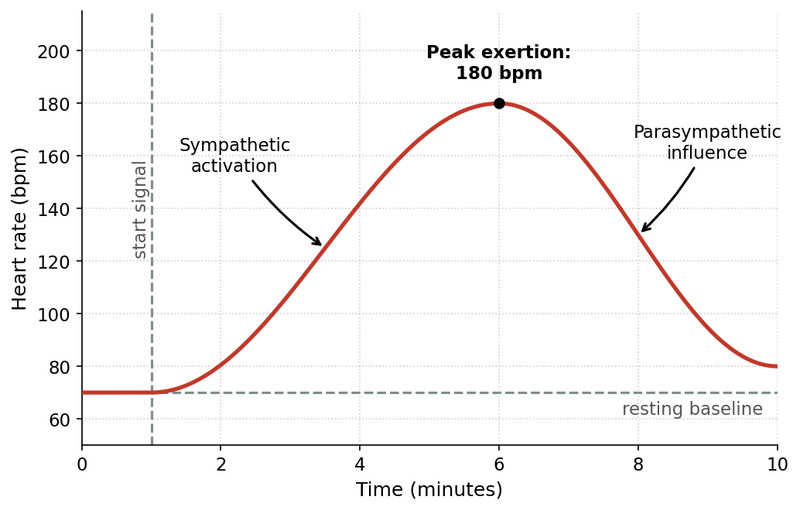
Heart rate during exertion and recovery
On tests, the best clue is the specific process. Ask what exactly is happening, then match it to the subsystem.
Key Takeaways
Nervous System
The body’s rapid communication and control network, enabling sensation, movement, thought, emotion, and physiological regulation
Central Nervous System (CNS)
The brain and spinal cord; the primary system for processing and coordinating neural information
Spinal Cord
A column of neural tissue that carries information between the brain and peripheral nerves and can help organize rapid responses
Peripheral Nervous System (PNS)
The nerves outside the brain and spinal cord that relay information between the central nervous system and the rest of the body
Somatic Nervous System
The peripheral nervous system division that carries bodily sensory information and governs voluntary skeletal-muscle movement
Autonomic Nervous System
The peripheral nervous system division that regulates largely involuntary internal processes, organs, and glands
Sympathetic Nervous System
The autonomic division that mobilizes the body for action and arousal—the fight-or-flight pattern
Parasympathetic Nervous System
The autonomic division that calms the body, conserves energy, and supports digestion and recovery—the rest-and-digest pattern
Notes
Nervous System
The body’s rapid communication and control network, enabling sensation, movement, thought, emotion, and physiological regulation
Central Nervous System (CNS)
The brain and spinal cord; the primary system for processing and coordinating neural information
Spinal Cord
A column of neural tissue that carries information between the brain and peripheral nerves and can help organize rapid responses
Peripheral Nervous System (PNS)
The nerves outside the brain and spinal cord that relay information between the central nervous system and the rest of the body
Somatic Nervous System
The peripheral nervous system division that carries bodily sensory information and governs voluntary skeletal-muscle movement
Autonomic Nervous System
The peripheral nervous system division that regulates largely involuntary internal processes, organs, and glands
Sympathetic Nervous System
The autonomic division that mobilizes the body for action and arousal—the fight-or-flight pattern
Parasympathetic Nervous System
The autonomic division that calms the body, conserves energy, and supports digestion and recovery—the rest-and-digest pattern
