Topic 5.2 Notes – Positive Psychology
What Positive Psychology Is
Positive psychology is the scientific study of the conditions and processes that help people thrive. That includes well-being, positive emotions, meaning, engagement, strengths, resilience, and overall psychological health.
A few core ideas hold this topic together:
- It is strongly associated with Martin Seligman.
- The character strengths and virtues framework was developed by Christopher Peterson and Seligman.
- It broadens psychology. Psychology still studies disorders and maladaptive behavior, but it also asks what helps people flourish.
- Psychological health means more than “not having a disorder.”
- Positive and negative states can coexist. You can feel anxious or sad and still feel gratitude, purpose, or closeness with others.
- Resilience means adapting, maintaining functioning, or recovering after adversity.
- Resilience is different from posttraumatic growth. Resilience is holding up or bouncing back. Growth is positive change beyond that.
Subjective Well-Being and Positive Subjective Experiences
A subjective experience is an internal state as you perceive and report it. Since it’s personal, psychologists often measure it with self-report.
Subjective well-being means your own evaluation of how well your life is going. It has three parts:
Positive emotions
- happiness, hope, gratitude, enjoyment
Lower frequency of negative emotions
- this does not mean zero stress, sadness, or fear
Life satisfaction
- your overall judgment that life is going well
That third part trips people up. Life satisfaction is more cognitive than emotional. It’s your evaluation of your life, not just your mood today.
Subjective well-being has an affective side, which includes positive and negative affect, and a cognitive side, which includes life evaluation.
External conditions matter, but they do not fully decide well-being. Two people with similar health, money, or school stress can report very different happiness levels.
This topic applies positive subjective experience in three main ways:
- gratitude
- exercising signature strengths
- posttraumatic growth
Gratitude and Character Strengths
Gratitude
Gratitude is recognizing and appreciating benefits, kindness, or positive experiences. Expressing it is linked to higher subjective well-being.
Common examples:
- keeping a gratitude journal
- writing a letter of appreciation
- thanking someone directly
- deliberately reflecting on what went well
Gratitude can also strengthen relationships because it shows people they matter to you. It does not mean pretending suffering is not real.
Character strengths and virtues
A character strength is a positive psychological quality shown in thoughts, feelings, and behavior. A virtue is a broader category those strengths fit into.
Positive psychology often groups character strengths into six broad virtues, shown in the wheel below and summarized in the table.
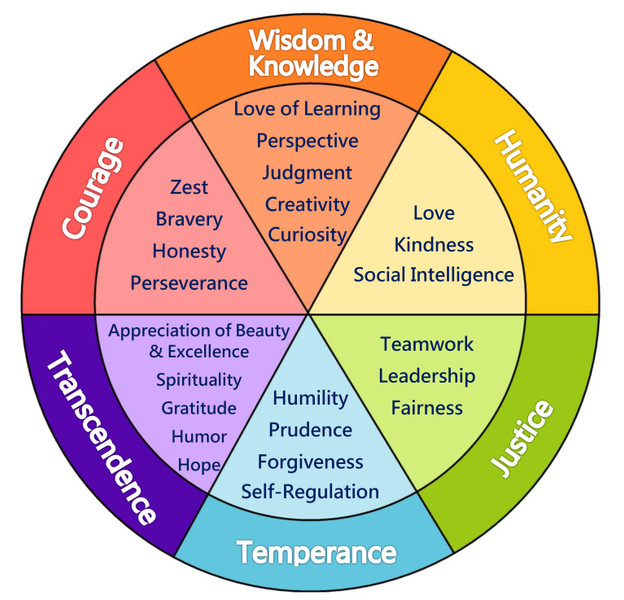
VIA character strengths and virtues
| Virtue | Examples of strengths |
|---|---|
| Wisdom and knowledge | curiosity, creativity, judgment, love of learning, perspective |
| Courage | bravery, perseverance, honesty, enthusiasm |
| Humanity | love, kindness, social intelligence |
| Justice | teamwork, fairness, leadership |
| Temperance | forgiveness, humility, prudence, self-regulation |
| Transcendence | appreciation of beauty and excellence, gratitude, hope, humor, spirituality |
Signature strengths
Signature strengths are the strengths most central to your identity. They feel authentic and meaningful.
The exam likes this distinction. It is the use of a signature strength that matters, not just scoring high on a survey.
- Using them is linked to greater happiness and subjective well-being
- They can increase engagement, competence, and meaning
- A strength can be overused or used poorly. For example, perseverance can turn into refusing to quit a bad plan.
Posttraumatic Growth
Posttraumatic growth is positive psychological change that may happen through struggling with trauma or major stress. The trauma itself is not positive.
Common forms include:
- greater appreciation for life
- stronger relationships
- recognition of personal strength
- new priorities or possibilities
- deeper spiritual or existential meaning
This can exist alongside grief, fear, anxiety, or posttraumatic stress.
Keep these three terms separate:
- Recovery = return toward previous functioning
- Resilience = adapt or maintain functioning during/after adversity
- Posttraumatic growth = positive change beyond simple recovery
Growth is possible, not guaranteed. AP Psychology does not treat trauma as necessary or beneficial.
How Positive Psychology Is Studied
Positive psychology uses the same research methods as the rest of psychology:
- experiments
- surveys
- correlational studies
- longitudinal research
- interviews
- observations
A huge idea here is operational definitions. Terms like happiness, gratitude, resilience, and growth must be measured clearly.
Self-report is common because well-being is subjective, but it has limits:
- memory errors
- current mood
- social desirability bias (answering in socially approved ways)
- demand characteristics (guessing the study’s purpose and responding to fit it)
Experiments with random assignment can test causation for things like gratitude exercises. Correlational studies can show a relationship, but cannot prove cause and effect.
Culture and life circumstances also shape well-being. Positive psychology does not mean “just think positive” or ignore poverty, discrimination, illness, or trauma.
Key Takeaways
Positive Psychology
The scientific study of conditions and processes that help individuals and communities function well and flourish
Positive Subjective Experience
A positive internal feeling or judgment as perceived and reported by the person experiencing it
Subjective Well-Being
A person’s assessment of life based on positive emotions, relatively fewer negative emotions, and life satisfaction
Gratitude
Recognition and appreciation of positive experiences, benefits, or kindness; expressing it increases subjective well-being
Character Strength
A positive psychological quality expressed through a person’s thoughts, feelings, and behavior
Virtue
A broad category of positive character expressed through more specific character strengths
Wisdom (Wisdom and Knowledge)
The virtue involving strengths used to acquire and apply knowledge, such as curiosity, creativity, judgment, and perspective
Courage
The virtue involving action toward valued goals despite fear, opposition, or difficulty
Humanity
The virtue involving caring relationships with others, including love, kindness, and social understanding
Justice
The virtue involving strengths that support fair and effective community life, such as teamwork, fairness, and leadership
Temperance
The virtue involving strengths that protect against excess and regulate behavior, such as prudence and self-control
Transcendence
The virtue involving strengths that connect a person to meaning or something larger than the self
Signature Strengths
Character strengths especially central, authentic, and meaningful to an individual; exercising them is associated with greater happiness and subjective well-being
Resilience
The capacity to adapt, maintain functioning, or recover following adversity, even when distress remains
Posttraumatic Growth
Positive psychological change in outlook, relationships, identity, or meaning that may emerge through struggling with trauma or major stress
Notes
Positive Psychology
The scientific study of conditions and processes that help individuals and communities function well and flourish
Positive Subjective Experience
A positive internal feeling or judgment as perceived and reported by the person experiencing it
Subjective Well-Being
A person’s assessment of life based on positive emotions, relatively fewer negative emotions, and life satisfaction
Gratitude
Recognition and appreciation of positive experiences, benefits, or kindness; expressing it increases subjective well-being
Character Strength
A positive psychological quality expressed through a person’s thoughts, feelings, and behavior
Virtue
A broad category of positive character expressed through more specific character strengths
Wisdom (Wisdom and Knowledge)
The virtue involving strengths used to acquire and apply knowledge, such as curiosity, creativity, judgment, and perspective
Courage
The virtue involving action toward valued goals despite fear, opposition, or difficulty
Humanity
The virtue involving caring relationships with others, including love, kindness, and social understanding
Justice
The virtue involving strengths that support fair and effective community life, such as teamwork, fairness, and leadership
Temperance
The virtue involving strengths that protect against excess and regulate behavior, such as prudence and self-control
Transcendence
The virtue involving strengths that connect a person to meaning or something larger than the self
Signature Strengths
Character strengths especially central, authentic, and meaningful to an individual; exercising them is associated with greater happiness and subjective well-being
Resilience
The capacity to adapt, maintain functioning, or recover following adversity, even when distress remains
Posttraumatic Growth
Positive psychological change in outlook, relationships, identity, or meaning that may emerge through struggling with trauma or major stress
