Topic 2.4 Notes – Encoding Memories
What Encoding Is
Encoding means turning information into a mental form your memory can use. The full memory sequence is encoding → storage → retrieval.
A quick grounding point:
- Storage means keeping information over time.
- Retrieval means pulling it back out later.
- Working memory is the short-term mental workspace where you actively hold and use information.
Encoding begins while information is in working memory. That means memory is already being shaped before long-term storage happens. Attention matters here. Prior knowledge matters too. So does depth of processing, which means how meaningfully you handle the information.
The core AP idea is simple but huge: how information is encoded affects how well it is remembered later.
Encoding Strategies That Improve Memory
These strategies help because they add meaning, structure, or strong cues.
Mnemonic devices
A mnemonic device is a memory aid that connects new information to something familiar, organized, or vivid.
Common examples:
- Acronyms like HOMES for the Great Lakes
- Acrostics like “Every Good Boy Does Fine”
- Rhymes or songs that give information a pattern
- Imagery that makes the material easier to picture
They work only if you can later recover the connection. If the cue is confusing, the mnemonic will not help much.
Method of loci
This is the named mnemonic you definitely need to know.
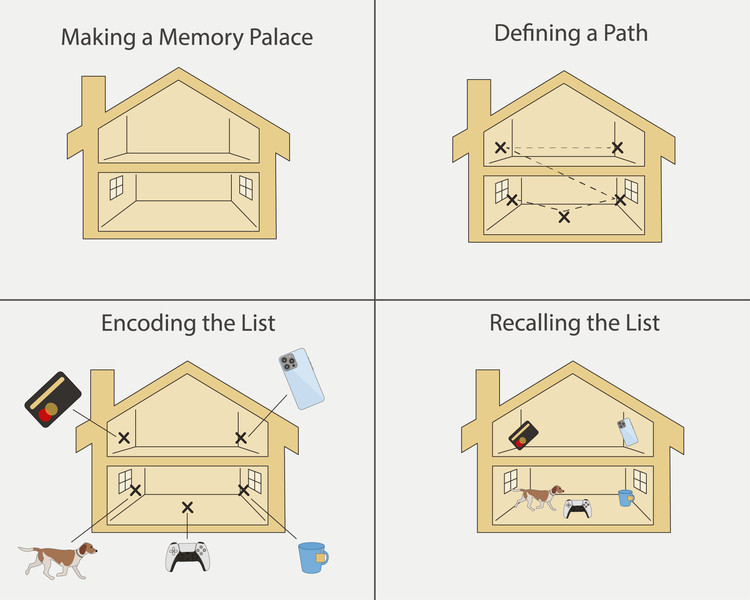
The method of loci uses familiar places as memory cues.
- Choose a familiar route.
- Pick clear locations along it.
- Make a vivid image linking each item to a location.
- Mentally walk the route to recall the items.
The house diagram below walks through that process from picking a memory palace to placing items and then recalling them by moving through the same path.
Why it works:
- the spatial layout is already familiar
- the vivid images make each item stand out
- each location becomes a retrieval cue
Method of loci
Chunking
Chunking means grouping separate bits into larger, meaningful units.
- Example: FBI-CIA-IRS is easier as 3 chunks than as 9 letters.
- It only works when the groups mean something to you.
- Randomly splitting a list is not strong chunking.
Chunking helps working memory because several parts can be treated as one unit.
Categories and hierarchies
Categorization groups items by shared features.
- birds
- fish
- trees
- flowers
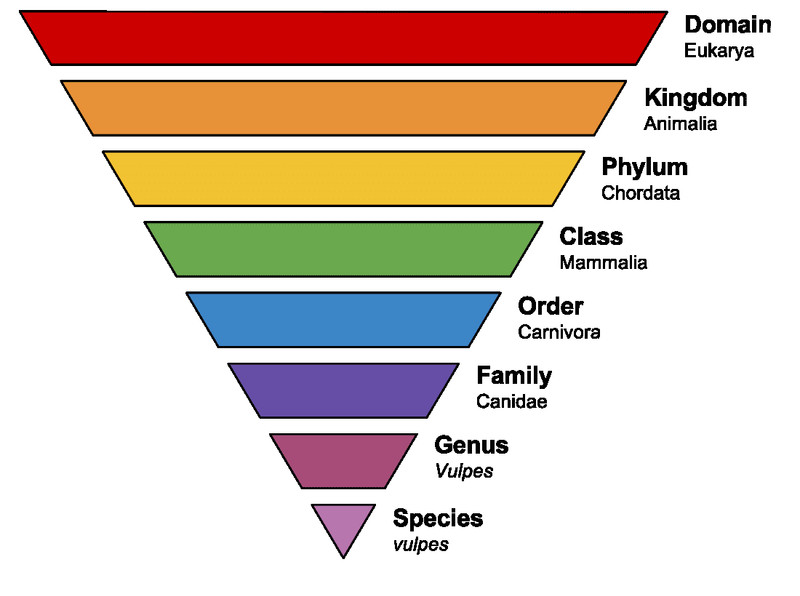
A hierarchy organizes from broad to narrow.
- living things
- animals
- birds
- fish
- plants
- trees
- flowers
- animals
Categories give you cue labels. Hierarchies show relationships and levels. The taxonomy diagram is just a familiar example of a hierarchy moving from very broad groups to very specific ones.
Biological hierarchy
How these differ
- Chunking = making units
- Categorization = grouping by similarity
- Hierarchy = arranging broad-to-specific levels
One strategy can overlap with another.
How Study Timing Changes Encoding
The spacing effect means distributed practice usually leads to better long-term memory than massed practice.
- Distributed practice means study spread over time.
- Massed practice means one long session, or cramming.
AP exam caution here. The comparison should use the same total study time.
Why spacing helps:
- it allows consolidation between sessions
- it gives repeated chances to encode the material
- some forgetting between sessions makes relearning stronger
Why cramming can feel good:
- it creates immediate fluency or familiarity
- that feeling can trick you into thinking learning will last
Test wording is often obvious:
- “studied over several days” = distributed practice
- “all at once the night before” = massed practice
How Order Affects What Gets Remembered
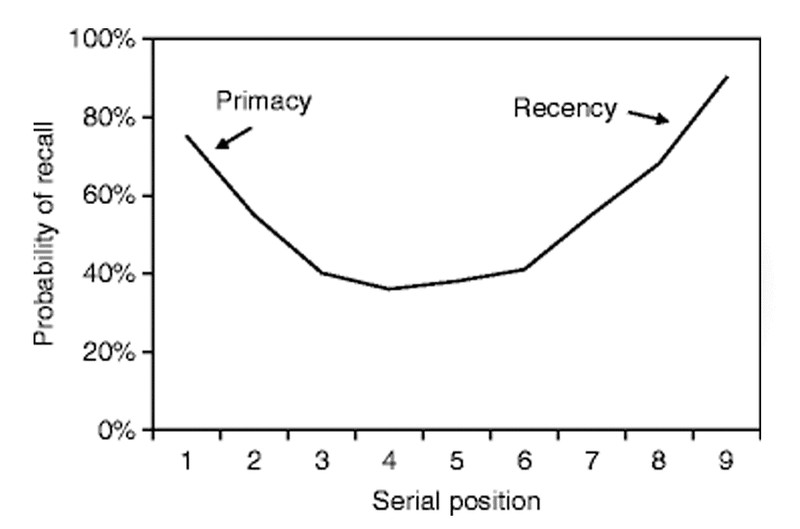
The serial position effect means people remember the beginning and end of a list better than the middle. The graph shows the classic U-shaped pattern, with higher recall for early and late items than for items in the middle.
Serial position curve
Primacy effect
The primacy effect is better memory for early items.
- early items get more attention and rehearsal
- they are more likely to enter long-term memory
Recency effect
The recency effect is better memory for the last items.
- those items are still active in working memory during immediate recall
- this is not mainly about stronger long-term encoding
A short filled delay, like counting backward, often weakens or removes recency but leaves primacy more intact.
How Encoding Is Tested in Experiments
Researchers change encoding conditions and then measure later memory.
A spacing-effect experiment might use:
- IV = study schedule, operationalized as massed vs distributed
- DV = memory score, such as number of words recalled later
Good controls include:
- same material
- same total study time
- same instructions
- same test
- same delay before testing
Random assignment helps control preexisting differences. If students choose their own study style, the result is correlational, so you cannot claim causation.
Other common designs compare:
- grouped vs ungrouped material for chunking
- method of loci vs another strategy
- recall by list position for serial position effect
Key Takeaways
Encoding
Transforming information into a mental representation that the memory system can use
Mnemonic Device
A memory strategy that connects new information to an organized, familiar, or easily imagined representation
Method of Loci
A mnemonic that links items to vivid images at ordered locations along a familiar route, which is mentally retraced for recall
Chunking
Grouping separate pieces of information into larger, meaningful units called chunks
Categorization
Organizing items into groups based on shared characteristics
Hierarchical Organization (Hierarchy)
Organizing information at multiple levels from broad categories to narrower subcategories and specific examples
Spacing Effect
The finding that distributed practice generally produces better long-term retention than equivalent massed practice
Distributed Practice vs. Massed Practice
Distributed practice spreads learning across sessions separated in time; massed practice concentrates it into one continuous or closely grouped session
Serial Position Effect
The tendency to remember items at the beginning and end of a sequence better than items in the middle
Primacy Effect
Better memory for items near the beginning of a sequence, often because they receive more attention and rehearsal
Recency Effect
Better memory for items near the end of a sequence because they remain readily available in working memory during immediate recall
Notes
Encoding
Transforming information into a mental representation that the memory system can use
Mnemonic Device
A memory strategy that connects new information to an organized, familiar, or easily imagined representation
Method of Loci
A mnemonic that links items to vivid images at ordered locations along a familiar route, which is mentally retraced for recall
Chunking
Grouping separate pieces of information into larger, meaningful units called chunks
Categorization
Organizing items into groups based on shared characteristics
Hierarchical Organization (Hierarchy)
Organizing information at multiple levels from broad categories to narrower subcategories and specific examples
Spacing Effect
The finding that distributed practice generally produces better long-term retention than equivalent massed practice
Distributed Practice vs. Massed Practice
Distributed practice spreads learning across sessions separated in time; massed practice concentrates it into one continuous or closely grouped session
Serial Position Effect
The tendency to remember items at the beginning and end of a sequence better than items in the middle
Primacy Effect
Better memory for items near the beginning of a sequence, often because they receive more attention and rehearsal
Recency Effect
Better memory for items near the end of a sequence because they remain readily available in working memory during immediate recall
