Topic 5.4 Notes – Selection of Categories of Psychological Disorders
Psychological Disorders as Symptom Patterns
A psychological disorder involves clinically significant distress, impaired functioning, or both. That means the behavior has to actually disrupt life.
A few grounding ideas matter before the categories:
- Context matters. Behavior is judged in developmental and cultural context. A behavior that is typical for a young child, or acceptable in one culture, may not signal a disorder.
- Pattern matters more than one symptom. One panic attack is not panic disorder. One odd belief is not schizophrenia. You look for persistence, impairment, and the overall symptom cluster.
- These are representative categories. AP does not expect every DSM disorder, only the selected ones in this topic.
- Causes are usually biopsychosocial. That means biological, psychological, and social-cultural factors interact.
- Comorbidity means one person can meet criteria for more than one disorder.
On tests, the usual move is this. Read the vignette, identify the disorder category from the symptom pattern, then connect it to a likely cause.
The Ten Disorder Categories You Need to Recognize
Neurodevelopmental disorders
These begin during development.
- ADHD involves persistent inattention and/or hyperactivity-impulsivity across settings, such as school and home.
- Risks include genetic, physiological, and environmental factors.
- ASD includes social-communication difficulty plus restricted or repetitive behaviors, interests, or sensory patterns.
- Strong genetic and physiological influences are especially important.
Schizophrenic spectrum disorders
The core issue is psychosis, which means losing contact with reality in some important way. Schizophrenia can be acute (a shorter episode) or chronic (long-lasting).
- Five symptom areas
- delusions
- hallucinations
- disorganized speech/thinking
- disorganized motor behavior
- negative symptoms
- Positive symptoms add abnormal experiences or behaviors.
- Negative symptoms reduce normal functioning.
Causes often mentioned on AP are genetic vulnerability, prenatal virus exposure, the dopamine hypothesis, and the diathesis-stress model.
Mood disorders
- Major depressive disorder means at least 2 weeks of depressed mood and/or anhedonia (loss of pleasure), plus other cognitive or physical symptoms.
- Persistent depressive disorder is chronic, lower-level depression over a long time.
- Bipolar I requires full mania.
- Bipolar II includes hypomania plus major depression, with no full mania.
Causes can be biological, genetic, cognitive, behavioral, social, and cultural.
Anxiety disorders
- Specific phobia means fear of one object or situation.
- Agoraphobia means fear of situations where escape or help may be hard.
- Panic disorder means recurrent unexpected panic attacks and fear of more attacks.
- Social anxiety disorder means fear of judgment or evaluation by others. A culture-linked example is taijin kyofusho.
- GAD means chronic, broad, free-floating worry.
- Ataque de nervios is a culture-bound example linked to panic/anxiety symptoms.
OCD and related disorders
- OCD includes obsessions and compulsions. Rituals keep happening because anxiety drops after the ritual, which is negative reinforcement.
- Hoarding disorder means persistent difficulty discarding possessions, and clutter impairs life.
Dissociative disorders
- Dissociative amnesia means traumatic memory loss. It can include fugue, which involves confused wandering or travel.
- DID involves two or more identity states plus memory gaps.
Trauma and stressor related disorders
- PTSD follows trauma exposure and can include flashbacks, avoidance, hypervigilance, insomnia, detachment, and hostility.
Feeding and eating disorders
- Anorexia nervosa involves restriction, fear of weight gain, and significantly low body weight.
- Bulimia nervosa involves binge eating plus compensatory behaviors like vomiting or excessive exercise.
Personality disorders
These are enduring, inflexible patterns that begin by adolescence or early adulthood.
| Cluster | Style | Disorders |
|---|---|---|
| A | odd/eccentric | paranoid, schizoid, schizotypal |
| B | dramatic/erratic | antisocial, histrionic, narcissistic, borderline |
| C | anxious/fearful | avoidant, dependent, OCPD |
The Distinctions That Show Up on Tests
These are the comparisons students mix up most. The schizophrenia chart here is a quick reminder of the negative symptoms cluster.
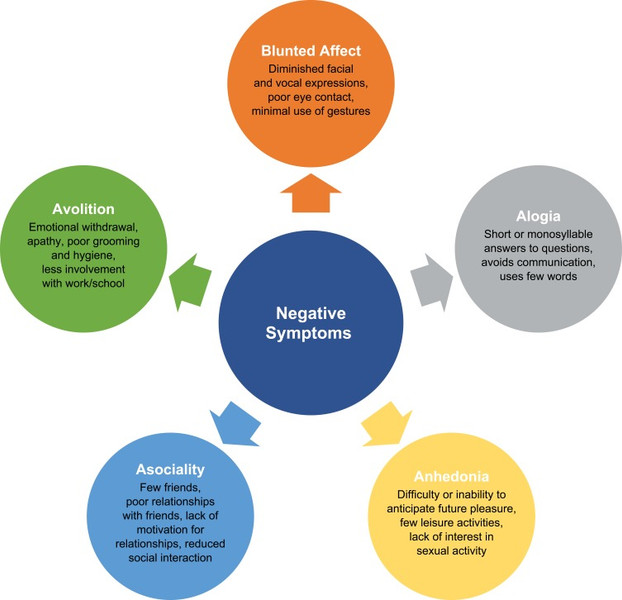
Negative symptoms of schizophrenia
- Schizophrenia vs DID
- schizophrenia = psychosis
- DID = identity disruption and memory gaps
- Positive vs negative schizophrenia symptoms
- positive = delusions, hallucinations, word salad, catatonic excitement
- negative = blunted or flat affect, catatonic stupor, reduced speech or motivation
- Bipolar vs depression
- mania means elevated or irritable mood, high energy, less need for sleep, risky behavior
- Bipolar I needs full mania
- Bipolar II has hypomania + depression
- Anxiety comparisons
- phobia = one thing
- agoraphobia = escape/help concern
- panic disorder = unexpected attacks
- social anxiety = judgment concern
- GAD = nonstop broad worry
- OCD vs OCPD
- OCD = intrusive thoughts + rituals
- OCPD = perfectionism and rigidity as a personality style
- Anorexia vs bulimia
- anorexia includes significantly low body weight
- bulimia is the binge-compensate cycle and the person may not be underweight
Causes and Classic Terms to Lock In
A few cause terms show up a lot in MCQs and FRQs:
- Schizophrenia connects to the dopamine hypothesis, prenatal viral exposure, genetic links, and diathesis-stress.
- Depression connects to Beck’s cognitive triad, learned helplessness, low reinforcement, stress, and loss.
- Anxiety and OCD connect to classical conditioning, observational learning, maladaptive thoughts, preparedness, and negative reinforcement.
- Dissociative disorders and PTSD are strongly tied to trauma and stress.
- Personality disorders and eating disorders usually involve mixed biological, genetic, cognitive, social, and cultural influences.
- Culture always matters in both symptom expression and interpretation.
Key Takeaways
Neurodevelopmental Disorders
Disorders beginning during development that involve age-inappropriate difficulties in behavior, cognition, communication, or social functioning
Attention-Deficit/Hyperactivity Disorder (ADHD)
A persistent, developmentally inappropriate pattern of inattention, hyperactivity and impulsivity, or both that impairs functioning across contexts
Autism Spectrum Disorder (ASD)
A neurodevelopmental disorder involving persistent social-communication difficulties plus restricted or repetitive behaviors, interests, or activities
Schizophrenic Spectrum Disorders
Disorders involving delusions, hallucinations, disorganized thought or behavior, negative symptoms, or some combination of these disturbances
Schizophrenia
A schizophrenic-spectrum disorder involving psychosis, disorganization, negative symptoms, or a combination, occurring acutely or chronically
Psychosis
Loss of accurate contact with important aspects of reality, often involving delusions or hallucinations
Acute vs. Chronic Schizophrenia
Acute schizophrenia has a relatively sudden, severe episode; chronic schizophrenia involves persistent or recurring impairment
Delusion
A persistent false belief maintained despite strong contradictory evidence and not ordinarily accepted in the person’s culture
Hallucination
A false sensory perception occurring without a corresponding external stimulus
Disorganized Thinking or Speech
Disrupted thought shown through weakly connected ideas, unrelated replies, or severely incoherent speech
Word Salad
A nonsensical string of words or phrases reflecting severely disorganized speech and thought
Disorganized Motor Behavior
Markedly abnormal movement or responsiveness ranging from unpredictable agitation to severely reduced activity
Catatonia
A marked disturbance of movement and responsiveness that may involve excessive purposeless movement or profound immobility
Flat Affect
Greatly diminished outward emotional expression, such as an unchanging face or reduced vocal tone
Dopamine Hypothesis
The hypothesis that dysregulated dopamine activity contributes to schizophrenia, particularly to some positive symptoms
Depressive Disorders
Disorders involving sad, empty, or irritable mood plus physical and cognitive changes that impair functioning
Major Depressive Disorder
A depressive disorder involving at least one impairing major depressive episode rather than ordinary brief sadness
Major Depressive Episode
At least two weeks of depressed mood, loss of interest or pleasure, or both, accompanied by additional cognitive and physical symptoms
Anhedonia
Loss of interest or pleasure in activities that were previously rewarding
Persistent Depressive Disorder (Dysthymia)
A chronic depressive condition in which depressed mood and related symptoms ordinarily persist for at least two years in adults
Cognitive Triad
Aaron Beck’s pattern of negative beliefs about the self, the world, and the future that can maintain depression
Learned Helplessness
The learned expectation that one’s actions will not affect outcomes, which can contribute to depression
Bipolar Disorders
Disorders involving episodes of mania or hypomania, usually within a course that also includes depressive episodes
Bipolar Cycling
Alternation between distinct manic or hypomanic periods and depressive periods that may last varying amounts of time
Bipolar I Disorder
A bipolar disorder requiring at least one full manic episode; a major depressive episode is common but not required for diagnosis
Bipolar II Disorder
A bipolar disorder involving at least one hypomanic episode and one major depressive episode, with no full manic episode
Anxiety Disorders
Disorders involving excessive fear or anxiety together with related behavioral disturbances such as maladaptive avoidance
Specific Phobia
Disproportionate, impairing fear or anxiety directed toward a particular object or situation that is avoided or endured with severe distress
Agoraphobia
Intense fear of situations where escape might be difficult or help unavailable, such as crowds, transportation, enclosed spaces, or leaving home alone
Panic Attack
An abrupt, overwhelming episode of intense fear or discomfort with biological, cognitive, and emotional symptoms
Panic Disorder
Recurrent unexpected panic attacks followed by persistent concern about further attacks or maladaptive behavior intended to prevent them
Ataque de Nervios
A culturally patterned episode of acute distress, especially in Caribbean and Iberian contexts, involving intense fear, loss of control, and expressive symptoms
Social Anxiety Disorder
Intense, impairing fear of social situations in which one may be watched, embarrassed, rejected, or negatively judged
Taijin Kyofusho
A culturally patterned anxiety syndrome, described primarily in Japan, involving fear that one’s body, appearance, odor, gaze, or behavior offends others
Generalized Anxiety Disorder (GAD)
Prolonged, excessive, difficult-to-control anxiety or worry across multiple areas of life rather than about one specific threat
Obsessive-Compulsive and Related Disorders
Disorders involving intrusive thoughts, repetitive behavior, or persistent difficulty regulating attachment to possessions
Obsessive-Compulsive Disorder (OCD)
A disorder involving distressing or impairing obsessions, compulsions, or both
Obsessions
Recurrent, intrusive, unwanted thoughts, images, or urges that produce distress
Compulsions
Repetitive behaviors or mental acts a person feels driven to perform in response to an obsession or rigid rule, usually to reduce distress or prevent a feared event
Hoarding Disorder
Persistent difficulty discarding possessions because of a perceived need to save them, causing distress and congested, unusable living spaces
Dissociative Disorders
Disorders involving impairing disruptions in consciousness, memory, identity, emotion, perception, body representation, motor control, or behavior
Dissociation
A disruption in normally integrated functions such as consciousness, memory, identity, emotion, perception, or motor control
Dissociative Amnesia
Inability to recall important autobiographical information, usually related to trauma or severe stress, beyond ordinary forgetting
Dissociative Amnesia With Fugue (Dissociative Fugue)
Dissociative amnesia accompanied by purposeful travel or bewildered wandering and confusion about identity or autobiographical information
Dissociative Identity Disorder (DID)
A disorder involving two or more distinct identity states plus recurrent memory gaps exceeding ordinary forgetting
Trauma- and Stressor-Related Disorders
Disorders in which exposure to a traumatic or severe stressful event is followed by significant psychological distress
Posttraumatic Stress Disorder (PTSD)
After trauma, persistent intrusion, avoidance, negative changes in thought or mood, and heightened arousal lasting more than one month and causing distress or impairment
Flashback
A vivid reexperiencing of a traumatic event in which it can feel as though the event is happening again
Hypervigilance
Persistent, heightened alertness and scanning for possible danger
Feeding and Eating Disorders
Disorders involving altered consumption or absorption of food that impairs physical health or psychological functioning
Anorexia Nervosa
Restriction producing significantly low body weight, intense fear of weight gain or persistent behavior preventing it, and distorted body image or failure to recognize the seriousness of low weight
Bulimia Nervosa
Recurrent binge eating with loss of control followed by compensatory behavior such as vomiting, fasting, or excessive exercise
Personality Disorders
Enduring, pervasive, inflexible patterns of inner experience and behavior that deviate from cultural expectations, begin by adolescence or early adulthood, and cause distress or impairment
Cluster A Personality Disorders
The odd or eccentric personality-disorder cluster: paranoid, schizoid, and schizotypal personality disorders
Paranoid Personality Disorder
A pervasive pattern of distrust and suspicion in which others’ motives or neutral actions are interpreted as threatening
Schizoid Personality Disorder
A pervasive pattern of detachment from social relationships and limited emotional expression
Schizotypal Personality Disorder
A pervasive pattern of social and interpersonal difficulty, eccentric behavior, unusual beliefs or perceptual experiences, and suspiciousness
Cluster B Personality Disorders
The dramatic, emotional, or erratic personality-disorder cluster: antisocial, histrionic, narcissistic, and borderline personality disorders
Antisocial Personality Disorder
A pervasive pattern of disregarding and violating others’ rights through conduct such as deceit, aggression, irresponsibility, or lack of remorse
Histrionic Personality Disorder
A pervasive pattern of excessive emotionality and attention seeking
Narcissistic Personality Disorder
A pervasive pattern of grandiosity, need for admiration, entitlement, and reduced empathy
Borderline Personality Disorder
A pervasive pattern of instability in relationships, self-image, and emotions together with marked impulsivity
Cluster C Personality Disorders
The anxious or fearful personality-disorder cluster: avoidant, dependent, and obsessive-compulsive personality disorders
Avoidant Personality Disorder
A pervasive pattern of social inhibition, inadequacy, and hypersensitivity to criticism or rejection despite desiring relationships
Dependent Personality Disorder
A pervasive excessive need for care that produces submissive or clinging behavior and fear of separation
Obsessive-Compulsive Personality Disorder (OCPD)
A pervasive pattern of orderliness, perfectionism, rules, and control at the expense of flexibility and efficiency
Positive Symptoms of Schizophrenia
Symptoms that add atypical experiences or behavior, such as delusions, hallucinations, disorganized speech, or catatonic excitement
Negative Symptoms of Schizophrenia
Symptoms involving reduced or absent typical functioning, such as flat affect, reduced motivation or speech, social withdrawal, or catatonic stupor
Delusion of Persecution
The false belief that other people or institutions intend to monitor, harm, or conspire against the person
Delusion of Grandeur
The unfounded belief that one has exceptional power, importance, knowledge, or identity
Catatonic Excitement
Excessive, purposeless, or agitated movement classified as a positive symptom manifestation
Catatonic Stupor
Markedly reduced movement and responsiveness classified as a negative symptom manifestation
Mania
An episode of abnormally elevated or irritable mood and increased energy causing marked impairment, hospitalization, or psychosis
Hypomania
A noticeable episode of elevated or irritable mood and increased energy that does not cause marked impairment, hospitalization, or psychosis
Fear vs. Anxiety
Fear responds to an immediate perceived threat; anxiety anticipates a future threat
Notes
Neurodevelopmental Disorders
Disorders beginning during development that involve age-inappropriate difficulties in behavior, cognition, communication, or social functioning
Attention-Deficit/Hyperactivity Disorder (ADHD)
A persistent, developmentally inappropriate pattern of inattention, hyperactivity and impulsivity, or both that impairs functioning across contexts
Autism Spectrum Disorder (ASD)
A neurodevelopmental disorder involving persistent social-communication difficulties plus restricted or repetitive behaviors, interests, or activities
Schizophrenic Spectrum Disorders
Disorders involving delusions, hallucinations, disorganized thought or behavior, negative symptoms, or some combination of these disturbances
Schizophrenia
A schizophrenic-spectrum disorder involving psychosis, disorganization, negative symptoms, or a combination, occurring acutely or chronically
Psychosis
Loss of accurate contact with important aspects of reality, often involving delusions or hallucinations
Acute vs. Chronic Schizophrenia
Acute schizophrenia has a relatively sudden, severe episode; chronic schizophrenia involves persistent or recurring impairment
Delusion
A persistent false belief maintained despite strong contradictory evidence and not ordinarily accepted in the person’s culture
Hallucination
A false sensory perception occurring without a corresponding external stimulus
Disorganized Thinking or Speech
Disrupted thought shown through weakly connected ideas, unrelated replies, or severely incoherent speech
Word Salad
A nonsensical string of words or phrases reflecting severely disorganized speech and thought
Disorganized Motor Behavior
Markedly abnormal movement or responsiveness ranging from unpredictable agitation to severely reduced activity
Catatonia
A marked disturbance of movement and responsiveness that may involve excessive purposeless movement or profound immobility
Flat Affect
Greatly diminished outward emotional expression, such as an unchanging face or reduced vocal tone
Dopamine Hypothesis
The hypothesis that dysregulated dopamine activity contributes to schizophrenia, particularly to some positive symptoms
Depressive Disorders
Disorders involving sad, empty, or irritable mood plus physical and cognitive changes that impair functioning
Major Depressive Disorder
A depressive disorder involving at least one impairing major depressive episode rather than ordinary brief sadness
Major Depressive Episode
At least two weeks of depressed mood, loss of interest or pleasure, or both, accompanied by additional cognitive and physical symptoms
Anhedonia
Loss of interest or pleasure in activities that were previously rewarding
Persistent Depressive Disorder (Dysthymia)
A chronic depressive condition in which depressed mood and related symptoms ordinarily persist for at least two years in adults
Cognitive Triad
Aaron Beck’s pattern of negative beliefs about the self, the world, and the future that can maintain depression
Learned Helplessness
The learned expectation that one’s actions will not affect outcomes, which can contribute to depression
Bipolar Disorders
Disorders involving episodes of mania or hypomania, usually within a course that also includes depressive episodes
Bipolar Cycling
Alternation between distinct manic or hypomanic periods and depressive periods that may last varying amounts of time
Bipolar I Disorder
A bipolar disorder requiring at least one full manic episode; a major depressive episode is common but not required for diagnosis
Bipolar II Disorder
A bipolar disorder involving at least one hypomanic episode and one major depressive episode, with no full manic episode
Anxiety Disorders
Disorders involving excessive fear or anxiety together with related behavioral disturbances such as maladaptive avoidance
Specific Phobia
Disproportionate, impairing fear or anxiety directed toward a particular object or situation that is avoided or endured with severe distress
Agoraphobia
Intense fear of situations where escape might be difficult or help unavailable, such as crowds, transportation, enclosed spaces, or leaving home alone
Panic Attack
An abrupt, overwhelming episode of intense fear or discomfort with biological, cognitive, and emotional symptoms
Panic Disorder
Recurrent unexpected panic attacks followed by persistent concern about further attacks or maladaptive behavior intended to prevent them
Ataque de Nervios
A culturally patterned episode of acute distress, especially in Caribbean and Iberian contexts, involving intense fear, loss of control, and expressive symptoms
Social Anxiety Disorder
Intense, impairing fear of social situations in which one may be watched, embarrassed, rejected, or negatively judged
Taijin Kyofusho
A culturally patterned anxiety syndrome, described primarily in Japan, involving fear that one’s body, appearance, odor, gaze, or behavior offends others
Generalized Anxiety Disorder (GAD)
Prolonged, excessive, difficult-to-control anxiety or worry across multiple areas of life rather than about one specific threat
Obsessive-Compulsive and Related Disorders
Disorders involving intrusive thoughts, repetitive behavior, or persistent difficulty regulating attachment to possessions
Obsessive-Compulsive Disorder (OCD)
A disorder involving distressing or impairing obsessions, compulsions, or both
Obsessions
Recurrent, intrusive, unwanted thoughts, images, or urges that produce distress
Compulsions
Repetitive behaviors or mental acts a person feels driven to perform in response to an obsession or rigid rule, usually to reduce distress or prevent a feared event
Hoarding Disorder
Persistent difficulty discarding possessions because of a perceived need to save them, causing distress and congested, unusable living spaces
Dissociative Disorders
Disorders involving impairing disruptions in consciousness, memory, identity, emotion, perception, body representation, motor control, or behavior
Dissociation
A disruption in normally integrated functions such as consciousness, memory, identity, emotion, perception, or motor control
Dissociative Amnesia
Inability to recall important autobiographical information, usually related to trauma or severe stress, beyond ordinary forgetting
Dissociative Amnesia With Fugue (Dissociative Fugue)
Dissociative amnesia accompanied by purposeful travel or bewildered wandering and confusion about identity or autobiographical information
Dissociative Identity Disorder (DID)
A disorder involving two or more distinct identity states plus recurrent memory gaps exceeding ordinary forgetting
Trauma- and Stressor-Related Disorders
Disorders in which exposure to a traumatic or severe stressful event is followed by significant psychological distress
Posttraumatic Stress Disorder (PTSD)
After trauma, persistent intrusion, avoidance, negative changes in thought or mood, and heightened arousal lasting more than one month and causing distress or impairment
Flashback
A vivid reexperiencing of a traumatic event in which it can feel as though the event is happening again
Hypervigilance
Persistent, heightened alertness and scanning for possible danger
Feeding and Eating Disorders
Disorders involving altered consumption or absorption of food that impairs physical health or psychological functioning
Anorexia Nervosa
Restriction producing significantly low body weight, intense fear of weight gain or persistent behavior preventing it, and distorted body image or failure to recognize the seriousness of low weight
Bulimia Nervosa
Recurrent binge eating with loss of control followed by compensatory behavior such as vomiting, fasting, or excessive exercise
Personality Disorders
Enduring, pervasive, inflexible patterns of inner experience and behavior that deviate from cultural expectations, begin by adolescence or early adulthood, and cause distress or impairment
Cluster A Personality Disorders
The odd or eccentric personality-disorder cluster: paranoid, schizoid, and schizotypal personality disorders
Paranoid Personality Disorder
A pervasive pattern of distrust and suspicion in which others’ motives or neutral actions are interpreted as threatening
Schizoid Personality Disorder
A pervasive pattern of detachment from social relationships and limited emotional expression
Schizotypal Personality Disorder
A pervasive pattern of social and interpersonal difficulty, eccentric behavior, unusual beliefs or perceptual experiences, and suspiciousness
Cluster B Personality Disorders
The dramatic, emotional, or erratic personality-disorder cluster: antisocial, histrionic, narcissistic, and borderline personality disorders
Antisocial Personality Disorder
A pervasive pattern of disregarding and violating others’ rights through conduct such as deceit, aggression, irresponsibility, or lack of remorse
Histrionic Personality Disorder
A pervasive pattern of excessive emotionality and attention seeking
Narcissistic Personality Disorder
A pervasive pattern of grandiosity, need for admiration, entitlement, and reduced empathy
Borderline Personality Disorder
A pervasive pattern of instability in relationships, self-image, and emotions together with marked impulsivity
Cluster C Personality Disorders
The anxious or fearful personality-disorder cluster: avoidant, dependent, and obsessive-compulsive personality disorders
Avoidant Personality Disorder
A pervasive pattern of social inhibition, inadequacy, and hypersensitivity to criticism or rejection despite desiring relationships
Dependent Personality Disorder
A pervasive excessive need for care that produces submissive or clinging behavior and fear of separation
Obsessive-Compulsive Personality Disorder (OCPD)
A pervasive pattern of orderliness, perfectionism, rules, and control at the expense of flexibility and efficiency
Positive Symptoms of Schizophrenia
Symptoms that add atypical experiences or behavior, such as delusions, hallucinations, disorganized speech, or catatonic excitement
Negative Symptoms of Schizophrenia
Symptoms involving reduced or absent typical functioning, such as flat affect, reduced motivation or speech, social withdrawal, or catatonic stupor
Delusion of Persecution
The false belief that other people or institutions intend to monitor, harm, or conspire against the person
Delusion of Grandeur
The unfounded belief that one has exceptional power, importance, knowledge, or identity
Catatonic Excitement
Excessive, purposeless, or agitated movement classified as a positive symptom manifestation
Catatonic Stupor
Markedly reduced movement and responsiveness classified as a negative symptom manifestation
Mania
An episode of abnormally elevated or irritable mood and increased energy causing marked impairment, hospitalization, or psychosis
Hypomania
A noticeable episode of elevated or irritable mood and increased energy that does not cause marked impairment, hospitalization, or psychosis
Fear vs. Anxiety
Fear responds to an immediate perceived threat; anxiety anticipates a future threat
