Topic 4.4 Notes – Psychodynamic and Humanistic Theories of Personality
Psychodynamic Personality Theory
In psychodynamic theory, personality is driven by unconscious motives, fears, wishes, and conflicts. That means your behavior is not always just a deliberate, conscious choice. Sometimes it reflects a struggle between inner forces you do not fully notice.
Levels of awareness
Freud described three levels of mind, often pictured as an iceberg:
- Conscious means what you are aware of right now.
- Preconscious means information you are not thinking about, but could bring up easily.
- Unconscious means thoughts, memories, and motives outside awareness that still affect you.
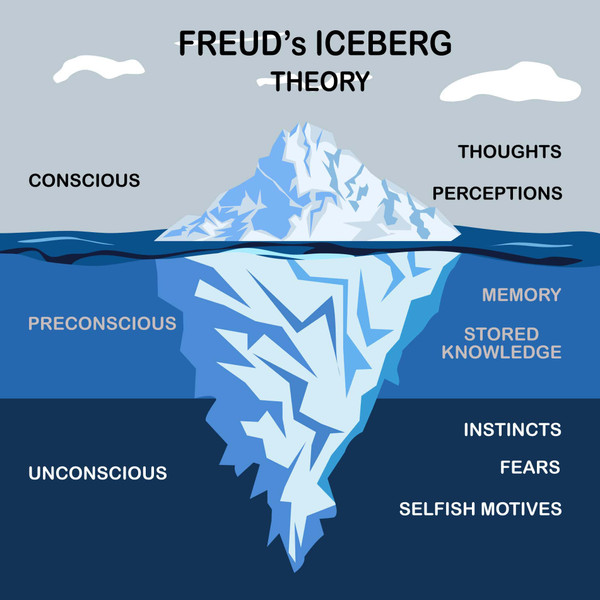
Freud’s iceberg model of consciousness
The key idea is that the largest part of mental life lies outside awareness, even though it still shapes behavior.
Freud’s structural model
Freud also described three parts of personality:
- Id
The primitive part. It wants immediate gratification and follows the pleasure principle. - Ego
The decision-maker. It works by the reality principle and tries to balance impulses, rules, and real-world limits. - Superego
Your internalized morals and ideals. It pushes you toward what you think you should do.
When these parts clash, anxiety can result. The ego then tries to reduce that anxiety using defense mechanisms.
Scope note you should know for AP Psych: Freud’s psychosexual stages are not tested here.
Ego Defense Mechanisms
Defense mechanisms are unconscious ways the ego protects itself from anxiety. They are different from conscious coping. If you use one, you usually do not realize you are doing it.
Defense mechanisms you must know
- Denial
Refusing to accept painful reality. - Displacement
Shifting emotion to a safer target. Example: mad at a teacher, snap at your sibling. - Projection
Assigning your own unacceptable feeling to someone else. Example: accusing others of being hostile when you feel hostile. - Rationalization
Making a self-protective explanation that sounds reasonable. - Reaction formation
Acting opposite to an unacceptable impulse. Example: treating someone with exaggerated kindness when you actually dislike them. - Regression
Returning to earlier, less mature behavior under stress. - Repression
Unconsciously pushing threatening thoughts or memories out of awareness. - Sublimation
Channeling an unacceptable impulse into something socially valued, like turning aggression into sports.
Easy distinctions
- Denial vs repression
Denial rejects external reality. Repression blocks internal material. - Projection vs displacement
Projection assigns your feeling to someone else. Displacement redirects your feeling. - Repression vs suppression
Repression is unconscious. Suppression is conscious. - Sublimation is usually the most adaptive one.
Projective Tests in Psychodynamic Assessment
If personality is shaped by the unconscious, then direct self-reports may miss important motives. That is why psychodynamic psychologists use projective tests, which give ambiguous stimuli and look for projected inner themes.
The classic example is the Rorschach Inkblot Test, shown here.

Rorschach inkblot
- Rorschach Inkblot Test
A person says what the inkblot looks like. Examiners may look for recurring themes like conflict, threat, or emotion. - Thematic Apperception Test (TAT)
A person sees ambiguous pictures of people and tells stories about what is happening, what characters think and feel, and how the story ends.
These tests can suggest patterns, but they have major limits:
- low reliability, especially interrater reliability if different scorers disagree
- questionable validity
- examiner bias and confirmation bias
- responses can be shaped by culture, language, mood, or storytelling skill
So projective tests can generate hypotheses, but they do not prove hidden motives.
Humanistic Personality Theory
Humanistic theory, linked most strongly to Carl Rogers, focuses on conscious experience, personal choice, growth, and meaning. Here, personality is less about hidden conflict and more about how you see yourself and move toward fulfillment.
- Self-actualizing tendency means people are motivated to develop their abilities and grow.
- Unconditional positive regard means being accepted and valued without having to earn worth by meeting conditions.
- Conditions of worth happen when acceptance depends on standards. That can make people deny parts of themselves.
- Self-concept is your set of beliefs about who you are.
- Congruence means your actual self, experiences, and ideal self line up fairly well.
- Incongruence means they do not match, which creates tension or distress.
The core idea to picture is the gap between the actual self and the ideal self. A small gap means higher congruence. A larger gap means more incongruence and more distress.
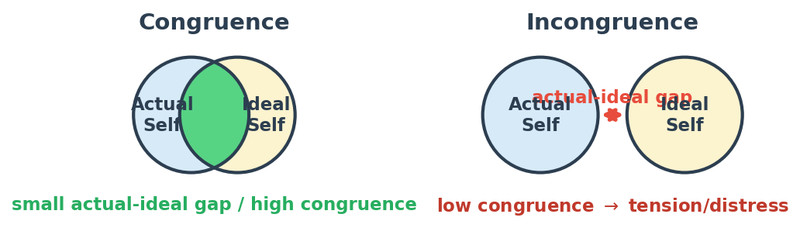
Congruence and incongruence in Rogers’ theory
Another scope note: Maslow’s hierarchy is not tested in this topic.
Humanistic Assessment and Psychodynamic vs Humanistic
Humanistic assessment looks at conscious self-perception. Common methods include:
- interviews
- self-reports
- descriptions of actual self and ideal self
What they assess:
- self-concept
- the actual-ideal self gap
- degree of congruence
Limits matter here too:
- social desirability bias
- inaccurate self-knowledge
- interviewer effects
- correlational findings cannot prove causation
Core comparison
| Psychodynamic | Humanistic |
|---|---|
| Unconscious conflict | Conscious experience |
| Defense mechanisms | Self-actualization |
| Projective tests | Interviews and self-reports |
| Freud | Carl Rogers |
Key Takeaways
Personality
Characteristic patterns of thought, feeling, motivation, and behavior that produce relative consistency across time and situations
Psychodynamic Theory of Personality
The view that unconscious motives, conflicts, and interacting psychological forces drive personality and behavior
Sigmund Freud
Founder of psychoanalytic theory, from which the psychodynamic theory of personality developed
Preconscious
Material not currently in awareness that can be brought into awareness relatively easily
Unconscious
Thoughts, wishes, fears, motives, and conflicts outside ordinary awareness that still affect thoughts, emotions, and behavior
Id
The primitive part of personality that seeks immediate gratification of impulses
Ego
The part of personality that deals with reality, regulates impulses, and mediates among the id, superego, and external demands
Superego
The part of personality representing internalized moral standards and ideals
Ego Defense Mechanisms
Unconscious processes that protect the ego from anxiety, threatening ideas, unacceptable impulses, or painful realities by altering awareness or interpretation
Denial
Refusing to accept or recognize a painful external reality
Displacement
Redirecting an emotion or impulse from its original target to a safer or more available substitute target
Projection
Attributing one’s own unacceptable thoughts, motives, or feelings to someone else
Rationalization
Creating a plausible, self-protective explanation that conceals a more threatening motive or explanation
Reaction Formation
Expressing attitudes or behaviors opposite to an unacceptable unconscious feeling or impulse
Regression
Returning under stress or anxiety to behavior characteristic of an earlier developmental period
Repression
Unconsciously excluding distressing thoughts, impulses, or memories from conscious awareness
Sublimation
Channeling an unacceptable impulse into a constructive or socially valued activity
Projective Tests
Personality assessments that use interpretations of ambiguous stimuli to probe preconscious or unconscious motives, conflicts, and concerns
Rorschach Inkblot Test
A projective test in which a person reports what a standard series of symmetrical inkblots might represent
Thematic Apperception Test (TAT)
A projective test in which a person constructs stories about ambiguous pictures of people
Humanistic Theory of Personality
The view that personality centers on subjective experience, conscious choice, acceptance, personal meaning, growth, and realizing one’s potential
Carl Rogers
Humanistic psychologist who emphasized self-concept, unconditional positive regard, congruence, and the self-actualizing tendency
Self-Actualizing Tendency
The inherent motivation to develop one’s capacities, maintain or enhance oneself, and move toward fuller realization of one’s potential
Self-Concept
The organized set of beliefs and perceptions a person has about who they are
Unconditional Positive Regard (Unconditional Regard)
Accepting and valuing a person without making their basic worth dependent on meeting particular conditions
Conditions of Worth
Standards that make a person feel valued only when behaving, feeling, or achieving in approved ways
Actual Self vs. Ideal Self
The actual self is who a person believes they are; the ideal self is who the person would like to be
Congruence vs. Incongruence
Congruence is relative consistency among self-concept, lived experience, and the ideal self; incongruence is a substantial mismatch among them
Humanistic Personality Assessment
Assessment of conscious subjective experience and self-concept through methods such as open-ended interviews, personal narratives, and actual–ideal self-reports
Notes
Personality
Characteristic patterns of thought, feeling, motivation, and behavior that produce relative consistency across time and situations
Psychodynamic Theory of Personality
The view that unconscious motives, conflicts, and interacting psychological forces drive personality and behavior
Sigmund Freud
Founder of psychoanalytic theory, from which the psychodynamic theory of personality developed
Preconscious
Material not currently in awareness that can be brought into awareness relatively easily
Unconscious
Thoughts, wishes, fears, motives, and conflicts outside ordinary awareness that still affect thoughts, emotions, and behavior
Id
The primitive part of personality that seeks immediate gratification of impulses
Ego
The part of personality that deals with reality, regulates impulses, and mediates among the id, superego, and external demands
Superego
The part of personality representing internalized moral standards and ideals
Ego Defense Mechanisms
Unconscious processes that protect the ego from anxiety, threatening ideas, unacceptable impulses, or painful realities by altering awareness or interpretation
Denial
Refusing to accept or recognize a painful external reality
Displacement
Redirecting an emotion or impulse from its original target to a safer or more available substitute target
Projection
Attributing one’s own unacceptable thoughts, motives, or feelings to someone else
Rationalization
Creating a plausible, self-protective explanation that conceals a more threatening motive or explanation
Reaction Formation
Expressing attitudes or behaviors opposite to an unacceptable unconscious feeling or impulse
Regression
Returning under stress or anxiety to behavior characteristic of an earlier developmental period
Repression
Unconsciously excluding distressing thoughts, impulses, or memories from conscious awareness
Sublimation
Channeling an unacceptable impulse into a constructive or socially valued activity
Projective Tests
Personality assessments that use interpretations of ambiguous stimuli to probe preconscious or unconscious motives, conflicts, and concerns
Rorschach Inkblot Test
A projective test in which a person reports what a standard series of symmetrical inkblots might represent
Thematic Apperception Test (TAT)
A projective test in which a person constructs stories about ambiguous pictures of people
Humanistic Theory of Personality
The view that personality centers on subjective experience, conscious choice, acceptance, personal meaning, growth, and realizing one’s potential
Carl Rogers
Humanistic psychologist who emphasized self-concept, unconditional positive regard, congruence, and the self-actualizing tendency
Self-Actualizing Tendency
The inherent motivation to develop one’s capacities, maintain or enhance oneself, and move toward fuller realization of one’s potential
Self-Concept
The organized set of beliefs and perceptions a person has about who they are
Unconditional Positive Regard (Unconditional Regard)
Accepting and valuing a person without making their basic worth dependent on meeting particular conditions
Conditions of Worth
Standards that make a person feel valued only when behaving, feeling, or achieving in approved ways
Actual Self vs. Ideal Self
The actual self is who a person believes they are; the ideal self is who the person would like to be
Congruence vs. Incongruence
Congruence is relative consistency among self-concept, lived experience, and the ideal self; incongruence is a substantial mismatch among them
Humanistic Personality Assessment
Assessment of conscious subjective experience and self-concept through methods such as open-ended interviews, personal narratives, and actual–ideal self-reports
