Topic 3.9 Notes – Social, Cognitive, and Neurological Factors in Learning
Learning Without Direct Reinforcement
Earlier in Unit 3, learning often meant associations or consequences. Here, learning can happen without direct reinforcement in the moment.
The most important distinction is this:
- Acquisition means the organism has learned or stored information.
- Performance means the organism actually shows that learning in behavior.
Those are not the same thing. You can know how to do something and still not do it because of:
- low motivation
- weak or missing incentives
- no opportunity
- limited ability
- expected consequences
That idea shows up in all three forms here:
- Observational learning = learning by watching a model
- Insight learning = sudden problem solving, the “aha” moment
- Latent learning = hidden learning that appears later
Observational Learning and Social Learning Theory
How observational learning works
Social learning theory says learning can happen through observation. A model is the person or organism being watched. Modeling means observing and imitating the behavior.
You do not need personal trial and error for this. You also do not need immediate imitation to prove learning. A student might watch a classmate solve a problem correctly and only use that method later on a quiz.
For observational learning to turn into performance, the observer must:
- attend to the behavior
- remember it
- be able to reproduce it
- have motivation to perform it
Vicarious conditioning
This is where observational learning connects to operant conditioning.
- Vicarious reinforcement = the model is rewarded, so the observer becomes more likely to copy the behavior
- Vicarious punishment = the model is punished, so the observer becomes less likely to copy it
The key AP point is that the consequence happens to the model, not the observer.
What makes a model influential
The most testable factor is similarity. The more similar the model feels to the observer, the more likely the behavior is to be learned.
Similarity can mean:
- age
- identity
- group membership
- interests
- experience
Other traits can help too, like status, competence, attractiveness, warmth, authority, and visible success.
Bandura and the Bobo doll study
Bandura tested this idea by having children watch adult models interact with a Bobo doll.

Bandura's Bobo doll study
Children watched either:
- an aggressive model
- a nonaggressive model
- no model
Later, children who saw aggression were more likely to imitate aggressive acts toward the Bobo doll. They copied specific observed behaviors, which is why this study matters so much.
In a later version, the model was:
- rewarded
- punished
- given no consequence
Punishment reduced immediate imitation, but children could still reproduce the behavior when offered incentives. That is the cleanest example of learning vs performance.
Neurological Support for Observational Learning
All learning depends on neural plasticity, which means experience changes neural connections.
Mirror neurons were first identified in macaque monkeys. These neurons fired both when the monkey performed an action and when it observed a similar action.
Human brain imaging suggests similar action-observation networks. This may help explain imitation and understanding actions. Still, mirror neurons do not explain everything by themselves. Attention, memory, motivation, prior experience, and context still matter.
Insight Learning
Insight learning is a sudden solution that appears through mental reorganization. The answer seems to click.
Köhler’s chimpanzees showed this in tool and box problems, like the classic setup below.
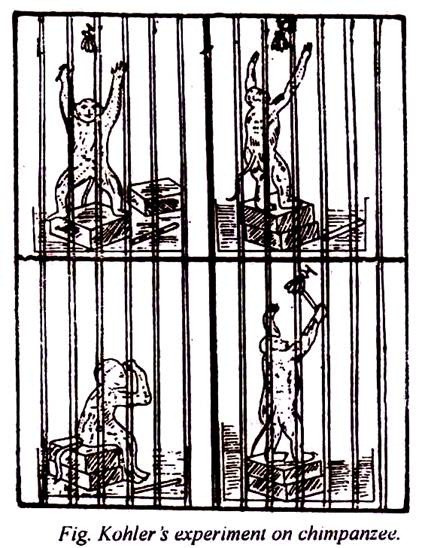
Köhler’s chimpanzee insight experiment
- using sticks to reach bananas
- stacking boxes to get to food
What made this insight was the pattern:
- a pause or survey period
- then a sudden, organized solution
That looks different from slow trial and error. Prior experience still matters, but the immediate solution is not built step-by-step through reinforcement. Once understood, the relationship can transfer to similar problems.
Latent Learning and Cognitive Maps
Latent learning
Latent learning is learning without reinforcement that is not immediately visible. Latent means hidden, not absent.
This is the strongest example of acquisition happening before performance.
Cognitive maps
A cognitive map is a mental representation of an environment.
It includes:
- routes
- landmarks
- spatial relationships
- shortcuts
- detours
This shows flexible navigation, not just memorizing one response chain.
Tolman and Honzik’s maze study
In Tolman and Honzik’s rat-maze study, the pattern across trials makes latent learning easy to see.
Three groups of rats:
- rewarded from the start
- never rewarded
- rewarded only after a delay
The delayed-reward group improved sharply once food appeared. That means they had already learned the maze before reinforcement. The reward revealed performance.
Fast comparisons
- Observational learning = learn by watching a model
- Insight learning = sudden mental reorganization
- Latent learning = hidden knowledge shown later
Key Takeaways
Social Learning Theory
The theory that learning can occur by observing models without personally experiencing consequences; similar models are more likely to influence behavior
Observational Learning
Learning by watching a model’s behavior and sometimes the consequences that follow it
Modeling
The process of observing and copying a particular behavior
Vicarious Conditioning
Learning from consequences experienced by a model rather than from consequences experienced personally
Vicarious Reinforcement
Becoming more likely to perform a behavior after observing a model rewarded for it
Vicarious Punishment
Becoming less likely to perform a behavior after observing a model receive an aversive consequence or lose something desirable
Bandura’s Bobo Doll Experiments
Experiments showing that children imitated an adult model’s distinctive aggression and that observed consequences affected performance more than acquisition
Mirror Neurons
Neurons or related networks active both when an action is performed and when a similar goal-directed action is observed
Neural Plasticity
The nervous system’s ability to change neural connections in response to experience
Insight Learning
A sudden problem solution produced through cognitive reorganization without a current association, consequence, or model
Köhler’s Chimpanzee Research
Chimpanzees sometimes paused and then suddenly used sticks or boxes in an organized way to reach food, demonstrating insight
Latent Learning
Learning that occurs without reinforcement and remains hidden until a reason or opportunity causes it to be performed
Acquisition vs. Performance
Acquisition is the learning or storage of information; performance is its observable use, which can depend on motivation, incentives, opportunity, and ability
Cognitive Map
A mental representation of the spatial relationships among locations, routes, landmarks, and possible shortcuts
Tolman’s Maze Research
Rats explored a maze without reward but rapidly reduced errors once food was introduced, revealing latent learning and cognitive maps
Notes
Social Learning Theory
The theory that learning can occur by observing models without personally experiencing consequences; similar models are more likely to influence behavior
Observational Learning
Learning by watching a model’s behavior and sometimes the consequences that follow it
Modeling
The process of observing and copying a particular behavior
Vicarious Conditioning
Learning from consequences experienced by a model rather than from consequences experienced personally
Vicarious Reinforcement
Becoming more likely to perform a behavior after observing a model rewarded for it
Vicarious Punishment
Becoming less likely to perform a behavior after observing a model receive an aversive consequence or lose something desirable
Bandura’s Bobo Doll Experiments
Experiments showing that children imitated an adult model’s distinctive aggression and that observed consequences affected performance more than acquisition
Mirror Neurons
Neurons or related networks active both when an action is performed and when a similar goal-directed action is observed
Neural Plasticity
The nervous system’s ability to change neural connections in response to experience
Insight Learning
A sudden problem solution produced through cognitive reorganization without a current association, consequence, or model
Köhler’s Chimpanzee Research
Chimpanzees sometimes paused and then suddenly used sticks or boxes in an organized way to reach food, demonstrating insight
Latent Learning
Learning that occurs without reinforcement and remains hidden until a reason or opportunity causes it to be performed
Acquisition vs. Performance
Acquisition is the learning or storage of information; performance is its observable use, which can depend on motivation, incentives, opportunity, and ability
Cognitive Map
A mental representation of the spatial relationships among locations, routes, landmarks, and possible shortcuts
Tolman’s Maze Research
Rats explored a maze without reward but rapidly reduced errors once food was introduced, revealing latent learning and cognitive maps
