Topic 4.6 Notes – Motivation
What Motivation Is
Motivation includes the processes that initiate, direct, energize, and sustain behavior. It explains:
- why behavior begins
- why one goal gets chosen over another
- how intense the behavior is
- why it continues or ends
A few terms are easy to mix up, so keep them separate:
- Need means a condition required for well-being, like water or social connection.
- Drive means internal tension caused by an unmet need.
- Incentive means an outside reward or outcome that pulls behavior.
- Motive is the general reason for behavior. It can be internal, external, or both.
One behavior can have more than one motive. You might eat because you're hungry, because food smells good, because it’s lunchtime, and because friends are eating with you.
The Main Theories of Motivation
Drive-reduction theory
This theory explains behavior as an effort to reduce physical tension and restore homeostasis, which means a stable internal state.
The sequence works like this:
- physiological deficit
- drive state
- motivated behavior
- drive reduced and balance restored
Dehydration → thirst → drinking is the classic example.
This theory fits best with hunger, thirst, and body temperature.
Arousal theory
Arousal theory says people try to maintain an optimal level of activation.
- Too little arousal can feel like boredom.
- Too much arousal can feel like overload or anxiety.
So motivation may raise stimulation or lower it, depending on the situation.
Yerkes-Dodson law
This is arousal theory applied to performance.
The graph shows the classic inverted-U pattern.
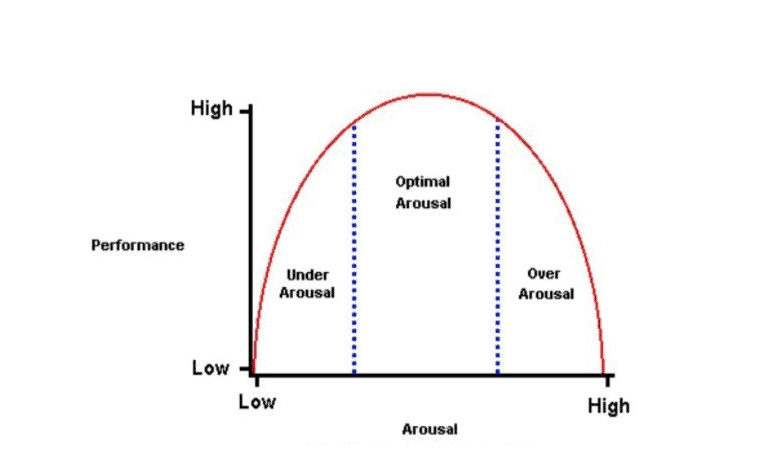
Yerkes-Dodson law
- Low arousal → low performance
- Moderate arousal → best performance
- Very high arousal → performance drops
One testable detail students miss is that hard or unfamiliar tasks need lower arousal than easy or well-practiced tasks.
Self-determination theory
This theory asks why you're doing the activity.
- Intrinsic motivation means doing something because it is enjoyable or meaningful in itself.
- Extrinsic motivation means doing it for an outside result, like a grade, money, or praise.
The same behavior can be intrinsic for one person and extrinsic for another. It also connects to autonomy, competence, and relatedness.
Incentive theory
Incentive theory says behavior is pulled by anticipated rewards.
Examples include:
- money
- grades
- praise
- prizes
This overlaps with extrinsic motivation, but the emphasis is on the attractive power of the reward itself.
Instinct theory
Instincts are innate, fixed behavior patterns in non-human animals.
A classic example is an orb-weaver spider building its web.

Orb-weaver spider web
In AP Psych, humans do not show complex instinctual behavior in this strict sense.
Conflict and Stimulation-Based Motives
Lewin’s motivational conflicts
Sometimes motivation comes from resolving a choice.
- Approach-approach means choosing between two good options.
- Example: two great colleges
- Approach-avoidance means one goal has both good and bad features.
- Example: a promotion with better pay but a long commute
- Avoidance-avoidance means choosing between two bad options.
- Example: expensive repair now or worse damage later
The common mistake is missing that approach-avoidance is one mixed option, not two separate choices.
Sensation-seeking theory
This theory focuses on stable differences in how much novelty and intensity people want.
Four forms:
- Experience seeking means wanting new ideas, cultures, art, or environments.
- Thrill and adventure seeking means wanting speed, danger, and physical excitement.
- Disinhibition means wanting socially uninhibited, high-energy stimulation.
- Boredom susceptibility means low tolerance for routine and repetition.
Eating and Belongingness
Hunger and satiety
Eating shows how biology, thinking, and environment work together. The hypothalamus helps regulate hunger and fullness.
- Ghrelin is produced mainly by the stomach and increases hunger.
- Leptin is produced mainly by fat cells and helps signal satiety.
Both hormones signal the hypothalamus, so the hypothalamus is the structure most relevant here.
This connects to drive-reduction because eating can reduce a physiological need.
External influences on eating
People also eat because of outside cues:
- visible or appealing food
- smell and variety
- portion size and access
- time of day and learned meal times
- social setting and culture
So you can eat without strong physiological hunger.
Belongingness
Belongingness is the motivation to form, maintain, and restore social relationships.
It helps explain:
- joining groups
- keeping friendships
- seeking inclusion
- reacting strongly to rejection
A social meal may be about connection as much as hunger. This also links back to relatedness in self-determination theory.
How to Apply the Theories
Match the theory to the part of behavior it explains:
- Drive reduction fits reducing a bodily need.
- Arousal fits changing stimulation level.
- Intrinsic vs. extrinsic fits the reason for doing the activity.
- Incentive fits attraction to a reward.
- Sensation seeking fits preference for novelty or intensity.
- Belongingness fits desire for social connection.
The same behavior may fit more than one theory at once.
Key Takeaways
Motivation
Processes that initiate, direct, energize, and sustain behavior and goal-directed mental activity
Need
A condition required for physical or psychological well-being
Drive
An internal state of tension associated with an unmet need that motivates need-reducing behavior
Drive-Reduction Theory
The theory that physiological needs create drives that motivate behaviors that reduce tension and restore homeostasis
Homeostasis
The body’s tendency to maintain relatively stable internal conditions
Arousal
A general state of physiological and psychological activation ranging from very low alertness to intense excitement or stress
Arousal Theory
The theory that people are motivated to regulate stimulation toward an optimal level of arousal
Yerkes-Dodson Law
Performance rises as arousal approaches an optimum and falls when arousal is too low or high; difficult tasks generally require lower arousal than simple tasks
Self-Determination Theory
The theory distinguishing intrinsic from extrinsic reasons for acting and emphasizing autonomy, competence, and connection in self-directed motivation
Intrinsic Motivation
Engaging in an activity because the activity itself is enjoyable, interesting, meaningful, or satisfying
Extrinsic Motivation
Engaging in an activity to obtain a separate outcome or avoid an unwanted consequence
Incentive
An external object or outcome with rewarding value that attracts and directs behavior
Incentive Theory
The theory that anticipated external rewards pull behavior toward them
Instinct
An innate, complex, relatively fixed behavior pattern that appears in a species in response to particular stimuli
Lewin’s Motivational Conflicts Theory
The theory that choices create motivational conflicts that a person must resolve
Approach-Approach Conflict
A motivational conflict requiring a choice between two appealing alternatives
Approach-Avoidance Conflict
A motivational conflict in which one option has both attractive and unattractive features
Avoidance-Avoidance Conflict
A motivational conflict requiring a choice between two unattractive alternatives
Sensation Seeking / Sensation-Seeking Theory
The theory that stable differences in the need for varied, novel, complex, or intense experiences motivate behavior
Experience Seeking
Pursuing new ideas, perceptions, cultures, environments, artistic experiences, or unconventional experiences
Thrill or Adventure Seeking
Desiring physically exciting activities involving speed, height, danger, or controlled risk
Disinhibition
Seeking stimulation through socially uninhibited activities that loosen ordinary self-control or social restraints
Boredom Susceptibility
A low tolerance for repetition, routine, predictability, or situations lacking novelty
Hunger
The motivational state associated with seeking and consuming food
Satiety
The state of fullness or satisfaction that reduces further eating
Ghrelin
A hormone produced primarily by the stomach that commonly rises before eating and promotes hunger and food-seeking
Leptin
A hormone produced primarily by fat cells that signals stored energy and generally promotes longer-term satiety and reduced eating
Hypothalamus
A brain structure that integrates hunger and satiety signals and coordinates feeding-related regulation
Pituitary Gland
An endocrine gland through which the hypothalamus coordinates broader hormonal functions involved in bodily regulation
Belongingness
The motivation to form, maintain, and restore stable social connections, acceptance, inclusion, and enduring relationships
Notes
Motivation
Processes that initiate, direct, energize, and sustain behavior and goal-directed mental activity
Need
A condition required for physical or psychological well-being
Drive
An internal state of tension associated with an unmet need that motivates need-reducing behavior
Drive-Reduction Theory
The theory that physiological needs create drives that motivate behaviors that reduce tension and restore homeostasis
Homeostasis
The body’s tendency to maintain relatively stable internal conditions
Arousal
A general state of physiological and psychological activation ranging from very low alertness to intense excitement or stress
Arousal Theory
The theory that people are motivated to regulate stimulation toward an optimal level of arousal
Yerkes-Dodson Law
Performance rises as arousal approaches an optimum and falls when arousal is too low or high; difficult tasks generally require lower arousal than simple tasks
Self-Determination Theory
The theory distinguishing intrinsic from extrinsic reasons for acting and emphasizing autonomy, competence, and connection in self-directed motivation
Intrinsic Motivation
Engaging in an activity because the activity itself is enjoyable, interesting, meaningful, or satisfying
Extrinsic Motivation
Engaging in an activity to obtain a separate outcome or avoid an unwanted consequence
Incentive
An external object or outcome with rewarding value that attracts and directs behavior
Incentive Theory
The theory that anticipated external rewards pull behavior toward them
Instinct
An innate, complex, relatively fixed behavior pattern that appears in a species in response to particular stimuli
Lewin’s Motivational Conflicts Theory
The theory that choices create motivational conflicts that a person must resolve
Approach-Approach Conflict
A motivational conflict requiring a choice between two appealing alternatives
Approach-Avoidance Conflict
A motivational conflict in which one option has both attractive and unattractive features
Avoidance-Avoidance Conflict
A motivational conflict requiring a choice between two unattractive alternatives
Sensation Seeking / Sensation-Seeking Theory
The theory that stable differences in the need for varied, novel, complex, or intense experiences motivate behavior
Experience Seeking
Pursuing new ideas, perceptions, cultures, environments, artistic experiences, or unconventional experiences
Thrill or Adventure Seeking
Desiring physically exciting activities involving speed, height, danger, or controlled risk
Disinhibition
Seeking stimulation through socially uninhibited activities that loosen ordinary self-control or social restraints
Boredom Susceptibility
A low tolerance for repetition, routine, predictability, or situations lacking novelty
Hunger
The motivational state associated with seeking and consuming food
Satiety
The state of fullness or satisfaction that reduces further eating
Ghrelin
A hormone produced primarily by the stomach that commonly rises before eating and promotes hunger and food-seeking
Leptin
A hormone produced primarily by fat cells that signals stored energy and generally promotes longer-term satiety and reduced eating
Hypothalamus
A brain structure that integrates hunger and satiety signals and coordinates feeding-related regulation
Pituitary Gland
An endocrine gland through which the hypothalamus coordinates broader hormonal functions involved in bodily regulation
Belongingness
The motivation to form, maintain, and restore stable social connections, acceptance, inclusion, and enduring relationships
