Topic 2.3 Notes – Introduction to Memory
What Memory Is
Memory means learning that lasts over time. Psychologists usually break it into three processes:
- Encoding means getting information into memory in a usable form.
- Storage means keeping that information over time.
- Retrieval means bringing it back into awareness, or letting it affect what you do.
A common test trap is thinking failed retrieval means the memory was never there. It might have been stored but you couldn’t access it at that moment.
Memory is also an information-processing system, not a video camera. It selects, organizes, and reconstructs information.
The main frameworks here answer different questions:
- Types of memory ask what kind of memory is this?
- Multi-store model asks where does information go?
- Working memory model asks what does active memory do?
- Levels of processing asks why do some encodings last better?
- Long-term potentiation asks what brain change helps memory last?
Types of Memory
Explicit memory
Explicit memory is conscious, declarative memory. You can describe it to someone else.
It has two forms that students mix up a lot:
Episodic memory
Memory for personal events. It includes what happened, and often where and when.
Example: remembering your last birthday party.Semantic memory
Memory for facts, meanings, and general knowledge.
Example: knowing what a diploma is or that water freezes at 0°C.
The key distinction is this. If you remember learning the fact, that is episodic. If you just know the fact, that is semantic.
Implicit memory
Implicit memory affects behavior without conscious recall. You often show it through performance.
- Procedural memory is memory for skills and habits.
Examples: typing, riding a bike, playing a practiced song pattern.
Prospective memory
Prospective memory is memory for future intentions.
- remembering to take medicine later
- remembering to turn in an assignment tomorrow
This is different from episodic memory because it points forward, not backward.
One situation can use several memory types at once. Playing piano from habit uses procedural memory, knowing note names uses semantic memory, and remembering to perform tomorrow uses prospective memory.
The Multi-Store Model
The multi-store model describes memory as three interacting systems.
This basic flow diagram matches the model you'll see in many psych classes.
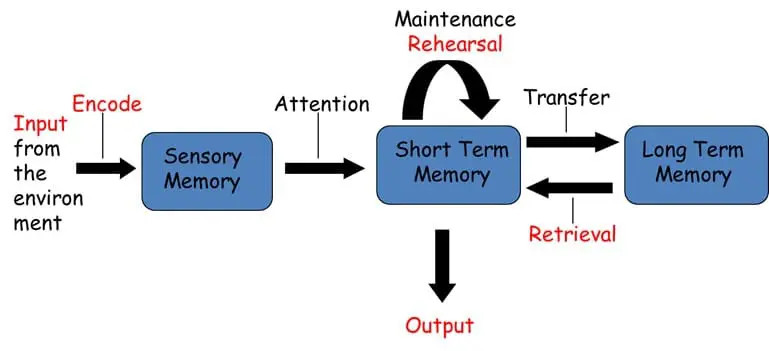
Multi-store model of memory
- Sensory memory holds incoming sensory info very briefly.
- Iconic memory = visual sensory memory
- Echoic memory = auditory sensory memory
Echoic lasts a bit longer, which helps you make sense of speech.
- Short-term memory briefly holds limited information in active awareness. Without continued processing, much is lost quickly.
- Long-term memory stores knowledge, experiences, and skills more durably. It includes both explicit and implicit memories.
How information moves in the diagram:
- Attention moves info from sensory memory to short-term memory.
- Maintenance rehearsal keeps information active in short-term memory.
- Transfer moves it into long-term memory.
- Retrieval brings long-term memory back into active awareness.
Automatic and effortful processing
- Automatic processing happens with little conscious effort.
- Effortful processing requires attention, rehearsal, and mental work.
Effortful processing usually gives stronger encoding into long-term memory.
How Working Memory Works
Working memory is active, limited-capacity memory. It doesn’t just hold information. It works with it.
Baddeley and Hitch’s model breaks working memory into parts that handle different kinds of information and a control system that manages them.
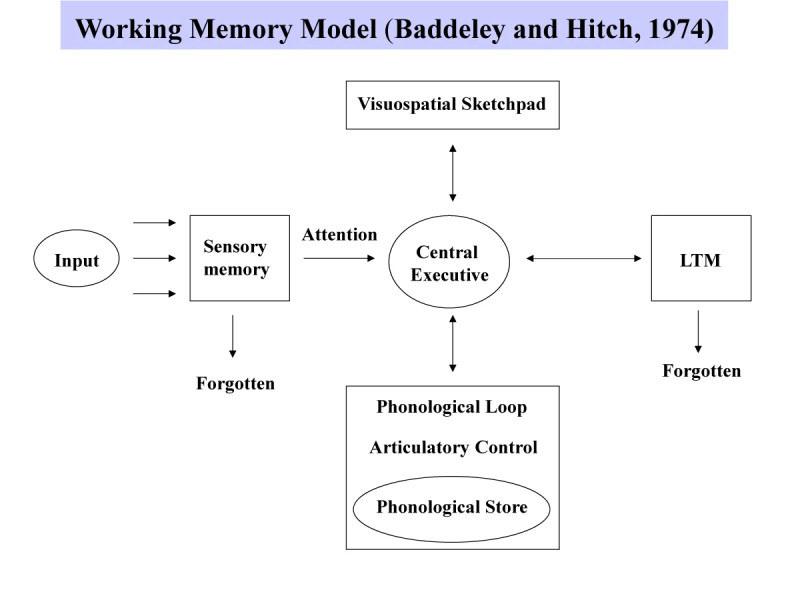
Baddeley and Hitch working memory model
- Central executive directs attention, switches focus, and coordinates the system.
- Phonological loop temporarily holds and rehearses verbal or auditory information, like repeating a phone number.
- Visuospatial sketchpad temporarily holds and manipulates visual or spatial information, like picturing a route.
Important distinction. The phonological loop and visuospatial sketchpad are parts of working memory. They are not sensory memory, and they are not long-term memory.
Why Some Memories Last
Levels of processing
The levels of processing model says memory depends on how deeply you encode information.
Think of it as a shift from shallow processing of what something looks or sounds like to deeper processing of what it means.
- Structural processing focuses on appearance
Example: uppercase letters or word length - Phonemic processing focuses on sound
Example: pronunciation or rhyming - Semantic processing focuses on meaning and connections
Example: using a word in a sentence
Semantic processing usually leads to the best retention. The reason is meaningful encoding, not just more time spent.
Long-term potentiation
Long-term potentiation (LTP) is a long-lasting strengthening of synaptic connections after repeated activation.
- often summed up as “neurons that fire together wire together”
- strongly linked to memory pathways like the hippocampus
- helps explain how experience creates lasting neural change
LTP supports memory. It is not the memory itself.
Key Takeaways
Memory
The persistence of learning over time through encoding, storage, and retrieval
Encoding
Transforming incoming information into a form the memory system can process
Storage
Retaining encoded information over time
Retrieval
Bringing stored information into active awareness or allowing it to influence behavior
Explicit Memory (Declarative Memory)
Memory that is consciously accessible and can be relatively easily stated or described
Episodic Memory
Explicit memory for personally experienced events, often including where and when they occurred
Semantic Memory
Explicit memory for facts, concepts, meanings, and general knowledge
Implicit Memory
Memory that influences behavior without requiring conscious recollection and is often expressed through performance
Procedural Memory
Implicit memory for learned skills, procedures, and sequences of action
Prospective Memory
Memory for an intended future action—remembering to do something later
Long-Term Potentiation (LTP)
A lasting increase in synaptic transmission strength following frequent or repeated activation of a neural pathway
Multi-Store Model (Three-Stage/Modal Model of Memory)
A model in which information moves among sensory, short-term, and long-term memory through attention, processing, and retrieval
Sensory Memory
The momentary preservation of a nearly immediate trace of sensory stimulation
Iconic Memory
Sensory memory for briefly retained visual information
Echoic Memory
Sensory memory for briefly retained auditory information
Short-Term Memory
The limited-capacity store that briefly holds active, available information
Long-Term Memory
Relatively enduring storage for knowledge, experiences, and learned skills
Automatic Processing
Encoding that occurs with little deliberate attention or conscious effort
Effortful Processing
Encoding that requires conscious attention and deliberate mental work
Central Executive
The working-memory component that directs attention and coordinates other components and limited mental resources
Phonological Loop
The working-memory component that temporarily holds and works with verbal and auditory information
Visuospatial Sketchpad
The working-memory component that temporarily holds and manipulates visual images and spatial relationships
Levels of Processing Model
A model proposing that deeper encoding produces stronger retention, progressing from structural to phonemic to semantic processing
Structural Processing
Shallow encoding focused on a stimulus's physical or visual features
Phonemic Processing
Encoding focused on sound, deeper than structural processing but shallower than semantic processing
Semantic Processing
Deep encoding focused on meaning and associations, generally producing the strongest retention
Working Memory
A limited-capacity active-memory system that temporarily holds and manipulates information
Working Memory Model
A model in which the central executive coordinates the phonological loop and visuospatial sketchpad to maintain and manipulate information
Notes
Memory
The persistence of learning over time through encoding, storage, and retrieval
Encoding
Transforming incoming information into a form the memory system can process
Storage
Retaining encoded information over time
Retrieval
Bringing stored information into active awareness or allowing it to influence behavior
Explicit Memory (Declarative Memory)
Memory that is consciously accessible and can be relatively easily stated or described
Episodic Memory
Explicit memory for personally experienced events, often including where and when they occurred
Semantic Memory
Explicit memory for facts, concepts, meanings, and general knowledge
Implicit Memory
Memory that influences behavior without requiring conscious recollection and is often expressed through performance
Procedural Memory
Implicit memory for learned skills, procedures, and sequences of action
Prospective Memory
Memory for an intended future action—remembering to do something later
Long-Term Potentiation (LTP)
A lasting increase in synaptic transmission strength following frequent or repeated activation of a neural pathway
Multi-Store Model (Three-Stage/Modal Model of Memory)
A model in which information moves among sensory, short-term, and long-term memory through attention, processing, and retrieval
Sensory Memory
The momentary preservation of a nearly immediate trace of sensory stimulation
Iconic Memory
Sensory memory for briefly retained visual information
Echoic Memory
Sensory memory for briefly retained auditory information
Short-Term Memory
The limited-capacity store that briefly holds active, available information
Long-Term Memory
Relatively enduring storage for knowledge, experiences, and learned skills
Automatic Processing
Encoding that occurs with little deliberate attention or conscious effort
Effortful Processing
Encoding that requires conscious attention and deliberate mental work
Central Executive
The working-memory component that directs attention and coordinates other components and limited mental resources
Phonological Loop
The working-memory component that temporarily holds and works with verbal and auditory information
Visuospatial Sketchpad
The working-memory component that temporarily holds and manipulates visual images and spatial relationships
Levels of Processing Model
A model proposing that deeper encoding produces stronger retention, progressing from structural to phonemic to semantic processing
Structural Processing
Shallow encoding focused on a stimulus's physical or visual features
Phonemic Processing
Encoding focused on sound, deeper than structural processing but shallower than semantic processing
Semantic Processing
Deep encoding focused on meaning and associations, generally producing the strongest retention
Working Memory
A limited-capacity active-memory system that temporarily holds and manipulates information
Working Memory Model
A model in which the central executive coordinates the phonological loop and visuospatial sketchpad to maintain and manipulate information
