Topic 3.4 Notes – Cognitive Development Across the Lifespan
How Cognitive Development Changes Thinking Across the Lifespan
A lot of this topic makes more sense once you hold onto one idea. Development is both continuous and discontinuous.
- Continuous change means thinking is always being adjusted through experience.
- A schema is a mental framework, or a category your mind uses to organize information.
- Assimilation happens when you fit new information into a schema you already have.
- Example: a child sees a butterfly and calls it a bird.
- Accommodation happens when the old schema no longer works, so it gets changed or a new one is made.
- Example: the child learns butterflies are insects, not birds.
Piaget said the child is an active constructor of knowledge. Kids are building and revising ideas, not just soaking up facts. Vygotsky agreed development matters, but he emphasized something else. He saw the child as a social learner whose thinking is shaped by other people and culture.
Piaget’s Four Stages of Cognitive Development
Piaget divided cognitive development into four broad stages, each with its own way of thinking.
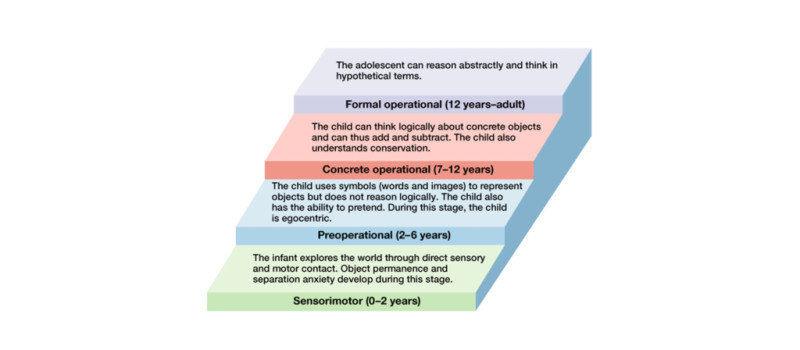
Piaget’s four stages of cognitive development
Sensorimotor stage
Birth to about age 2. Knowledge comes through senses and actions.
- The key idea is object permanence.
- This means understanding that objects still exist even when you can’t see them.
- In the classic hidden-object task, a baby with object permanence will search for the toy after it is covered.
Preoperational stage
About ages 2 to 7. Symbolic thinking grows fast.
- Kids use words, images, and pretend play.
- They also show several classic limits:
- Conservation means knowing quantity stays the same even if appearance changes.
- Reversibility means mentally undoing a change.
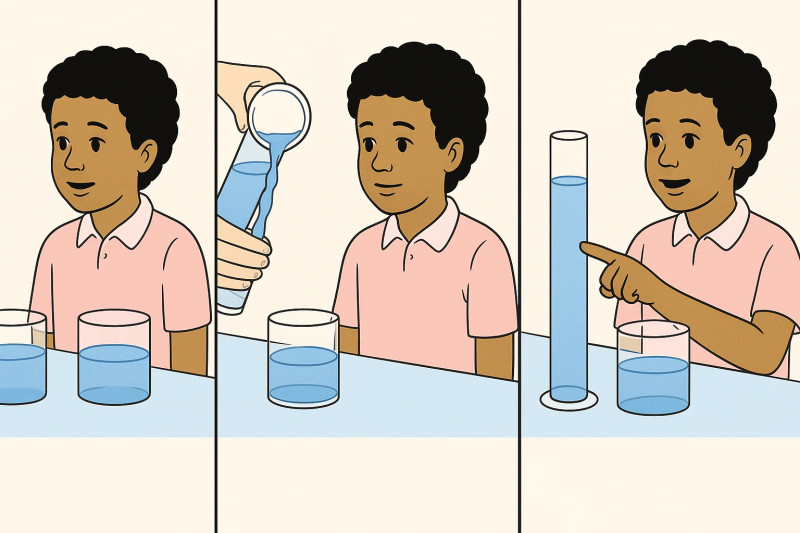
Conservation of liquid task
- Egocentrism means difficulty seeing from another person’s point of view. In Piaget’s three-mountains task, children often pick their own view instead of the doll’s.
- Animism means giving lifelike qualities to nonliving things.
- Theory of mind begins developing here. This is understanding that other people have different beliefs, desires, and knowledge.
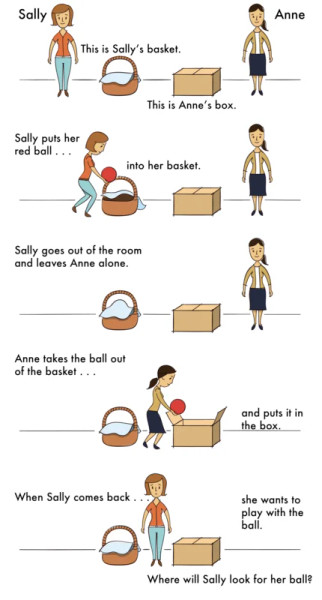
Sally-Anne false-belief task
A child who passes a false-belief task knows someone else can believe something that is wrong.
Concrete operational stage
About ages 7 to 11. Thinking becomes logical for real, familiar situations.
- Children now succeed at conservation and use reversibility.
- They can classify, put things in order, and handle simple cause and effect.
- Abstract and hypothetical thinking is still weak.
Formal operational stage
About age 12 and up. Abstract and hypothetical reasoning becomes possible.
- People can test hypotheses and isolate variables.
- Piaget’s pendulum problem checks this. A formal thinker changes one variable at a time.
- Piaget also said not all adults use formal operational thinking all the time.
What Piaget Got Right and Where His Theory Is Limited
Piaget was right that children think differently from adults. That idea was huge. He also made thinking visible by turning it into tasks.
Limits matter too:
- Stage ages are approximate
- Development can be uneven
- Children may do better when tasks use simpler language or less memory
- Culture and schooling affect performance
One test favorite:
- Object permanence = hidden object still exists
- Conservation = quantity stays the same after appearance changes
Vygotsky’s Sociocultural Theory
Vygotsky said cognitive development happens through interaction with more knowledgeable others. Culture matters because language, tools, values, and teaching methods shape thinking.
He did not propose universal stages.
Zone of proximal development
The zone of proximal development is the gap between what you can do alone and what you can do with help. Best learning happens in that gap.
Scaffolding
Scaffolding is temporary support matched to the learner’s need.
- A helper models or gives hints
- The task is broken into manageable parts
- Feedback guides the learner
- Support is gradually removed
That matters for Piaget too. Piaget stressed independent discovery. Vygotsky stressed guided learning. On the AP exam, treat them as different emphases, not enemies.
Cognitive Development in Adulthood
Crystallized and fluid intelligence
| Type | What it is | Lifespan trend |
|---|---|---|
| Crystallized intelligence | accumulated knowledge, vocabulary, expertise | stays stable or improves through much of adulthood |
| Fluid intelligence | solving new problems quickly and flexibly | tends to decline with age |
Typical aging vs. dementia
Normal aging can include slower processing and occasional retrieval problems.
Dementia is major cognitive decline that interferes with daily functioning. It can affect memory, reasoning, judgment, attention, and language. It is not a normal part of aging.
Alzheimer’s disease is a common cause of dementia, but the terms are not the same.
Key Takeaways
Continuous vs. Discontinuous Cognitive Development
Continuous development involves gradual change, such as schema revision; discontinuous development involves qualitative shifts, such as Piaget’s stages
Piaget’s Constructivist Account
Children actively construct knowledge by forming and revising schemas and progress through four cognitive stages in a fixed order
Schema
A mental framework used to organize and interpret information
Assimilation
Interpreting new information through an existing schema without fundamentally changing the schema
Accommodation
Altering an existing schema or creating a new one when old schemas do not fit new information
Sensorimotor Stage
Piaget’s birth-to-about-age-2 stage, when infants learn through sensory experience and physical action and develop object permanence
Object Permanence
The understanding that an object continues to exist even when it cannot be directly perceived
Preoperational Stage
Piaget’s roughly ages-2-to-7 stage, marked by symbolic thought and pretend play but limited conservation, reversibility, and perspective-taking
Conservation
The understanding that quantity remains unchanged when appearance or arrangement changes but nothing is added or removed
Reversibility
The ability to mentally undo or reverse an operation or transformation
Egocentrism
Difficulty taking another person’s perceptual or cognitive perspective, rather than selfishness
Animism
Attributing life, intentions, feelings, or other humanlike mental qualities to inanimate objects
Theory of Mind
Understanding that others have beliefs, desires, intentions, perceptions, and knowledge that may differ from one’s own or from reality
Concrete Operational Stage
Piaget’s roughly ages-7-to-11 stage, when children reason logically about concrete information and master conservation and reversibility but struggle with abstraction
Formal Operational Stage
Piaget’s stage beginning around age 12, marked by abstract, hypothetical, and systematic reasoning, though not everyone consistently attains it
Vygotsky’s Sociocultural Theory
Cognitive development occurs through social interaction, guided participation, and culturally provided tools and practices
Zone of Proximal Development (ZPD)
The range between what a learner can do independently and what the learner can accomplish with effective assistance
Scaffolding
Temporary, adjustable support for a task within the learner’s ZPD that is gradually withdrawn as competence increases
Crystallized Intelligence
Accumulated knowledge and the ability to use learned information and skills, which generally remains stable or improves through much of adulthood
Fluid Intelligence
The ability to reason flexibly, recognize novel patterns, and solve unfamiliar problems, which tends to decline with age
Dementia
Substantial cognitive decline beyond typical aging that interferes with independent daily functioning
Notes
Continuous vs. Discontinuous Cognitive Development
Continuous development involves gradual change, such as schema revision; discontinuous development involves qualitative shifts, such as Piaget’s stages
Piaget’s Constructivist Account
Children actively construct knowledge by forming and revising schemas and progress through four cognitive stages in a fixed order
Schema
A mental framework used to organize and interpret information
Assimilation
Interpreting new information through an existing schema without fundamentally changing the schema
Accommodation
Altering an existing schema or creating a new one when old schemas do not fit new information
Sensorimotor Stage
Piaget’s birth-to-about-age-2 stage, when infants learn through sensory experience and physical action and develop object permanence
Object Permanence
The understanding that an object continues to exist even when it cannot be directly perceived
Preoperational Stage
Piaget’s roughly ages-2-to-7 stage, marked by symbolic thought and pretend play but limited conservation, reversibility, and perspective-taking
Conservation
The understanding that quantity remains unchanged when appearance or arrangement changes but nothing is added or removed
Reversibility
The ability to mentally undo or reverse an operation or transformation
Egocentrism
Difficulty taking another person’s perceptual or cognitive perspective, rather than selfishness
Animism
Attributing life, intentions, feelings, or other humanlike mental qualities to inanimate objects
Theory of Mind
Understanding that others have beliefs, desires, intentions, perceptions, and knowledge that may differ from one’s own or from reality
Concrete Operational Stage
Piaget’s roughly ages-7-to-11 stage, when children reason logically about concrete information and master conservation and reversibility but struggle with abstraction
Formal Operational Stage
Piaget’s stage beginning around age 12, marked by abstract, hypothetical, and systematic reasoning, though not everyone consistently attains it
Vygotsky’s Sociocultural Theory
Cognitive development occurs through social interaction, guided participation, and culturally provided tools and practices
Zone of Proximal Development (ZPD)
The range between what a learner can do independently and what the learner can accomplish with effective assistance
Scaffolding
Temporary, adjustable support for a task within the learner’s ZPD that is gradually withdrawn as competence increases
Crystallized Intelligence
Accumulated knowledge and the ability to use learned information and skills, which generally remains stable or improves through much of adulthood
Fluid Intelligence
The ability to reason flexibly, recognize novel patterns, and solve unfamiliar problems, which tends to decline with age
Dementia
Substantial cognitive decline beyond typical aging that interferes with independent daily functioning
