Topic 1.3 Notes – The Neuron and Neural Firing
What Neurons Do
A neuron is a specialized cell that receives, processes, and transmits information. Glial cells are the support team. They insulate neurons, help them communicate, give structure, and remove waste.
Behavior and mental processes come from neural networks, not one neuron working alone. That matters on the AP exam because questions often connect a tiny cell-level change to a larger behavior.
Here’s the basic structure of a neuron and the direction a signal usually travels.
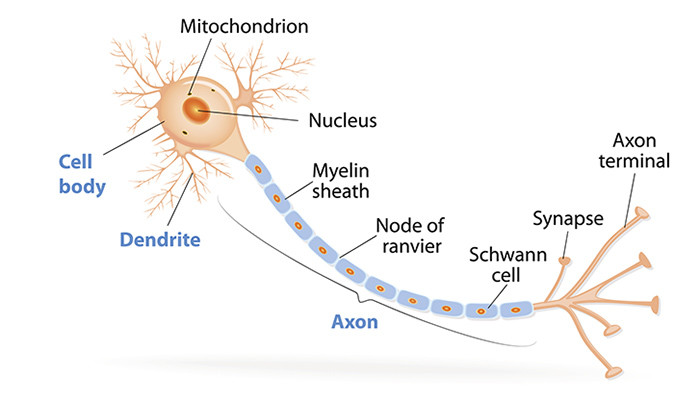
Neuron structure
The usual flow looks like this:
- Dendrites receive incoming messages.
- The soma or cell body combines excitatory and inhibitory input.
- The axon carries the electrical impulse away from the soma.
- Myelin insulates the axon and speeds transmission.
- Axon terminals release neurotransmitters.
- The synapse or synaptic gap is where the message crosses to the next neuron, muscle, or gland.
Two disorders help show why structure matters:
- Multiple sclerosis damages myelin, so signals travel poorly.
- Myasthenia gravis disrupts acetylcholine receptors at the neuromuscular junction, causing muscle weakness.
Types of Neurons and the Reflex Arc
Three neuron types work together in one pathway:
Sensory neurons
They carry incoming information from receptors to the CNS or central nervous system.
Interneurons
They process and connect information within the CNS.
Motor neurons
They carry outgoing commands to muscles and glands.
A reflex arc shows this teamwork in action. In a withdrawal reflex, the signal travels from a skin receptor through a sensory neuron to the spinal cord, where an interneuron passes it to a motor neuron.
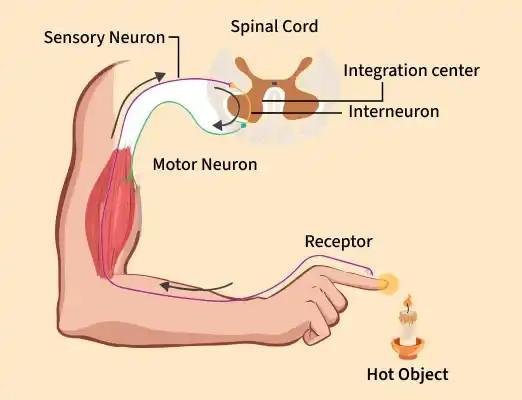
Reflex arc
If you touch a hot stove, this happens:
- Heat activates skin receptors.
- A sensory neuron carries the signal to the spinal cord.
- An interneuron relays it in the spinal cord.
- A motor neuron sends a command to the muscles.
- Your hand pulls away.
The key idea is speed. A reflex is automatic and rapid. The spinal cord can trigger the response before you consciously feel the pain, though the brain still gets the pain message.
How Neural Firing and Synaptic Transmission Work
Inside one neuron, communication is electrical. Between neurons, it is chemical.
The firing sequence goes in order:
- Resting potential means the neuron is polarized and ready.
- Excitatory input makes firing more likely. Inhibitory input makes it less likely.
- Threshold is the minimum stimulation needed to fire.
- Reaching threshold causes depolarization and an action potential down the axon.
- All-or-none means the neuron fires completely or not at all.
- The refractory period is the brief recovery time before it can fire again.
A common trap is this. Stronger stimulation does not make a bigger action potential. It causes more frequent firing or activates more neurons. Also, AP Psych does not test sodium-potassium pump details.
Across the synapse:
- Action potential reaches axon terminals.
- Neurotransmitters are released.
- They bind to matching receptors on the next cell.
- The effect can be excitatory or inhibitory.
- Reuptake pulls neurotransmitters back into the sending neuron.
Neurotransmitters and Hormones
Know these neurotransmitters cold:
- Dopamine: reward, motivation, attention, learning, movement
- Serotonin: mood, sleep, appetite
- Norepinephrine: alertness, arousal
- Glutamate: main excitatory neurotransmitter; learning and memory
- GABA: main inhibitory neurotransmitter; calms neural activity
- Acetylcholine: muscle contraction, learning, memory
- Endorphins: pain relief, pleasure/euphoria
- Substance P: pain transmission
High-value contrasts:
- Glutamate vs GABA = excitation vs inhibition
- Endorphins vs substance P = reducing pain vs sending pain signals
Hormones are chemical messengers that travel through the bloodstream, so they usually act slower but longer than neurotransmitters.
- Adrenaline: fight-or-flight
- Leptin: satiety
- Ghrelin: hunger
- Melatonin: sleep-wake cycle
- Oxytocin: bonding, trust, childbirth, milk release
How Psychoactive Drugs Change Communication
Psychoactive drugs change brain activity, behavior, and mental processes by altering neural communication.
Main mechanisms:
- Agonists mimic or increase neurotransmitter action
- Antagonists block neurotransmitter action
- Reuptake inhibitors keep neurotransmitters in the synapse longer
Named examples you should recognize:
- Heroin is an opioid agonist
- Naloxone is an opioid antagonist
- SSRIs block serotonin reuptake
- Cocaine is a stimulant and also blocks reuptake, including dopamine
Major drug classes:
- Stimulants increase neural activity and arousal, like caffeine and cocaine
- Depressants decrease CNS activity, like alcohol
- Hallucinogens distort perception or cognition, like marijuana in AP classification
- Opioids relieve pain and may cause euphoria, like heroin
Repeated use can lead to:
- Tolerance: less effect from the same dose
- Addiction: compulsive use despite harm
- Withdrawal: distress when use stops after the body adapts
Key Takeaways
Neuron
A specialized neural cell that receives, processes, and transmits information
Glial Cell
A neural cell that provides neurons with structure, insulation, communication support, nourishment, and waste transport
Dendrite
A branching part of a neuron that receives incoming messages from other neurons
Cell Body / Soma
The part of a neuron that contains the nucleus, maintains the cell, and integrates incoming messages
Axon
The part of a neuron that carries an electrical impulse away from the cell body
Myelin
Fatty insulation around many axons that allows neural impulses to travel more efficiently
Axon Terminals / Terminal Branches / Terminal Buttons
The ends of an axon that release chemical messengers to communicate with the next cell
Synapse
The junction where a neuron communicates with another neuron, muscle cell, or gland
Synaptic Gap / Synaptic Cleft
The microscopic space across which neurotransmitters travel between sending and receiving cells
Receptor Site
A selective site on a receiving cell to which an appropriate neurotransmitter or drug can bind
Sensory Neuron
A neuron that carries incoming information from sensory receptors toward the central nervous system
Interneuron
A neuron within the central nervous system that connects or processes information between other neurons
Motor Neuron
A neuron that carries outgoing commands from the central nervous system to muscles or glands
Reflex Arc
A rapid, automatic pathway in which a sensory neuron signals an interneuron in the spinal cord, which signals a motor neuron to produce a response
Action Potential
An electrical impulse produced after threshold is reached that travels along a neuron's axon
Resting Potential
The polarized state of a neuron when it is not firing, with the inside negatively charged relative to the outside
Excitatory vs. Inhibitory Messages
Excitatory messages make an action potential more likely, whereas inhibitory messages make one less likely
Threshold
The minimum combined level of stimulation required to trigger an action potential
Depolarization
The temporary reversal of charge across a neuron's membrane that initiates and propagates an action potential
All-or-None Principle
Once threshold is reached, a neuron produces a complete action potential; below threshold, it produces none
Refractory Period
The recovery period after firing during which a neuron cannot immediately produce another action potential
Neurotransmitter
A chemical messenger released by a neuron that crosses a synapse and binds to receptors on a receiving cell
Reuptake
The reabsorption of neurotransmitter molecules from the synapse by the sending neuron
Multiple Sclerosis
A disorder involving central nervous system myelin damage that disrupts the efficient movement of neural impulses
Myasthenia Gravis
An autoimmune disorder that disrupts acetylcholine receptors at skeletal muscles, causing weakness and fatigue
Dopamine
A neurotransmitter involved in reward, motivation, attention, learning, and movement control
Serotonin
A neurotransmitter that contributes to the regulation of mood, sleep, and appetite
Norepinephrine
A neurotransmitter associated with alertness, arousal, and readiness to respond
Glutamate
The primary excitatory neurotransmitter in the central nervous system, important in learning and memory
Gamma-Aminobutyric Acid / GABA
The primary inhibitory neurotransmitter in the central nervous system, reducing neural firing and excessive activity
Acetylcholine / ACh
A neurotransmitter involved in skeletal muscle contraction, learning, and memory
Endorphins
Internally produced opioid-like chemicals that reduce pain signaling and can contribute to pleasure or euphoria
Substance P
A neurotransmitter involved in transmitting pain information
Hormone
A chemical messenger that travels through the bloodstream to target cells, generally acting more slowly and lasting longer than a neurotransmitter
Adrenaline
A hormone that supports fight-or-flight by increasing physiological readiness during stress or danger
Leptin
A hormone that signals stored energy and is associated with satiety and reduced hunger
Ghrelin
A hormone that stimulates hunger and contributes to meal initiation
Melatonin
A hormone that helps regulate circadian timing and the sleep-wake cycle
Oxytocin
A hormone involved in social bonding, attachment, trust, childbirth, and milk release
Psychoactive Drug
A chemical substance that alters brain activity and consequently affects behavior or mental processes
Agonist
A substance that mimics a neurotransmitter or otherwise increases its effect at a receptor
Antagonist
A substance that blocks a neurotransmitter's action or reduces its ability to activate a receptor
Reuptake Inhibitor
A substance that blocks neurotransmitter reabsorption, leaving more of it in the synapse and prolonging its effect
Stimulant
A psychoactive drug that typically increases neural activity and physiological arousal, such as caffeine or cocaine
Depressant
A psychoactive drug that typically decreases central nervous system activity, such as alcohol
Hallucinogen
A psychoactive drug that typically distorts perception, cognition, or the experience of reality, such as marijuana
Opioid
A psychoactive drug that acts on opioid receptors to relieve pain and may cause euphoria and depressed breathing, such as heroin
Tolerance
A reduced response to the same drug dose after repeated use, often requiring a larger dose for the previous effect
Addiction
Compulsive substance seeking or use that continues despite harmful consequences
Withdrawal
Unpleasant physical or psychological symptoms that occur when drug use is reduced or stopped after adaptation
Notes
Neuron
A specialized neural cell that receives, processes, and transmits information
Glial Cell
A neural cell that provides neurons with structure, insulation, communication support, nourishment, and waste transport
Dendrite
A branching part of a neuron that receives incoming messages from other neurons
Cell Body / Soma
The part of a neuron that contains the nucleus, maintains the cell, and integrates incoming messages
Axon
The part of a neuron that carries an electrical impulse away from the cell body
Myelin
Fatty insulation around many axons that allows neural impulses to travel more efficiently
Axon Terminals / Terminal Branches / Terminal Buttons
The ends of an axon that release chemical messengers to communicate with the next cell
Synapse
The junction where a neuron communicates with another neuron, muscle cell, or gland
Synaptic Gap / Synaptic Cleft
The microscopic space across which neurotransmitters travel between sending and receiving cells
Receptor Site
A selective site on a receiving cell to which an appropriate neurotransmitter or drug can bind
Sensory Neuron
A neuron that carries incoming information from sensory receptors toward the central nervous system
Interneuron
A neuron within the central nervous system that connects or processes information between other neurons
Motor Neuron
A neuron that carries outgoing commands from the central nervous system to muscles or glands
Reflex Arc
A rapid, automatic pathway in which a sensory neuron signals an interneuron in the spinal cord, which signals a motor neuron to produce a response
Action Potential
An electrical impulse produced after threshold is reached that travels along a neuron's axon
Resting Potential
The polarized state of a neuron when it is not firing, with the inside negatively charged relative to the outside
Excitatory vs. Inhibitory Messages
Excitatory messages make an action potential more likely, whereas inhibitory messages make one less likely
Threshold
The minimum combined level of stimulation required to trigger an action potential
Depolarization
The temporary reversal of charge across a neuron's membrane that initiates and propagates an action potential
All-or-None Principle
Once threshold is reached, a neuron produces a complete action potential; below threshold, it produces none
Refractory Period
The recovery period after firing during which a neuron cannot immediately produce another action potential
Neurotransmitter
A chemical messenger released by a neuron that crosses a synapse and binds to receptors on a receiving cell
Reuptake
The reabsorption of neurotransmitter molecules from the synapse by the sending neuron
Multiple Sclerosis
A disorder involving central nervous system myelin damage that disrupts the efficient movement of neural impulses
Myasthenia Gravis
An autoimmune disorder that disrupts acetylcholine receptors at skeletal muscles, causing weakness and fatigue
Dopamine
A neurotransmitter involved in reward, motivation, attention, learning, and movement control
Serotonin
A neurotransmitter that contributes to the regulation of mood, sleep, and appetite
Norepinephrine
A neurotransmitter associated with alertness, arousal, and readiness to respond
Glutamate
The primary excitatory neurotransmitter in the central nervous system, important in learning and memory
Gamma-Aminobutyric Acid / GABA
The primary inhibitory neurotransmitter in the central nervous system, reducing neural firing and excessive activity
Acetylcholine / ACh
A neurotransmitter involved in skeletal muscle contraction, learning, and memory
Endorphins
Internally produced opioid-like chemicals that reduce pain signaling and can contribute to pleasure or euphoria
Substance P
A neurotransmitter involved in transmitting pain information
Hormone
A chemical messenger that travels through the bloodstream to target cells, generally acting more slowly and lasting longer than a neurotransmitter
Adrenaline
A hormone that supports fight-or-flight by increasing physiological readiness during stress or danger
Leptin
A hormone that signals stored energy and is associated with satiety and reduced hunger
Ghrelin
A hormone that stimulates hunger and contributes to meal initiation
Melatonin
A hormone that helps regulate circadian timing and the sleep-wake cycle
Oxytocin
A hormone involved in social bonding, attachment, trust, childbirth, and milk release
Psychoactive Drug
A chemical substance that alters brain activity and consequently affects behavior or mental processes
Agonist
A substance that mimics a neurotransmitter or otherwise increases its effect at a receptor
Antagonist
A substance that blocks a neurotransmitter's action or reduces its ability to activate a receptor
Reuptake Inhibitor
A substance that blocks neurotransmitter reabsorption, leaving more of it in the synapse and prolonging its effect
Stimulant
A psychoactive drug that typically increases neural activity and physiological arousal, such as caffeine or cocaine
Depressant
A psychoactive drug that typically decreases central nervous system activity, such as alcohol
Hallucinogen
A psychoactive drug that typically distorts perception, cognition, or the experience of reality, such as marijuana
Opioid
A psychoactive drug that acts on opioid receptors to relieve pain and may cause euphoria and depressed breathing, such as heroin
Tolerance
A reduced response to the same drug dose after repeated use, often requiring a larger dose for the previous effect
Addiction
Compulsive substance seeking or use that continues despite harmful consequences
Withdrawal
Unpleasant physical or psychological symptoms that occur when drug use is reduced or stopped after adaptation
