Topic 2.5 Notes – Storing Memories
Memory Storage Systems
Storage means retaining encoded information over time. A quick reminder of the full process helps here. Encoding gets information in, storage keeps it, and retrieval brings it back out later.
These memory systems differ in duration, capacity, and content.
Sensory memory
This is the immediate, super-brief storage of sensory input. It has large capacity, but most of it disappears unless you pay attention to it.
- Iconic memory is visual sensory memory. It lasts about 0.2 to 0.5 seconds.
- Echoic memory is auditory sensory memory. It lasts about 3 to 4 seconds.
That longer echoic memory helps you hear speech as one continuous stream instead of random sounds.
George Sperling’s partial-report study is the classic evidence. People saw a grid of letters too quickly to report all of them, but when told right after which row to report, they could give most of that row. In the figure, focus on the partial-report example with the cued row. That result showed brief, high-capacity iconic storage.
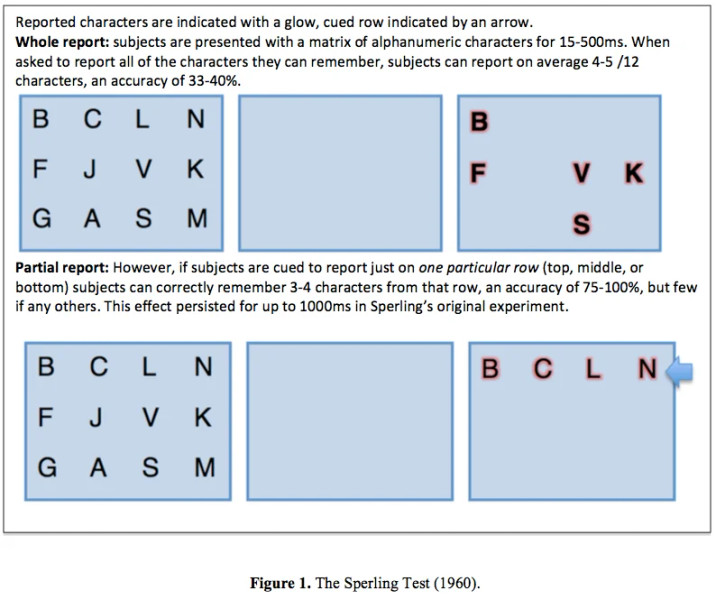
Sperling’s partial-report study
Short-term memory
Short-term memory is temporary conscious storage.
- Duration is about 15 to 30 seconds without rehearsal.
- Capacity is limited.
- Classic idea: Miller’s 7 ± 2
- More recent work often finds it’s closer to about 4 chunks
A chunk is a meaningful unit. For example, remembering 1 7 7 6 as “1776” uses chunking and saves space.
The Peterson and Peterson study showed how quickly short-term memory fades when rehearsal is blocked. Participants had to remember consonants while counting backward, and recall dropped fast.
Working memory
This is one of the most tested distinctions. Short-term memory is brief holding. Working memory is holding and using information.
Examples:
- doing mental math
- following multistep directions
- rearranging digits in your head
Baddeley and Hitch described working memory with parts:
- Central executive directs attention
- Phonological loop handles verbal and auditory information
- Visuospatial sketchpad handles visual and spatial information
Many diagrams also include the episodic buffer, which helps integrate information across the system.
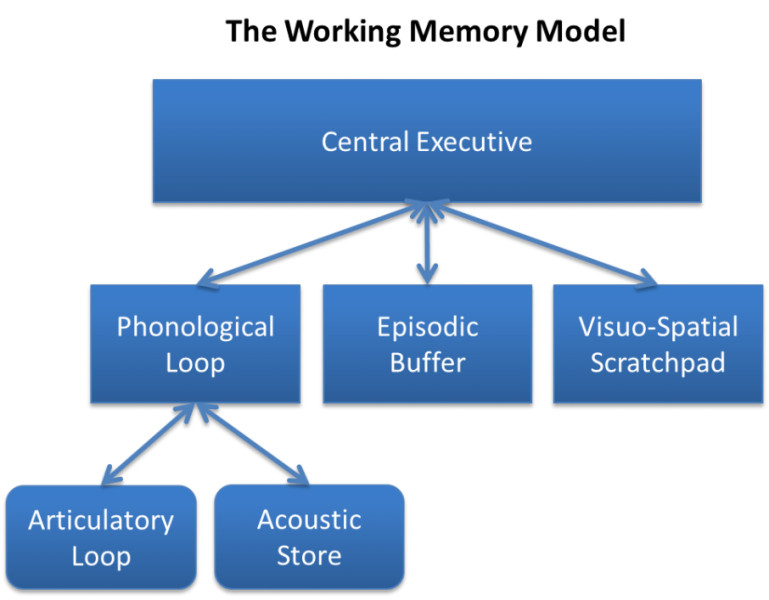
Baddeley and Hitch’s working memory model
Long-term memory
Long-term memory is relatively permanent storage, from hours to a lifetime, with essentially unlimited capacity.
It includes:
- Semantic memory for facts and concepts
- Episodic memory for personal events
- Procedural memory for skills
This is not a literal file cabinet. Memories are spread across neural networks. The hippocampus is especially important for forming many new explicit long-term memories.
How Information Stays in Memory
Information often moves like this:
- sensory input enters sensory memory
- attention selects some of it
- it enters short-term or working memory
- if retained, it becomes long-term memory
Working memory also pulls stored knowledge back from long-term memory when you think.
Two biology ideas matter here:
- Long-term potentiation means repeated neural firing strengthens synaptic connections.
- Consolidation helps stabilize memories over time.
Stronger storage usually comes from meaningful processing, not just being exposed to something.
Rehearsal and Stronger Retention
Maintenance rehearsal
This is rote repetition. You repeat a phone number or code to keep it active.
It helps mostly with short-term retention. If no meaning is added, it is weaker for lasting long-term memory.
Elaborative rehearsal
This is much stronger for long-term storage. You connect new information to:
- prior knowledge
- meaning
- imagery
- examples
- categories
- personal experience
If a test question says someone explains, connects, visualizes, or personalizes information, that is elaborative rehearsal.
Autobiographical Memory and Exceptional Memory
Autobiographical memory
This is memory for your own life. It includes:
- episodic memories of events
- semantic knowledge about yourself
The self-reference effect means information tied to yourself is remembered especially well. That happens because self-related processing usually creates more elaboration.
Highly superior autobiographical memory
HSAM, or hyperthymesia, is exceptional recall for personal life events and dates.
Important limit: it does not mean perfect memory in every area. Research suggests biological contributions, but those findings usually come from case studies and correlational research, so they cannot prove cause and effect.
When Storage Is Impaired or Limited
Amnesia
Amnesia is major memory loss or inability to form memories.
- Retrograde amnesia is loss of memories from before injury.
- Anterograde amnesia is inability to form new long-term explicit memories after injury.
Patient H.M. (Henry Molaison) had hippocampal and medial temporal lobe damage. He could hold information briefly, but he could not form new explicit long-term memories. He still improved at mirror tracing, which showed procedural memory can stay intact.
Alzheimer’s disease
This is a progressive neurodegenerative disorder, not normal aging. Early damage often affects the hippocampus, so forming new episodic memories becomes difficult. Recent memories usually decline before older ones. Later, language, judgment, orientation, and daily functioning are affected.
Infantile amnesia
This is the inability of older children and adults to recall very early autobiographical episodes. Most adults have few true episodic memories from before about age 3.
This does not mean infants cannot learn. Likely causes include an immature hippocampus, limited language, and an undeveloped self-concept.
Key Takeaways
Memory Storage
The retention of encoded information over time
Sensory Memory
The immediate, extremely brief retention of detailed sensory information after a stimulus ends
Iconic Memory
Sensory memory for visual information, generally lasting about 0.2 to 0.5 seconds
Echoic Memory
Sensory memory for auditory information, generally lasting about 3 to 4 seconds
Sperling’s Partial-Report Experiment
After briefly showing a letter array, Sperling used a tone to cue one row; accurate reports showed that iconic memory briefly holds extensive visual information before rapidly decaying
Short-Term Memory
The limited-capacity storage of information in conscious awareness for about 15 to 30 seconds without rehearsal
Peterson and Peterson Procedure
Participants recalled consonant trigrams after counting backward to prevent rehearsal; recall declined as the delay increased, demonstrating rapid loss from short-term memory
Working Memory
A limited-capacity system that temporarily holds and actively manipulates information during thinking
Long-Term Memory
The relatively enduring, essentially unlimited storage of information for periods ranging from hours to a lifetime
Long-Term Potentiation
The strengthening of synaptic connections after repeated activation, a biological mechanism associated with memory storage
Maintenance Rehearsal
Rote repetition that keeps information active in short-term memory without adding meaning
Elaborative Rehearsal
Connecting new information with meaning, prior knowledge, imagery, examples, categories, or personal experience to improve long-term retention
Autobiographical Memory
Memory for information connected to one’s own life, including personal experiences and knowledge about oneself
Self-Reference Effect
The tendency to remember information better when it is connected to oneself
Highly Superior Autobiographical Memory (HSAM)/Hyperthymesia
The unusual ability to recall personal experiences and their dates with exceptional detail, without having perfect memory for everything
Amnesia
A significant loss of memory or ability to form memories, often associated with brain injury, disease, surgery, or severe psychological trauma
Retrograde Amnesia
Loss of memories formed before the onset of an injury or disorder
Anterograde Amnesia
An inability or severe difficulty forming new long-term memories after the onset of an injury or disorder
Henry Molaison (Patient H.M.)
A patient whose medial temporal lobe surgery caused profound anterograde amnesia while sparing brief retention and some procedural learning, revealing distinct memory systems
Alzheimer’s Disease
A progressive neurodegenerative disorder that damages memory and other cognitive abilities, often affecting new episodic learning before remote memories
Infantile Amnesia/Childhood Amnesia
The ordinary inability of older children and adults to recall autobiographical episodes from the earliest years of life, especially before about age 3
Notes
Memory Storage
The retention of encoded information over time
Sensory Memory
The immediate, extremely brief retention of detailed sensory information after a stimulus ends
Iconic Memory
Sensory memory for visual information, generally lasting about 0.2 to 0.5 seconds
Echoic Memory
Sensory memory for auditory information, generally lasting about 3 to 4 seconds
Sperling’s Partial-Report Experiment
After briefly showing a letter array, Sperling used a tone to cue one row; accurate reports showed that iconic memory briefly holds extensive visual information before rapidly decaying
Short-Term Memory
The limited-capacity storage of information in conscious awareness for about 15 to 30 seconds without rehearsal
Peterson and Peterson Procedure
Participants recalled consonant trigrams after counting backward to prevent rehearsal; recall declined as the delay increased, demonstrating rapid loss from short-term memory
Working Memory
A limited-capacity system that temporarily holds and actively manipulates information during thinking
Long-Term Memory
The relatively enduring, essentially unlimited storage of information for periods ranging from hours to a lifetime
Long-Term Potentiation
The strengthening of synaptic connections after repeated activation, a biological mechanism associated with memory storage
Maintenance Rehearsal
Rote repetition that keeps information active in short-term memory without adding meaning
Elaborative Rehearsal
Connecting new information with meaning, prior knowledge, imagery, examples, categories, or personal experience to improve long-term retention
Autobiographical Memory
Memory for information connected to one’s own life, including personal experiences and knowledge about oneself
Self-Reference Effect
The tendency to remember information better when it is connected to oneself
Highly Superior Autobiographical Memory (HSAM)/Hyperthymesia
The unusual ability to recall personal experiences and their dates with exceptional detail, without having perfect memory for everything
Amnesia
A significant loss of memory or ability to form memories, often associated with brain injury, disease, surgery, or severe psychological trauma
Retrograde Amnesia
Loss of memories formed before the onset of an injury or disorder
Anterograde Amnesia
An inability or severe difficulty forming new long-term memories after the onset of an injury or disorder
Henry Molaison (Patient H.M.)
A patient whose medial temporal lobe surgery caused profound anterograde amnesia while sparing brief retention and some procedural learning, revealing distinct memory systems
Alzheimer’s Disease
A progressive neurodegenerative disorder that damages memory and other cognitive abilities, often affecting new episodic learning before remote memories
Infantile Amnesia/Childhood Amnesia
The ordinary inability of older children and adults to recall autobiographical episodes from the earliest years of life, especially before about age 3
