Topic 3.7 Notes – Classical Conditioning
Classical Conditioning and the Behaviorist View
Classical conditioning is learning by association between two stimuli. One stimulus starts out neutral, then becomes a signal that predicts another stimulus and triggers a response.
A quick foundation:
- A stimulus is any event or object that affects an organism.
- A response is the organism’s reaction.
This idea fits the behavioral perspective, which grew out of behaviorism. Behaviorists cared most about observable behavior and how the environment shapes it. They did not center their work on hidden mental processes like thoughts or feelings.
Classical conditioning usually involves responses that are:
- automatic like salivation or blinking
- emotional like fear
- physiological like sweating or increased heart rate
- reflexive rather than chosen on purpose
That helps you separate it from operant conditioning. In classical conditioning, you link stimulus with stimulus. In operant conditioning, you link behavior with consequence.
Key names to know:
- Ivan Pavlov studied dogs and salivation.
- John B. Watson helped build behaviorism and showed emotional conditioning.
The Core Parts of Classical Conditioning
The four terms together
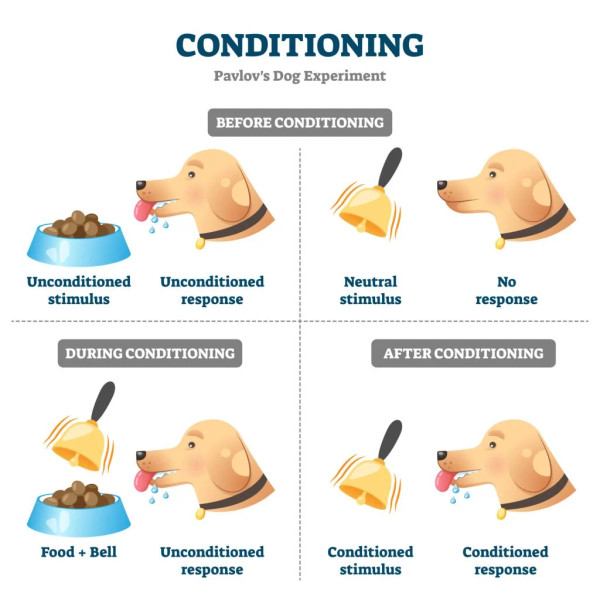
These terms only make sense as a set, so keep them connected. Pavlov’s dog setup is the classic way to see how they fit together:
- UCS = unconditioned stimulus
Naturally triggers a response. - UCR = unconditioned response
Automatic, unlearned response to the UCS. - NS = neutral stimulus
Starts out not causing the target response. - CS = conditioned stimulus
Formerly neutral stimulus that gains meaning through association. - CR = conditioned response
Learned response to the CS.
Pavlov’s dogs
The diagram breaks the process into before, during, and after conditioning:
Before conditioning
- Food = UCS
- Salivation to food = UCR
- Bell = NS
During conditioning
- Bell comes before food
- Repeated pairings build the association
After conditioning
- Bell becomes CS
- Salivation to bell becomes CR
A common trap is mixing up UCR and CR. They may look the same, but the label depends on what caused them.
Fast identification rule
When you see an example, ask:
- What naturally causes the response? That is the UCS.
- What is the automatic response to it? That is the UCR.
- What used to be neutral but now predicts the UCS? That is the CS.
- What is the learned response to that cue? That is the CR.
How Conditioning Is Learned and Changed
Acquisition is the learning phase. The NS becomes a CS because it predicts the UCS. The key detail the AP exam likes is order. The CS should come before the UCS and signal it. You do not need the labels delayed, trace, simultaneous, or backward conditioning for AP Psych.
A data pattern for acquisition shows the CR rising across trials, then leveling off.
Extinction happens when the CS is presented without the UCS over and over, so the CR weakens. The original UCS → UCR relationship still exists.
Spontaneous recovery means the CR comes back after extinction if there is a rest period and the CS appears again. It usually returns weaker.
Higher-order conditioning means an already learned CS can help condition a new neutral stimulus. If tone predicts food, and then light predicts tone, the light may also trigger salivation.
How Responses Spread or Become Selective
Stimulus generalization means stimuli similar to the CS also trigger the CR. A dog conditioned to one tone may respond to similar tones too. This is adaptive because similar cues may mean the same thing.
Stimulus discrimination means learning to respond only to the specific CS. If only one tone predicts food, the organism responds mainly to that tone.
Little Albert as the classic emotional example
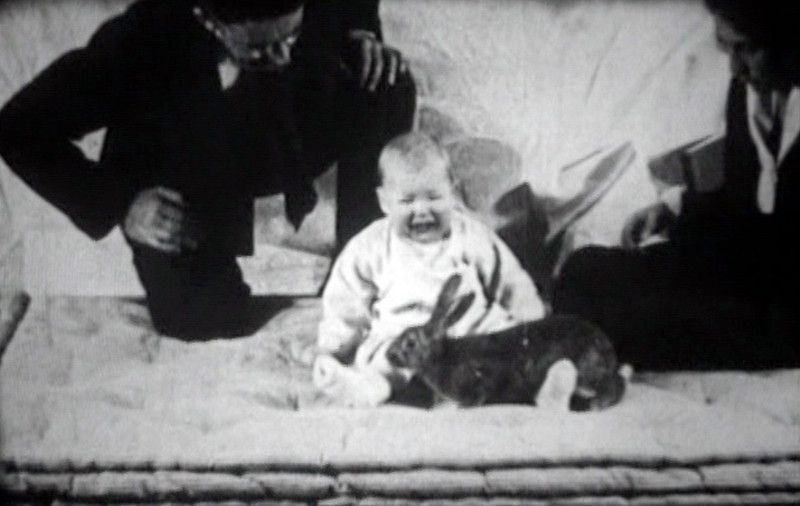
Watson and Rosalie Rayner showed that emotions can be classically conditioned:
- Loud noise = UCS
- Fear/startle to noise = UCR
- White rat = NS, later CS
- Fear of rat = CR
Little Albert experiment
In the well-known image from the study, Albert reacts with distress in the presence of a furry animal. He also feared other furry objects, which showed generalization. This study is also a major ethics problem and would not meet modern standards.
Special Cases and Why This Matters
Counterconditioning replaces an unwanted CR with a new, incompatible response. A feared object might be paired with relaxation, which is why this idea matters for therapy.
Taste aversion is a special kind of classical conditioning shown by John Garcia. If a flavor is followed by illness, an organism may avoid that flavor after just one pairing. This is one-trial conditioning.
Taste aversion also shows biological preparedness. Organisms are biologically ready to learn some associations faster than others, especially ones with survival value like avoiding poison.
Habituation is different. It means a reduced response to a repeated or constant stimulus, like stopping notice of a background hum. There is no pairing of two stimuli, so it is not classical conditioning, and it is also not extinction.
Common data patterns:
- rising CR = acquisition
- falling CR with CS alone = extinction
- return after break = spontaneous recovery
- response to similar stimuli = generalization
- response mainly to one specific cue = discrimination
Key Takeaways
Behavioral Perspective
The perspective that psychology should focus on observable, measurable behavior and how environmental events shape it through conditioning
Associative Learning
Learning that events or stimuli occur together, allowing one to predict another
Classical Conditioning
Associative learning in which one stimulus becomes associated with another and comes to elicit a response
Pavlov’s Classical Conditioning Demonstration (Ivan Pavlov)
Pavlov showed that dogs learned to salivate to a tone after the tone repeatedly preceded food
Neutral Stimulus (NS)
Before conditioning, a stimulus that does not yet elicit the target response
Unconditioned Stimulus (UCS)
A stimulus that naturally and automatically elicits a response without prior learning
Unconditioned Response (UCR)
The unlearned, automatic response elicited by an unconditioned stimulus
Conditioned Stimulus (CS)
A previously neutral stimulus that elicits a learned response after being associated with the UCS.
Conditioned Response (CR)
The learned response elicited by the conditioned stimulus
Acquisition
The formation of the association in which an initially neutral stimulus becomes a CS and begins eliciting a CR.
Extinction
The weakening and eventual disappearance of a CR when the CS is repeatedly presented without the UCS.
Spontaneous Recovery
The return of an extinguished CR when the CS is presented after a pause
Stimulus Generalization
The tendency for stimuli resembling the original CS to also elicit the CR.
Stimulus Discrimination
The learned ability to distinguish the CS from other stimuli and respond selectively to it
Higher-Order Conditioning
Conditioning in which an established CS is used like a UCS to make a new neutral stimulus into another CS.
Conditioned Emotional Response
A learned emotional reaction elicited by a previously neutral stimulus after it is paired with an emotion-producing event
Little Albert Study (John B. Watson and Rosalie Rayner)
Watson and Rayner conditioned fear in an infant by pairing a white rat with a frightening noise, with fear later generalizing to similar furry objects
Counterconditioning
Replacing an unwanted conditioned response by establishing a different, more adaptive response to the CS.
Taste Aversion
A learned avoidance of a food or flavor that has been associated with nausea or illness
Garcia’s Taste-Aversion Research (John Garcia)
Garcia showed that rats could avoid a flavor after one flavor-illness pairing, demonstrating one-trial conditioning and biological preparedness
One-Trial Conditioning (One-Trial Learning)
Acquiring an association through one pairing without the association being strengthened by further pairings
Biological Preparedness
An inherited predisposition to learn some stimulus-response associations more readily than others
Habituation
A diminished response caused by repeated or enduring exposure to a stimulus
Notes
Behavioral Perspective
The perspective that psychology should focus on observable, measurable behavior and how environmental events shape it through conditioning
Associative Learning
Learning that events or stimuli occur together, allowing one to predict another
Classical Conditioning
Associative learning in which one stimulus becomes associated with another and comes to elicit a response
Pavlov’s Classical Conditioning Demonstration (Ivan Pavlov)
Pavlov showed that dogs learned to salivate to a tone after the tone repeatedly preceded food
Neutral Stimulus (NS)
Before conditioning, a stimulus that does not yet elicit the target response
Unconditioned Stimulus (UCS)
A stimulus that naturally and automatically elicits a response without prior learning
Unconditioned Response (UCR)
The unlearned, automatic response elicited by an unconditioned stimulus
Conditioned Stimulus (CS)
A previously neutral stimulus that elicits a learned response after being associated with the UCS.
Conditioned Response (CR)
The learned response elicited by the conditioned stimulus
Acquisition
The formation of the association in which an initially neutral stimulus becomes a CS and begins eliciting a CR.
Extinction
The weakening and eventual disappearance of a CR when the CS is repeatedly presented without the UCS.
Spontaneous Recovery
The return of an extinguished CR when the CS is presented after a pause
Stimulus Generalization
The tendency for stimuli resembling the original CS to also elicit the CR.
Stimulus Discrimination
The learned ability to distinguish the CS from other stimuli and respond selectively to it
Higher-Order Conditioning
Conditioning in which an established CS is used like a UCS to make a new neutral stimulus into another CS.
Conditioned Emotional Response
A learned emotional reaction elicited by a previously neutral stimulus after it is paired with an emotion-producing event
Little Albert Study (John B. Watson and Rosalie Rayner)
Watson and Rayner conditioned fear in an infant by pairing a white rat with a frightening noise, with fear later generalizing to similar furry objects
Counterconditioning
Replacing an unwanted conditioned response by establishing a different, more adaptive response to the CS.
Taste Aversion
A learned avoidance of a food or flavor that has been associated with nausea or illness
Garcia’s Taste-Aversion Research (John Garcia)
Garcia showed that rats could avoid a flavor after one flavor-illness pairing, demonstrating one-trial conditioning and biological preparedness
One-Trial Conditioning (One-Trial Learning)
Acquiring an association through one pairing without the association being strengthened by further pairings
Biological Preparedness
An inherited predisposition to learn some stimulus-response associations more readily than others
Habituation
A diminished response caused by repeated or enduring exposure to a stimulus
