Topic 2.7 Notes – Forgetting and Other Memory Challenges
Why Memories Fail
A quick reminder first. For a memory to work, information has to be encoded (get into memory), stored (kept over time), and retrieved (brought back out). Problems can happen at any point.
Two outcomes matter here:
- Forgetting means you cannot retrieve the information.
- Memory error means you retrieve something, but it is inaccurate or false.
That difference shows up a lot on tests. A student who blanks on a term has a different problem from a student who confidently gives the wrong definition.
The main explanations you need to know are:
- encoding failure
The memory never got formed well in the first place. - forgetting over time
Retention drops, especially soon after learning. - interference
Other memories get in the way. - retrieval failure
The memory is there, but you cannot access it right then. - repression
Freud’s psychodynamic idea that distressing memories are pushed out of awareness unconsciously. - constructive memory errors
Memory gets rebuilt and can be changed by schemas, suggestion, or imagination.
Main Causes of Forgetting
The forgetting curve
Hermann Ebbinghaus studied memory with nonsense syllables so meaning would not help. He measured forgetting by seeing how much he remembered later and how quickly he could relearn the list.
That work led to the forgetting curve, which shows a steep drop in retention soon after learning and then a slower decline over time.
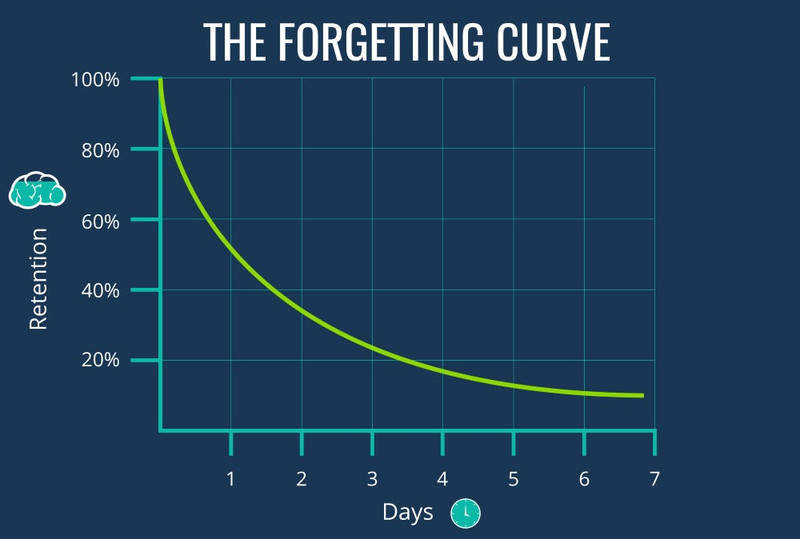
What the curve shows:
- Forgetting is fastest right after learning.
- The loss then slows down and the curve flattens.
- Relearning is faster than original learning, which shows some memory remains.
- The curve shows time is linked to forgetting, but it does not prove that time alone erases memory.
- Spacing effect and distributed practice help slow this loss.
Encoding failure
With encoding failure, the information never became a durable long-term memory.
Common causes:
- inattention
- shallow processing
- divided attention
- little rehearsal
A classic example is a common object or sign you see all the time but cannot describe in detail. You were exposed to it, but exposure alone is not enough.
Interference
Interference happens when memories compete, especially if they are similar.
- Proactive interference
Old information messes up new information.
Example: your old password keeps popping up when you try to enter the new one. - Retroactive interference
New information messes up old information.
Example: after learning the new password, the old one becomes hard to remember.
Shortcut that helps on tests:
- proactive = old forward onto new
- retroactive = new backward onto old
Retrieval failure
Sometimes the memory is stored, but you cannot reach it. That is retrieval failure.
- Usually this happens because retrieval cues are weak or missing.
- Recognition is easier than recall because recognition gives you cues.
Tip-of-the-tongue
This is a classic retrieval failure.
- You feel sure you know it.
- You may remember the first letter, number of syllables, or a similar word.
- That partial access shows the memory may still exist.
Repression
Repression is Freud’s idea that distressing memories are unconsciously pushed out of awareness to protect the ego.
Be careful here:
- It is unconscious.
- It is different from suppression, which is deliberate.
- On AP Psych, treat repression as a psychodynamic theory, not a universally proven memory mechanism.
When Memory Becomes Inaccurate
Constructive memory
Memory is reconstructed, not played back like a video recording. Each time a memory is consolidated and stored again, schemas, expectations, and later information can fill in gaps.
That means:
- false memory is different from lying
- confidence does not guarantee accuracy
Misinformation effect
The misinformation effect happens when misleading information after an event changes later memory.
Elizabeth Loftus and Palmer showed this with car crash studies, where changing a single verb changed how fast people thought the cars were going.
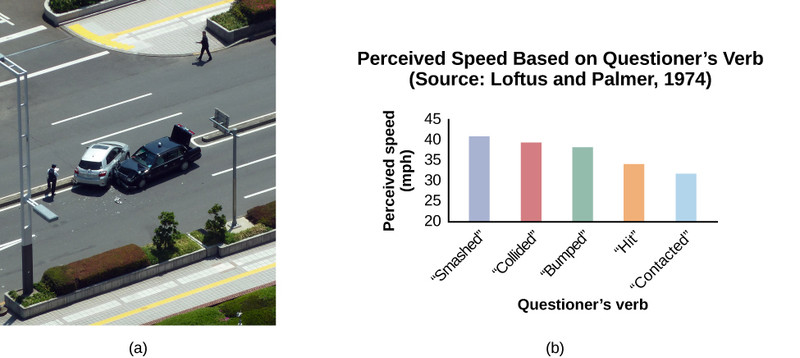
Loftus and Palmer misinformation effect study
Key points:
- Independent variable = wording of the question
- Dependent variables = speed estimate and later memory report
- “Smashed” led to higher speed estimates than “hit”
- People later falsely remembered broken glass that was never there
Source amnesia
With source amnesia, you remember the information but forget where it came from. This is also called a source-monitoring error.
Example: you remember a detail from a rumor or news story as if you personally witnessed it.
Imagination inflation
Imagination inflation means imagining an event can increase confidence that it really happened.
- Repeated visualization makes the event feel familiar and believable.
- Later, imagined details may get confused with real experience.
How to Tell These Apart on a Test
- Never learned it in the first place = encoding failure
- Forgot a lot soon after studying = forgetting curve
- Old messes up new = proactive interference
- New messes up old = retroactive interference
- Know it but cannot pull it up = retrieval failure
- Partial clues and strong feeling of knowing = tip-of-the-tongue
- Distressing memory kept out unconsciously = repression
- Later suggestion changes memory = misinformation effect
- Remember the detail but not its origin = source amnesia
- Imagined event starts feeling real = imagination inflation
Key Takeaways
Forgetting Curve
The pattern in which retention declines rapidly soon after learning and then levels off over time
Encoding Failure
Failure to form a retrievable long-term memory because information was not adequately encoded
Retrieval Failure
The inability to access stored information at a particular moment, often because effective retrieval cues are absent
Tip-of-the-Tongue Phenomenon
A temporary inability to retrieve stored information despite partial access and a strong feeling that recall is close
Interference
Competition between sets of information that makes learning or accurate retrieval more difficult
Proactive Interference
Interference in which older information disrupts the learning or retrieval of newer information
Retroactive Interference
Interference in which newer information disrupts the retrieval of older information
Repression
The psychodynamic defense mechanism that unconsciously keeps distressing thoughts, feelings, or memories out of awareness
Constructive Memory
The rebuilding of a memory from stored information, schemas, expectations, and later information rather than replaying an exact recording
Memory Consolidation
The process through which a newly encoded memory becomes stable and integrated into long-term storage
Reconsolidation
The restabilization of a retrieved memory after it becomes temporarily open to updating or modification
Misinformation Effect
The alteration of a later memory report by misleading information encountered after an event
Source Amnesia
Remembering information while forgetting or misidentifying where that information originated
Imagination Inflation
An increase in confidence that an event occurred after the event has been imagined
Notes
Forgetting Curve
The pattern in which retention declines rapidly soon after learning and then levels off over time
Encoding Failure
Failure to form a retrievable long-term memory because information was not adequately encoded
Retrieval Failure
The inability to access stored information at a particular moment, often because effective retrieval cues are absent
Tip-of-the-Tongue Phenomenon
A temporary inability to retrieve stored information despite partial access and a strong feeling that recall is close
Interference
Competition between sets of information that makes learning or accurate retrieval more difficult
Proactive Interference
Interference in which older information disrupts the learning or retrieval of newer information
Retroactive Interference
Interference in which newer information disrupts the retrieval of older information
Repression
The psychodynamic defense mechanism that unconsciously keeps distressing thoughts, feelings, or memories out of awareness
Constructive Memory
The rebuilding of a memory from stored information, schemas, expectations, and later information rather than replaying an exact recording
Memory Consolidation
The process through which a newly encoded memory becomes stable and integrated into long-term storage
Reconsolidation
The restabilization of a retrieved memory after it becomes temporarily open to updating or modification
Misinformation Effect
The alteration of a later memory report by misleading information encountered after an event
Source Amnesia
Remembering information while forgetting or misidentifying where that information originated
Imagination Inflation
An increase in confidence that an event occurred after the event has been imagined
