Topic 1.5 Notes – Sleep
Sleep and the Sleep-Wake Cycle
Consciousness means your awareness of thoughts, feelings, behavior, and what’s happening inside and outside you. That awareness changes. Wakefulness and sleep are two different states of consciousness.
Sleep is:
- biological because body systems regulate it
- active because the brain keeps working in patterned ways
- reversible because you can wake up
Your sleep/wake cycle is a circadian rhythm, a body rhythm that runs about every 24 hours. It helps time:
- sleepiness and alertness
- body temperature
- when you feel ready to sleep or wake
Light is the biggest cue that sets, or entrains, this rhythm. Meals, exercise, and routines also help. Melatonin rises in darkness and helps regulate sleep timing.
A common confusion is sleep pressure versus circadian timing:
- Sleep pressure builds the longer you stay awake.
- Circadian timing creates daily highs and lows in alertness.
So performance can drop because you’ve been awake too long, because your body clock says “sleep now,” or both.
Circadian disruption
- Jet lag happens when you cross time zones and your internal clock no longer matches local time.
- Shift work forces wakefulness during your biological sleep time. Rotating shifts are especially rough because the body keeps having to reset.
Daytime effects often show up on tests as application examples:
- fatigue
- irritability
- slower reaction time
- weaker attention, judgment, learning, and memory
Sleep Stages and Brain-Wave Patterns
Sleep is mainly measured with EEG, which records brain-wave activity. In sleep labs, polysomnography may also include:
- EOG for eye movements
- EMG for muscle tension
Across a typical night, sleep moves through repeating cycles instead of staying in one stage.
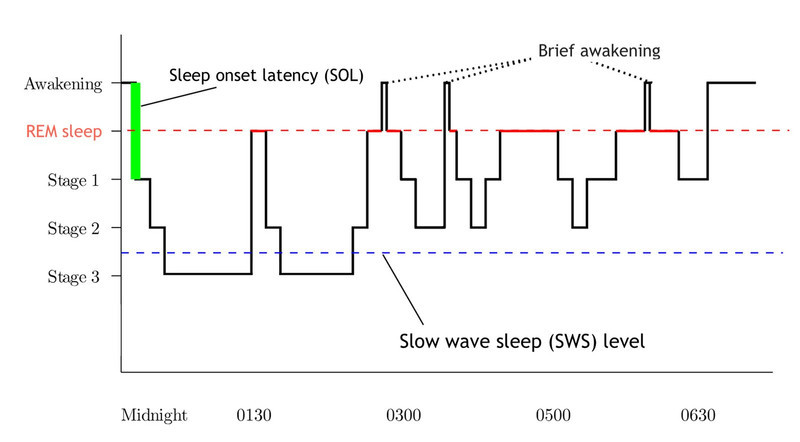
Typical sleep cycles across one night
One full sleep cycle lasts about 90 minutes and repeats through the night. Early cycles have more deep NREM Stage 3. Later cycles have more REM.
Wakefulness and NREM stages
- Alert wakefulness shows beta waves
- Relaxed wakefulness shows alpha waves
- Stage 1 NREM shows theta waves
- light sleep
- hypnagogic sensations can happen here, like feeling like you’re falling
- hypnic jerks are sudden body jerks as you drift off
- Stage 2 NREM
- clearly asleep
- marked by sleep spindles and K-complexes
- Stage 3 NREM
- delta waves
- deep slow-wave sleep
- hardest to wake from
- linked to physical restoration
- somnambulism happens here
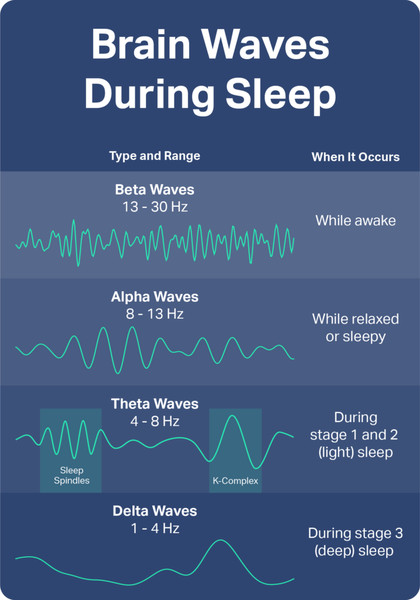
EEG patterns in wakefulness and NREM sleep
REM sleep
REM means rapid eye movement sleep. Brain waves look wake-like, but the body is deeply relaxed because of skeletal-muscle atonia. That’s why REM is called paradoxical sleep.
In the night-long sleep graph above, REM periods become longer toward morning.
Key REM facts:
- dreams are most frequent and vivid here
- dreaming can happen outside REM too
- REM periods get longer later in the night
- REM rebound means extra REM after REM deprivation
Dreams and Why Sleep Happens
Dreams are sequences of images, thoughts, emotions, and sensations during sleep.
Theories of dreams
- Activation-synthesis theory says the brain is trying to make sense of internal neural activity, especially during REM.
- Consolidation theory of dreams says dream content reflects memory processing and recent experiences being integrated.
Psychoanalytic dream theory is outside AP exam scope here.
Why sleep occurs
Two main ideas matter, and they work together:
- Memory consolidation strengthens and stabilizes new learning.
- Restoration helps the body and mind recover resources used during the day.
Sleep loss hurts:
- attention
- memory
- decision-making
- reaction time
- mood
- physical performance
People often underestimate how impaired they are when sleep deprived. That gets tested a lot in scenario questions.
Sleep Disorders You Must Know
| Disorder | What it is | Key detail |
|---|---|---|
| Insomnia | Ongoing trouble falling asleep, staying asleep, or getting restful sleep | Not the same as choosing to stay up |
| Narcolepsy | Excessive daytime sleepiness and sudden sleep attacks | May enter REM unusually fast |
| REM sleep behavior disorder | Loss of normal REM atonia | Person acts out dreams during REM |
| Sleep apnea | Repeated breathing interruptions during sleep | Snoring, gasping, fragmented sleep, daytime sleepiness |
| Somnambulism | Sleepwalking | Happens in deep Stage 3 NREM, not REM |
Treatment and regular sleep schedules can improve daytime functioning and well-being.
Key Takeaways
Consciousness
An individual’s varying awareness of thoughts, feelings, behavior, and events in the internal and external worlds
Sleep
A recurring, biologically active, and reversible state of consciousness with reduced awareness and responsiveness
Sleep/Wake Cycle
The circadian pattern regulating when sleep and wakefulness tend to occur across the day and night
Circadian Rhythm
A biological pattern that repeats about once every 24 hours and helps regulate sleepiness, alertness, and related processes
Entrainment
Synchronization of an internal circadian rhythm with environmental cues, especially light and regular daily routines
Sleep Pressure
The increasing immediate need for sleep that develops the longer a person remains awake
Jet Lag
Circadian misalignment caused by rapid travel across time zones, producing sleepiness or alertness at inappropriate local times
Shift Work
A work schedule that can require wakefulness and sleep at times that conflict with circadian signals
Electroencephalogram (EEG)
A scalp recording of the combined electrical activity of large groups of brain cells, used to identify sleep stages
Polysomnography
A laboratory sleep recording that combines EEG with measures such as eye movements, muscle activity, breathing, and heart rate
Hypnogram
A graph showing movement among wakefulness, NREM stages, and REM sleep over time
Sleep Cycle
The roughly 90-minute progression through NREM sleep toward REM sleep that repeats several times per night
Beta Waves
Relatively fast, low-amplitude EEG activity associated with alert wakefulness
Alpha Waves
EEG activity associated with relaxed wakefulness, especially when the eyes are closed
Theta Waves
EEG activity characteristic of NREM Stage 1 and underlying the distinctive events of NREM Stage 2
Sleep Spindles
Brief bursts of rapid, rhythmic EEG activity that help identify NREM Stage 2
K-Complexes
Large, isolated EEG waves occurring spontaneously or in response to stimulation during NREM Stage 2
Delta Waves
High-amplitude, low-frequency EEG waves characteristic of deep NREM Stage 3 sleep
NREM Sleep
Non-rapid-eye-movement sleep comprising Stages 1 through 3, whose duration—especially Stage 3—generally decreases across the night
NREM Stage 1
The brief, lightest sleep stage marking the transition from wakefulness, with fading awareness and theta activity
Hypnagogic Sensations
Falling, floating, dreamlike, or jerking sensations experienced while entering initial NREM Stage 1 sleep
NREM Stage 2
A sleep stage characterized by theta activity interrupted by sleep spindles and K-complexes
NREM Stage 3 (Deep, Slow-Wave Sleep)
The deepest NREM stage, marked by delta waves, difficult awakening, and concentration early in the night
REM Sleep (Paradoxical Sleep)
Rapid-eye-movement sleep in which wake-like brain activity and vivid dreaming occur while skeletal muscles are strongly relaxed
REM Rebound
The tendency to enter REM sooner or spend more time in REM after being deprived of REM sleep
Activation-Synthesis Theory
The theory that dreams arise as the brain organizes and interprets internally generated neural activity into a narrative
Consolidation Theory of Dreams
The theory that dreaming reflects the sleeping brain’s processing, organizing, and integrating of recent experiences and memories
Memory Consolidation
The organization and stabilization of newly acquired information for later use, a process supported by sleep
Restoration Theory
The theory that sleep restores physical and mental resources depleted during waking activity
Sleep Deprivation
Insufficient sleep that can impair attention, reaction time, judgment, learning, memory, mood, and physical performance
Insomnia
Recurring difficulty falling asleep, staying asleep, or obtaining restorative sleep, with negative waking consequences
Narcolepsy
A disorder involving excessive daytime sleepiness and sudden, difficult-to-control sleep attacks, sometimes with unusually rapid entry into REM.
REM Sleep Behavior Disorder
A disorder in which normal REM muscle atonia is reduced or absent, allowing a sleeper to act out dream content
Sleep Apnea
A disorder involving repeated breathing interruptions that fragment sleep and may reduce blood oxygen
Somnambulism (Sleepwalking)
Walking or performing familiar actions while largely unresponsive during deep NREM Stage 3 sleep, usually with little later memory
Notes
Consciousness
An individual’s varying awareness of thoughts, feelings, behavior, and events in the internal and external worlds
Sleep
A recurring, biologically active, and reversible state of consciousness with reduced awareness and responsiveness
Sleep/Wake Cycle
The circadian pattern regulating when sleep and wakefulness tend to occur across the day and night
Circadian Rhythm
A biological pattern that repeats about once every 24 hours and helps regulate sleepiness, alertness, and related processes
Entrainment
Synchronization of an internal circadian rhythm with environmental cues, especially light and regular daily routines
Sleep Pressure
The increasing immediate need for sleep that develops the longer a person remains awake
Jet Lag
Circadian misalignment caused by rapid travel across time zones, producing sleepiness or alertness at inappropriate local times
Shift Work
A work schedule that can require wakefulness and sleep at times that conflict with circadian signals
Electroencephalogram (EEG)
A scalp recording of the combined electrical activity of large groups of brain cells, used to identify sleep stages
Polysomnography
A laboratory sleep recording that combines EEG with measures such as eye movements, muscle activity, breathing, and heart rate
Hypnogram
A graph showing movement among wakefulness, NREM stages, and REM sleep over time
Sleep Cycle
The roughly 90-minute progression through NREM sleep toward REM sleep that repeats several times per night
Beta Waves
Relatively fast, low-amplitude EEG activity associated with alert wakefulness
Alpha Waves
EEG activity associated with relaxed wakefulness, especially when the eyes are closed
Theta Waves
EEG activity characteristic of NREM Stage 1 and underlying the distinctive events of NREM Stage 2
Sleep Spindles
Brief bursts of rapid, rhythmic EEG activity that help identify NREM Stage 2
K-Complexes
Large, isolated EEG waves occurring spontaneously or in response to stimulation during NREM Stage 2
Delta Waves
High-amplitude, low-frequency EEG waves characteristic of deep NREM Stage 3 sleep
NREM Sleep
Non-rapid-eye-movement sleep comprising Stages 1 through 3, whose duration—especially Stage 3—generally decreases across the night
NREM Stage 1
The brief, lightest sleep stage marking the transition from wakefulness, with fading awareness and theta activity
Hypnagogic Sensations
Falling, floating, dreamlike, or jerking sensations experienced while entering initial NREM Stage 1 sleep
NREM Stage 2
A sleep stage characterized by theta activity interrupted by sleep spindles and K-complexes
NREM Stage 3 (Deep, Slow-Wave Sleep)
The deepest NREM stage, marked by delta waves, difficult awakening, and concentration early in the night
REM Sleep (Paradoxical Sleep)
Rapid-eye-movement sleep in which wake-like brain activity and vivid dreaming occur while skeletal muscles are strongly relaxed
REM Rebound
The tendency to enter REM sooner or spend more time in REM after being deprived of REM sleep
Activation-Synthesis Theory
The theory that dreams arise as the brain organizes and interprets internally generated neural activity into a narrative
Consolidation Theory of Dreams
The theory that dreaming reflects the sleeping brain’s processing, organizing, and integrating of recent experiences and memories
Memory Consolidation
The organization and stabilization of newly acquired information for later use, a process supported by sleep
Restoration Theory
The theory that sleep restores physical and mental resources depleted during waking activity
Sleep Deprivation
Insufficient sleep that can impair attention, reaction time, judgment, learning, memory, mood, and physical performance
Insomnia
Recurring difficulty falling asleep, staying asleep, or obtaining restorative sleep, with negative waking consequences
Narcolepsy
A disorder involving excessive daytime sleepiness and sudden, difficult-to-control sleep attacks, sometimes with unusually rapid entry into REM.
REM Sleep Behavior Disorder
A disorder in which normal REM muscle atonia is reduced or absent, allowing a sleeper to act out dream content
Sleep Apnea
A disorder involving repeated breathing interruptions that fragment sleep and may reduce blood oxygen
Somnambulism (Sleepwalking)
Walking or performing familiar actions while largely unresponsive during deep NREM Stage 3 sleep, usually with little later memory
