Topic 2.1 Notes – Perception
What Perception Is
Perception is the brain’s organization and interpretation of sensory input. Sensation is earlier. It means detecting stimulus energy, like light waves or sound waves. Perception is what those signals mean to you.
That matters because perception is constructive. Your brain doesn’t just copy the world. It builds an interpretation, which means perception can be accurate or mistaken.
Bottom-up processing
Bottom-up processing begins with sensory details from the environment.
- You take in features like edges, color, brightness, and shape.
- The brain builds upward from those parts to a whole object.
- This is strongest when the stimulus is new, clear, or unfamiliar.
Top-down processing
Top-down processing uses what you already know.
- It relies on prior knowledge, expectations, context, and experience.
- It is strongest when the input is ambiguous, incomplete, or brief.
The B/13 example is classic: the same exact symbol is perceived differently because context pushes your expectation.
Filters That Shape Perception
Perception gets filtered by what’s inside you and what’s around you.
Internal filters
- Schemas are mental frameworks for categories, objects, events, or situations.
- They help you interpret things fast by filling in likely meaning.
- A restaurant schema includes menus, ordering, eating, paying, and leaving.
- Schemas save time, but they can also distort perception by making you notice what fits expectations.
- Perceptual sets are a readiness to perceive something in a certain way.
- They’re shaped by expectations, emotion, motivation, and recent experience.
- If a stimulus is unclear, a perceptual set can bias what you think you saw or heard.
External filters
- Context changes meaning. The B/13 symbol proves that surrounding cues matter.
- Experience changes what you can organize quickly. A trained musician sees notes and rhythm in sheet music. A beginner sees marks.
- Culture shapes attention and interpretation through learned meanings, gestures, symbols, reading direction, and spatial habits.
Gestalt principles of perceptual organization
Gestalt psychology says we naturally organize sensory input into meaningful wholes. The Rubin vase illusion is a classic example of figure-ground organization because your perception can flip between a vase and two faces.
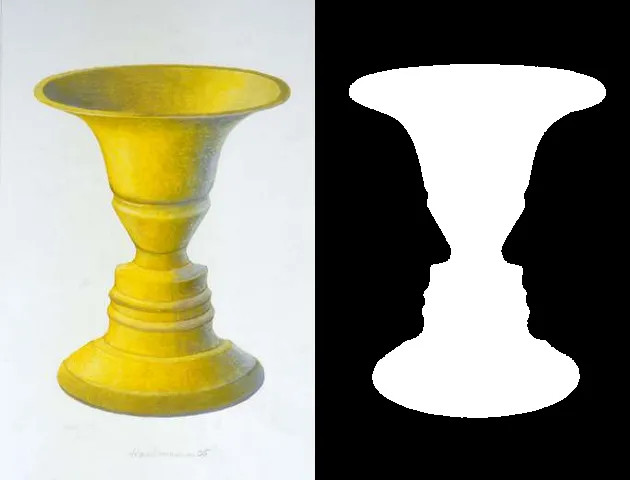
Rubin vase illusion
- Closure means you fill in missing gaps to see a complete object.
- Figure-ground means you separate the object of attention from its background.
- Proximity means you group nearby items together.
- Similarity means you group items that look alike.
Attention and What We Miss
Attention is focusing awareness on selected stimuli. It connects sensation and perception because lots of things may be detected, but only some get full processing.
- Selective attention lets you focus on one task or stimulus while filtering others out.
- The cocktail party effect happens when personally important information, especially your name, grabs your attention even in a noisy setting.
- Attention is limited, so inattention can make you miss visible information.
Two terms get tested a lot here:
- Perceptual blindness means visible information goes unnoticed because attention is elsewhere.
- Change blindness means you fail to notice a change in the environment, often when attention is occupied or viewing is interrupted.
Depth Cues
Your retinas get a 2D image, but you perceive a 3D world because of depth cues.
Binocular depth cues
These use both eyes.
- Retinal disparity means each eye gets a slightly different image. Greater disparity usually means the object is closer.
- Convergence means your eyes turn inward more for nearby objects. The muscle tension helps signal distance.
Monocular depth cues
These work with one eye and often create depth on flat surfaces. The railroad tracks below are a classic example of linear perspective, where parallel lines seem to meet in the distance.

Linear perspective
| Cue | What it tells you |
|---|---|
| Relative clarity | clearer = nearer, hazier = farther |
| Relative size | if same actual size is assumed, smaller retinal image = farther |
| Texture gradient | coarse and distinct nearby, fine and dense farther away |
| Linear perspective | parallel lines seem to meet in the distance |
| Interposition | if one object blocks another, the blocker seems nearer |
Only these listed monocular cues are in AP scope for this topic.
Perceptual Constancy and Apparent Movement
Perceptual constancy means you see objects as stable even when the retinal image changes.
- Size constancy keeps an object the same perceived size as distance changes.
- Shape constancy keeps an object the same shape across angle changes, like an opening door still seeming rectangular.
- Brightness constancy keeps lightness fairly stable across lighting conditions.
- Color constancy keeps familiar colors fairly stable under different illumination.
Apparent movement is motion you perceive even when nothing is moving continuously.
- Film and animation use rapid still images.
- The phi phenomenon happens when adjacent stationary lights flash in sequence and appear to move.
Key Takeaways
Perception
The process by which the brain organizes and interprets sensory information as meaningful objects, events, and relationships
Bottom-Up Processing
Perception that begins with sensory stimulation and builds elementary features into a complete representation
Top-Down Processing
The use of prior knowledge, expectations, experiences, and context to interpret sensory information
Schema
An organized mental framework for understanding a category, situation, person, object, or event
Perceptual Set
A readiness or predisposition to perceive a stimulus in a particular way
Gestalt Psychology
The approach emphasizing that perception organizes sensations into meaningful wholes rather than separate parts
Closure
The tendency to perceive an incomplete figure as complete by filling in missing boundaries
Figure and Ground (Figure-Ground Organization)
The organization of a visual field into an attended figure and the background against which it appears
Proximity
The tendency to group elements that are near one another
Similarity
The tendency to group elements that share visual characteristics such as shape, color, size, or orientation
Attention
The focusing of awareness on selected stimuli or features
Selective Attention
Concentrating awareness on one stimulus or task while other available information receives less processing
Cocktail Party Effect
The tendency for personally significant information, such as one’s name, to capture attention outside the current focus
Change Blindness
Failure to perceive an environmental change because attention is elsewhere or viewing continuity is interrupted
Depth Perception
The ability to perceive distance and three-dimensional relationships
Binocular Depth Cues
Depth information that depends on input from both eyes
Retinal Disparity
The difference between the images projected onto the two retinas, with greater disparity generally indicating a nearer object
Convergence
The inward turning of the eyes when focusing on a nearby object, with greater turning signaling a closer object
Monocular Depth Cues
Depth information available to either eye alone that can also create depth on flat surfaces
Relative Clarity
The tendency to perceive clearer, sharper objects as nearer and hazier objects as farther away
Relative Size
When objects are assumed to have similar actual sizes, the one producing the smaller retinal image is perceived as farther away
Texture Gradient
The gradual change from coarse, detailed nearby texture to finer, denser, less distinct distant texture
Linear Perspective
The tendency for parallel lines to appear to converge as they extend into the distance
Interposition (Occlusion)
A depth cue in which an object blocking part of another is perceived as nearer than the partly hidden object
Visual Perceptual Constancies
Tendencies to perceive familiar objects as stable even when their retinal images change
Size Constancy
Perceiving an object’s actual size as relatively stable despite changes in the size of its retinal image
Shape Constancy
Perceiving an object’s shape as stable despite viewing-angle changes in the shape of its retinal image
Brightness Constancy (Lightness Constancy)
Perceiving an object’s relative lightness as stable despite changes in illumination
Color Constancy
Perceiving familiar surface colors as relatively stable under differing illumination
Apparent Movement
The perception of motion when no object is actually moving continuously through the perceived path
Stroboscopic Movement
Apparent continuous movement produced by rapidly presenting a sequence of slightly different still images
Phi Phenomenon
Apparent movement in which adjacent stationary lights flashing in sequence seem to be one moving light
Notes
Perception
The process by which the brain organizes and interprets sensory information as meaningful objects, events, and relationships
Bottom-Up Processing
Perception that begins with sensory stimulation and builds elementary features into a complete representation
Top-Down Processing
The use of prior knowledge, expectations, experiences, and context to interpret sensory information
Schema
An organized mental framework for understanding a category, situation, person, object, or event
Perceptual Set
A readiness or predisposition to perceive a stimulus in a particular way
Gestalt Psychology
The approach emphasizing that perception organizes sensations into meaningful wholes rather than separate parts
Closure
The tendency to perceive an incomplete figure as complete by filling in missing boundaries
Figure and Ground (Figure-Ground Organization)
The organization of a visual field into an attended figure and the background against which it appears
Proximity
The tendency to group elements that are near one another
Similarity
The tendency to group elements that share visual characteristics such as shape, color, size, or orientation
Attention
The focusing of awareness on selected stimuli or features
Selective Attention
Concentrating awareness on one stimulus or task while other available information receives less processing
Cocktail Party Effect
The tendency for personally significant information, such as one’s name, to capture attention outside the current focus
Change Blindness
Failure to perceive an environmental change because attention is elsewhere or viewing continuity is interrupted
Depth Perception
The ability to perceive distance and three-dimensional relationships
Binocular Depth Cues
Depth information that depends on input from both eyes
Retinal Disparity
The difference between the images projected onto the two retinas, with greater disparity generally indicating a nearer object
Convergence
The inward turning of the eyes when focusing on a nearby object, with greater turning signaling a closer object
Monocular Depth Cues
Depth information available to either eye alone that can also create depth on flat surfaces
Relative Clarity
The tendency to perceive clearer, sharper objects as nearer and hazier objects as farther away
Relative Size
When objects are assumed to have similar actual sizes, the one producing the smaller retinal image is perceived as farther away
Texture Gradient
The gradual change from coarse, detailed nearby texture to finer, denser, less distinct distant texture
Linear Perspective
The tendency for parallel lines to appear to converge as they extend into the distance
Interposition (Occlusion)
A depth cue in which an object blocking part of another is perceived as nearer than the partly hidden object
Visual Perceptual Constancies
Tendencies to perceive familiar objects as stable even when their retinal images change
Size Constancy
Perceiving an object’s actual size as relatively stable despite changes in the size of its retinal image
Shape Constancy
Perceiving an object’s shape as stable despite viewing-angle changes in the shape of its retinal image
Brightness Constancy (Lightness Constancy)
Perceiving an object’s relative lightness as stable despite changes in illumination
Color Constancy
Perceiving familiar surface colors as relatively stable under differing illumination
Apparent Movement
The perception of motion when no object is actually moving continuously through the perceived path
Stroboscopic Movement
Apparent continuous movement produced by rapidly presenting a sequence of slightly different still images
Phi Phenomenon
Apparent movement in which adjacent stationary lights flashing in sequence seem to be one moving light
