Topic 4.5 Notes – Social-Cognitive and Trait Theories of Personality
Social-Cognitive Personality Theory
Albert Bandura is the key name here. His view connects personality to learning, thinking, and social situations.
A quick reminder from learning theory helps here. People do not just react automatically. Observation, expectations, and cognition shape behavior. That is why Bandura saw personality as more than fixed inner traits and more than the situation alone.
In this theory, personality comes from the interaction among:
- your thoughts and beliefs
- your behavior
- your environment
That means your behavior can change across contexts in meaningful ways. A person may act confident in one setting and hesitant in another, and that difference still tells us something real about personality.
Reciprocal Determinism and the Self
Reciprocal determinism
This is the core idea. Reciprocal determinism means three factors all influence one another:
Personal factors
Beliefs, expectations, emotions, goals, and biologyBehavioral factors
Choices, habits, effort, persistence, and avoidanceEnvironmental factors
Rewards, consequences, other people, opportunities, and culture
Bandura often represented this as a triangle of mutual influence.
The influence runs in every direction. Personal factors affect behavior, behavior affects the environment, and the environment feeds back into both.
Self-concept
Self-concept is your overall view of who you are. It includes:
- traits you think you have
- roles like friend, student, sibling
- abilities
- goals
- relationships
It is shaped by feedback from others, social comparison, and your past successes and failures. Then it feeds back into behavior. If you see yourself as responsible, you may act that way more often.
Self-efficacy
Self-efficacy is your belief that you can succeed at a specific task.
- “I can do this speech” = self-efficacy
- It affects effort, persistence, and whether you even try
- High self-efficacy often leads to approaching challenges
- Low self-efficacy often leads to avoidance
This is a favorite test distinction. It is task-specific, not your whole self-worth.
Self-esteem
Self-esteem is your overall sense of worth or value.
- Self-efficacy = “I can do this.”
- Self-esteem = “I am worthwhile.”
Self-efficacy and self-esteem can connect, but they are not the same thing.
Public speaking example
A classic Bandura example works like this:
- You believe you are bad at public speaking
- You avoid speaking
- You get fewer chances to improve
- Other people stop expecting you to speak
- The environment reinforces your original belief
If you do one successful speech and get positive feedback, the cycle can reverse.
How Social-Cognitive Theory Assesses Personality
This approach looks at behavior in context, not just one global personality score.
Psychologists may use:
- Self-reports for self-concept, self-esteem, and self-efficacy
- Observation in realistic or structured situations
- Conditional patterns, such as acting outgoing with friends but quiet with strangers
The measure has to match the construct:
| If the question is about... | The construct is... |
|---|---|
| worth, value, feeling good about yourself | self-esteem |
| confidence in doing a specific task | self-efficacy |
Research rules still matter here. Good measures need reliability, validity, and clear operational definitions.
Trait Theory and the Big Five
What traits are
Traits are enduring characteristics that lead to typical responses to stimuli and situations.
A few important details:
- traits are dimensions, not either-or types
- “typical” does not mean identical behavior every time
- trait theory mostly describes personality more than it explains how it develops
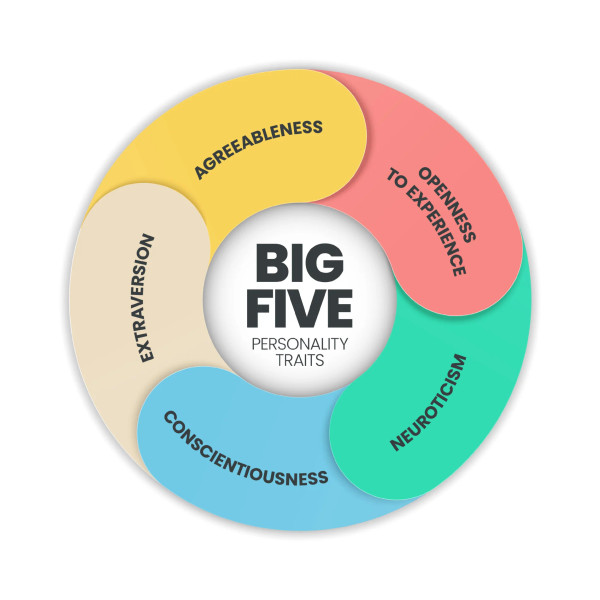
The Big Five
The Big Five are often remembered with OCEAN. You may also see the fifth trait labeled as neuroticism, as it is in the diagram, rather than emotional stability.
Openness to experience
Curiosity, imagination, creativity, interest in noveltyConscientiousness
Organization, responsibility, self-discipline, persistenceExtraversion
Sociability, assertiveness, outgoing energy
Introversion is not the same as shyness.Agreeableness
Trust, empathy, cooperation, compassionEmotional stability
Calmness, resilience, less frequent negative emotion
The opposite label is neuroticism
What trait profiles mean
You get a score on each trait, not one overall personality score. A high score in one area does not tell you your score in the others. Trait theory helps predict broad tendencies across time.
Personality Inventories and Factor Analysis
Personality inventories
These are standardized self-report measures of traits.
- they use multiple items for each trait
- many use rating scales
- reverse-scored items help reduce response bias
- results are shown as a profile across the Big Five
- scores can be compared to a norm group
A percentile rank shows relative standing compared with others. It does not mean percent correct.
Factor analysis
Factor analysis is the statistical method that groups correlated item responses into broader factors.
It helped researchers identify the Big Five because it showed which items tended to go together. It groups items, not people into personality types, and it uses data from many respondents.
Limits and research use
A few limits always matter:
- self-reports can include bias, faking, or weak self-insight
- observer ratings can help, but they also have bias
- most Big Five studies are correlational
- correlation with outcomes does not prove causation
Trait theory describes broad stable tendencies. Social-cognitive theory explains person-situation interaction.
Key Takeaways
Social-Cognitive Theory of Personality
The view that personality develops through ongoing interactions among personal factors, behavior, and the social environment; assessment examines beliefs and behavior in context
Reciprocal Determinism
The mutual, multidirectional interaction among personal factors, behavior, and the environment
Self-Concept
A person’s understanding of who they are, including their perceived characteristics, abilities, roles, goals, and relationships
Self-Efficacy
A person’s belief in their ability to perform the behaviors needed to succeed at a particular task or challenge
Self-Esteem
A person’s general positive or negative evaluation of their own worth or value
Trait Theory of Personality
The view that personality consists of relatively enduring dimensions that describe and predict typical responses across time and situations
Trait
A relatively enduring characteristic or dimension on which people differ and that predicts typical, not invariant, responses
Big Five Model
A trait model describing personality through openness, conscientiousness, extraversion, agreeableness, and emotional stability
Openness to Experience
The Big Five dimension involving curiosity, imagination, creativity, receptiveness to unfamiliar ideas, and interest in novelty
Conscientiousness
The Big Five dimension involving organization, responsibility, dependability, self-discipline, planning, and persistence
Agreeableness
The Big Five dimension involving cooperation, trust, empathy, compassion, and concern for social harmony
Emotional Stability / Neuroticism
The Big Five dimension involving calmness and resilience; neuroticism is its inverse, reflecting greater negative emotional reactivity
Personality Inventory
A standardized set of items used to produce scores on one or more personality dimensions
Factor Analysis
A statistical method that organizes correlated inventory items or responses into broader underlying factors
Extraversion
The Big Five dimension involving sociability, assertiveness, activity, and a tendency to seek interpersonal stimulation; its lower pole is introversion
Notes
Social-Cognitive Theory of Personality
The view that personality develops through ongoing interactions among personal factors, behavior, and the social environment; assessment examines beliefs and behavior in context
Reciprocal Determinism
The mutual, multidirectional interaction among personal factors, behavior, and the environment
Self-Concept
A person’s understanding of who they are, including their perceived characteristics, abilities, roles, goals, and relationships
Self-Efficacy
A person’s belief in their ability to perform the behaviors needed to succeed at a particular task or challenge
Self-Esteem
A person’s general positive or negative evaluation of their own worth or value
Trait Theory of Personality
The view that personality consists of relatively enduring dimensions that describe and predict typical responses across time and situations
Trait
A relatively enduring characteristic or dimension on which people differ and that predicts typical, not invariant, responses
Big Five Model
A trait model describing personality through openness, conscientiousness, extraversion, agreeableness, and emotional stability
Openness to Experience
The Big Five dimension involving curiosity, imagination, creativity, receptiveness to unfamiliar ideas, and interest in novelty
Conscientiousness
The Big Five dimension involving organization, responsibility, dependability, self-discipline, planning, and persistence
Agreeableness
The Big Five dimension involving cooperation, trust, empathy, compassion, and concern for social harmony
Emotional Stability / Neuroticism
The Big Five dimension involving calmness and resilience; neuroticism is its inverse, reflecting greater negative emotional reactivity
Personality Inventory
A standardized set of items used to produce scores on one or more personality dimensions
Factor Analysis
A statistical method that organizes correlated inventory items or responses into broader underlying factors
Extraversion
The Big Five dimension involving sociability, assertiveness, activity, and a tendency to seek interpersonal stimulation; its lower pole is introversion
