Topic 2.8 Notes – Intelligence and Achievement
What Intelligence Is
Psychologists usually define intelligence as the ability to learn from experience, reason, solve problems, and adapt. That sounds simple, but there is no single definition everyone agrees on. The big debate is whether intelligence is one broad mental ability or several different abilities.
Spearman’s general intelligence
Charles Spearman noticed that people who do well on one mental task often do fairly well on others too. Using factor analysis (a statistical method that finds patterns among scores), he argued for g, or general intelligence.
- g = a broad mental ability shared across many tasks
- s = specific abilities needed for particular tasks
So your score on a math task might reflect both your overall reasoning power and your specific math skills.
Gardner’s multiple intelligences
Howard Gardner argued that intelligence is not one score. He proposed several distinct intelligences.
- Linguistic
- Logical-mathematical
- Spatial
- Musical
- Bodily-kinesthetic
- Interpersonal
- Intrapersonal
- Naturalistic
This helps explain why someone can be amazing with people, music, or movement without looking like a top test-taker. A common criticism is that some of these may be better described as talents than fully separate intelligences.
Sternberg’s triarchic theory
Robert Sternberg said intelligence has three parts:
- Analytical intelligence = solving academic and logical problems
- Creative intelligence = handling new situations and producing original ideas
- Practical intelligence = dealing effectively with everyday life
This theory matters because school success does not capture everything we mean by being “smart.”
How Intelligence Is Measured
Early intelligence testing
Alfred Binet and Théodore Simon created early intelligence tests to identify students who needed extra educational support. They used mental age, which means the level of performance typical for a certain age group.
Lewis Terman later revised this work into the Stanford-Binet.
The historical IQ formula was:
So a 10-year-old performing like an average 12-year-old would have an IQ of 120. Modern IQ testing does not use this formula. Today, IQ is based on deviation scores, with an average of 100. That is why IQ scores are usually shown on a bell-shaped curve centered at 100.
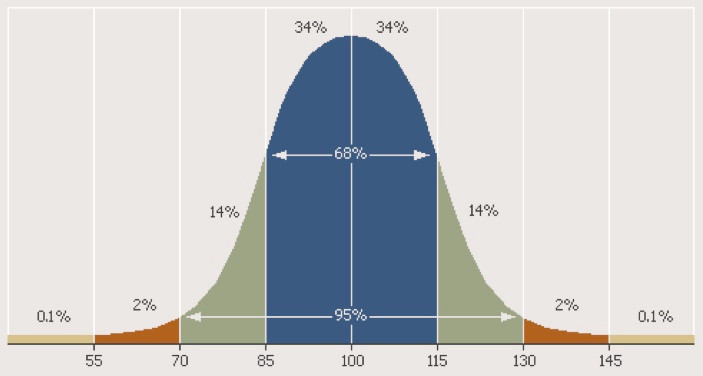
IQ scores on a normal distribution
Psychometric rules for a good test
Psychometrics means the measurement of psychological traits. A useful intelligence test needs three things.
| Principle | What it means | Example |
|---|---|---|
| Standardization | same directions, timing, setting, and scoring | everyone takes the test under the same conditions |
| Validity | measures what it claims to measure | an intelligence test should measure reasoning, not just vocabulary |
| Reliability | gives consistent results | scores stay similar over time or across parts of the test |
Validity
- Construct validity asks whether the test actually measures intelligence.
- Predictive validity asks whether the score predicts something later, like school performance.
Reliability
- Test-retest reliability means similar scores on separate test dates.
- Split-half reliability means two halves of the test give similar results.
One testable idea students miss a lot is this. A test can be reliable without being valid. If it consistently measures the wrong thing, it’s still reliable.
Culture, Bias, and the Uses and Misuses of IQ
Intelligence scores reflect both ability and the testing situation.
- Sociocultural responsiveness means making tests fairer by reducing irrelevant language or cultural barriers and using appropriate norms.
- Stereotype threat happens when fear of confirming a negative stereotype lowers performance.
- Stereotype lift happens when favorable comparison to another group boosts performance.
The Flynn effect is the long-term rise in IQ scores across generations, linked to nutrition, health care, education, technology, and SES. That shows environment shapes test performance.
Historically, IQ tests were also misused. During World War I, the Army Alpha and Army Beta sorted recruits. Test results were later used by the eugenics movement to justify limits on jobs, education, military rank, and immigration in the 1920s.
One of the biggest AP points here is interpretation:
- there is more variation within groups than between groups
- group averages overlap a lot
- poverty, discrimination, stress, health, and unequal schooling affect scores
- you should never use group membership to judge one individual’s intelligence
Achievement, Aptitude, and Mindset
An achievement test measures what you have already learned.
- examples: unit tests, final exams, end-of-course tests
An aptitude test predicts future performance or ability to benefit from training.
- example: the SAT is often treated as more aptitude-oriented
An intelligence test aims at broader cognitive ability than either one subject test.
Carol Dweck studied mindsets.
- Fixed mindset = intelligence is set
- Growth mindset = intelligence can develop through effort, strategies, instruction, and feedback
Growth mindset often leads to persistence and better strategy use. One important limit is that it does not mean “just try harder.” Improvement depends on effective methods and real opportunities too.
Key Takeaways
Intelligence
The ability to learn from experience, reason, solve problems, and adapt effectively to new situations
General Intelligence (g)
Spearman’s broad mental ability that contributes to performance across many different cognitive tasks
Factor Analysis
A statistical method that identifies clusters of correlated measures and the underlying factors that may explain them
Positive Manifold
The pattern in which performance on different cognitive tasks tends to be positively correlated
Gardner’s Theory of Multiple Intelligences
The theory that intelligence consists of relatively distinct linguistic, logical-mathematical, spatial, musical, bodily-kinesthetic, interpersonal, intrapersonal, and naturalistic capacities
Sternberg’s Triarchic Theory
The theory that intelligence includes three connected forms: analytical, creative, and practical intelligence
Analytical Intelligence
The ability to analyze information, evaluate alternatives, compare ideas, and solve familiar academic problems
Creative Intelligence
The ability to handle novel situations, generate original ideas, and combine information in new ways
Practical Intelligence
The ability to apply knowledge effectively by adapting to, shaping, or selecting everyday environments
Alfred Binet and Théodore Simon
Researchers who developed an early intelligence assessment to identify French schoolchildren needing educational assistance and introduced mental age
Mental Age
The chronological-age level whose typical performance matches a person’s performance on an intelligence test
Lewis Terman and the Stanford-Binet Test
Terman’s United States adaptation of Binet and Simon’s early intelligence assessment
Intelligence Quotient (IQ)
Historically, mental age divided by chronological age and multiplied by 100: IQ = mental age ÷ chronological age × 100
Deviation IQ Score
A modern IQ score based on comparison with the score distribution of an appropriate same-age sample, commonly scaled to a mean of 100
Psychometrics
The study of measuring psychological characteristics
Standardization
Administering and scoring a test with consistent directions, time limits, materials, rules, and testing conditions
Validity
The extent to which evidence supports interpreting and using a test score for its intended purpose
Construct Validity
The extent to which an assessment actually measures the theoretical construct it is intended to measure
Predictive Validity
The extent to which a test score accurately forecasts a relevant future outcome
Reliability
The consistency with which a test produces similar results when the measured characteristic has not changed
Test-Retest Reliability
Consistency measured by correlating the same participants’ scores on the same test given on two occasions
Split-Half Reliability
Internal consistency measured by dividing a test into comparable halves and correlating the two sets of scores
Socioculturally Responsive Assessment
Assessment designed and interpreted with attention to linguistic and cultural contexts so construct-irrelevant barriers are reduced
Stereotype Threat
Reduced performance caused by concern that one may confirm a negative stereotype about one’s group
Stereotype Lift
Improved performance that can occur when a favorable social comparison makes one’s group seem relatively advantaged
Flynn Effect
The general rise in intelligence-test performance across generations in much of the world because of changing societal and environmental conditions
Within-Group Versus Between-Group Variation in IQ Scores
IQ scores usually vary more within socially defined groups than between group averages, producing substantially overlapping distributions
Achievement Test
A test intended to measure knowledge and skills a person has already learned
Aptitude Test
A test intended to predict future performance or a person’s capacity to benefit from particular instruction or training
Fixed Mindset
The belief that intelligence is essentially stable and cannot be substantially developed
Growth Mindset
The belief that intellectual abilities can develop through experience, effective effort, instruction, strategies, feedback, and help
Notes
Intelligence
The ability to learn from experience, reason, solve problems, and adapt effectively to new situations
General Intelligence (g)
Spearman’s broad mental ability that contributes to performance across many different cognitive tasks
Factor Analysis
A statistical method that identifies clusters of correlated measures and the underlying factors that may explain them
Positive Manifold
The pattern in which performance on different cognitive tasks tends to be positively correlated
Gardner’s Theory of Multiple Intelligences
The theory that intelligence consists of relatively distinct linguistic, logical-mathematical, spatial, musical, bodily-kinesthetic, interpersonal, intrapersonal, and naturalistic capacities
Sternberg’s Triarchic Theory
The theory that intelligence includes three connected forms: analytical, creative, and practical intelligence
Analytical Intelligence
The ability to analyze information, evaluate alternatives, compare ideas, and solve familiar academic problems
Creative Intelligence
The ability to handle novel situations, generate original ideas, and combine information in new ways
Practical Intelligence
The ability to apply knowledge effectively by adapting to, shaping, or selecting everyday environments
Alfred Binet and Théodore Simon
Researchers who developed an early intelligence assessment to identify French schoolchildren needing educational assistance and introduced mental age
Mental Age
The chronological-age level whose typical performance matches a person’s performance on an intelligence test
Lewis Terman and the Stanford-Binet Test
Terman’s United States adaptation of Binet and Simon’s early intelligence assessment
Intelligence Quotient (IQ)
Historically, mental age divided by chronological age and multiplied by 100: IQ = mental age ÷ chronological age × 100
Deviation IQ Score
A modern IQ score based on comparison with the score distribution of an appropriate same-age sample, commonly scaled to a mean of 100
Psychometrics
The study of measuring psychological characteristics
Standardization
Administering and scoring a test with consistent directions, time limits, materials, rules, and testing conditions
Validity
The extent to which evidence supports interpreting and using a test score for its intended purpose
Construct Validity
The extent to which an assessment actually measures the theoretical construct it is intended to measure
Predictive Validity
The extent to which a test score accurately forecasts a relevant future outcome
Reliability
The consistency with which a test produces similar results when the measured characteristic has not changed
Test-Retest Reliability
Consistency measured by correlating the same participants’ scores on the same test given on two occasions
Split-Half Reliability
Internal consistency measured by dividing a test into comparable halves and correlating the two sets of scores
Socioculturally Responsive Assessment
Assessment designed and interpreted with attention to linguistic and cultural contexts so construct-irrelevant barriers are reduced
Stereotype Threat
Reduced performance caused by concern that one may confirm a negative stereotype about one’s group
Stereotype Lift
Improved performance that can occur when a favorable social comparison makes one’s group seem relatively advantaged
Flynn Effect
The general rise in intelligence-test performance across generations in much of the world because of changing societal and environmental conditions
Within-Group Versus Between-Group Variation in IQ Scores
IQ scores usually vary more within socially defined groups than between group averages, producing substantially overlapping distributions
Achievement Test
A test intended to measure knowledge and skills a person has already learned
Aptitude Test
A test intended to predict future performance or a person’s capacity to benefit from particular instruction or training
Fixed Mindset
The belief that intelligence is essentially stable and cannot be substantially developed
Growth Mindset
The belief that intellectual abilities can develop through experience, effective effort, instruction, strategies, feedback, and help
