Topic 3.2 Notes – Physical Development Across the Lifespan
How Physical Development Changes Across the Lifespan
Physical development means changes in the body and nervous system that affect what you can do, how you respond, and even how you think and learn.
The core pattern is simple:
- Before birth, prenatal influences can shape later physical and psychological outcomes.
- Infancy and childhood, reflexes and motor skills grow, which increases independence.
- Adolescence, a growth spurt and puberty lead to reproductive maturity.
- Adulthood, many abilities level off and then decline gradually, but not all at the same speed.
One AP idea to keep in mind the whole time is this: development follows the same basic sequence for most people, but timing differs because maturation interacts with health, nutrition, experience, and environment.
Prenatal Influences on Later Development
Before birth, the body and brain are developing fast, so outside influences can matter a lot. AP does not test the named prenatal stages here. It cares about what can affect development and the later results.
What can affect prenatal development
Major influences include:
- Teratogens
Environmental agents that interfere with prenatal development. - Maternal illness
Infections and health conditions can affect the fetus. - Genetic mutations and chromosomal differences
Some are inherited, some happen spontaneously. - Hormonal factors
Hormones guide growth and tissue differentiation. - Broader environment
Nutrition, pollution, stress, and prenatal care all matter.
Teratogens
The placenta helps, but it is not a complete barrier.
- Common teratogens include alcohol, nicotine, drugs, some medications, chemicals, and radiation.
- Alcohol is the classic AP example.
- Prenatal alcohol exposure can cause fetal alcohol spectrum disorders.
- Effects can include growth restriction, central nervous system damage, and later problems with attention, memory, impulse control, learning, and judgment.
- Nicotine is linked to low birth weight, premature birth, and restricted growth.
Maternal illness and health
- Rubella during pregnancy can cause hearing, vision, and heart problems.
- Zika virus is linked to microcephaly and impaired brain development.
- Diabetes, malnutrition, fever, low oxygen, and stress can also affect development.
Genetic and hormonal factors
- Mutations may be inherited or spontaneous.
- Down syndrome involves an extra chromosome 21.
- Hormones regulate growth, so endocrine disruption can alter typical development.
Broader prenatal environment
- Good nutrition supports body and brain growth.
- Folic acid helps reduce neural tube defect risk.
- Pollution and heavy metals can harm neurological development.
- Prenatal health care lowers risk by catching and managing problems.
What AP questions usually want is the link. Example: prenatal alcohol exposure can later affect attention because it can disrupt nervous system development. Also remember that prenatal research often shows association, and association alone does not always prove causation.
Physical Development in Infancy and Childhood
This period is all about growing control over the body. As children gain movement, they also gain new ways to explore, learn, and act independently.
Maturation and motor development
Maturation is a biologically guided growth process. Development tends to happen in a predictable order, even if children reach milestones at different ages.
Two patterns show that order:
- Cephalocaudal = development from head to toe
- Proximodistal = development from the center outward
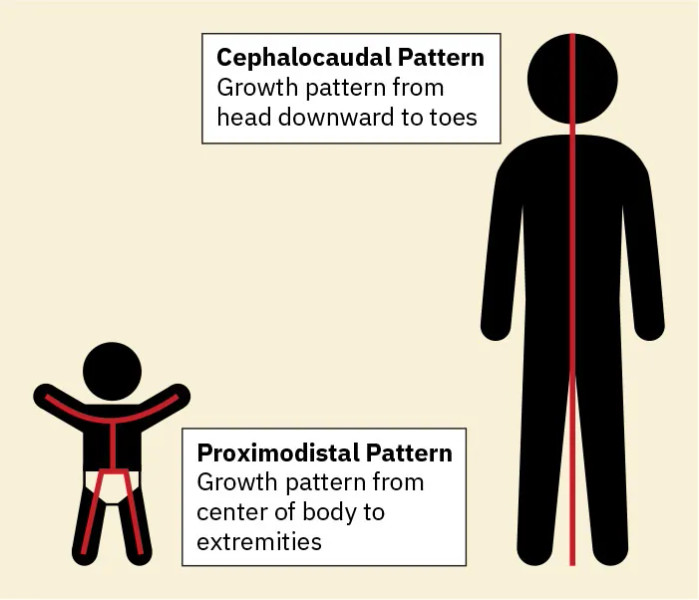
Cephalocaudal and proximodistal patterns
Gross and fine motor skills
| Type | What it means | Examples |
|---|---|---|
| Gross motor | Large-muscle movement | sitting, standing, walking, running, balancing |
| Fine motor | Small, precise movement | reaching, pincer grasp, using utensils, drawing, writing |
Motor development matters because it increases independence. A child who can crawl, grasp, and walk can explore more, which changes learning opportunities.
Infant reflexes
A reflex is an automatic, unlearned response.
- Rooting reflex
Touch the cheek and the infant turns toward it and opens the mouth. - Sucking reflex
Touch the mouth and sucking begins. - Moro reflex
Startle response. - Palmar grasp reflex
The hand closes around an object.
These reflexes show early neurological functioning. If a reflex is absent, uneven, or lasts too long, that can signal a concern.
Visual cliff and depth perception
Eleanor Gibson and Richard Walk used the visual cliff to study depth perception in infants.
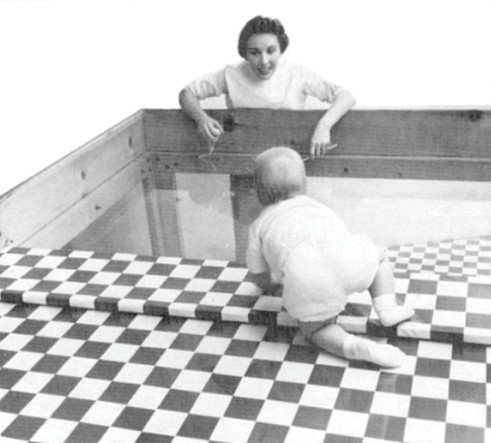
Visual cliff experiment
In the photo, the caregiver is encouraging the infant from across the apparent drop. If infants avoid that side, it suggests early depth perception. One subtle AP point here: avoidance supports depth sensitivity, but if an infant does not avoid it, that does not automatically prove no depth perception.
Critical and sensitive periods
- Critical period
A narrow window when an experience must happen for typical development. - Sensitive period
A broader window when experience is especially effective.
For humans, language exposure is the main example. Early exposure supports more typical language development.
In animals, Konrad Lorenz studied imprinting in goslings. They followed the first moving object they saw early in life. That is a classic timing effect, but it is a non-human animal example, not human attachment.
Physical Development in Adolescence
Adolescence brings fast physical change, and those visible changes affect how teens see themselves and how others treat them.
The adolescent growth spurt
This is a rapid increase in height, weight, and body size. It usually begins earlier in females than in males. Because growth can be uneven, coordination may look awkward for a while.
Puberty and sex characteristics
Puberty is sexual maturation and the development of reproductive capability.
- Primary sex characteristics
Structures directly involved in reproduction - Secondary sex characteristics
Visible traits linked to maturation but not directly required for reproduction
Important milestones:
- Menarche = first menstrual period
- Spermarche = first ejaculation
These physical changes can affect self-image, social treatment, and behavior, which is why puberty matters psychologically too.
Physical Development in Adulthood
Adulthood covers most of life. Physical abilities often level off and then gradually decline, but there is huge variation from person to person.
- Menopause is the end of menstrual cycles and natural reproductive capacity.
- Male reproductive decline is usually more gradual.
- Mobility and flexibility often decrease with age.
- Reaction time slows, especially on rapid-response tasks.
- Visual acuity declines.
- Presbyopia means trouble focusing on nearby objects.
- Auditory acuity declines.
- Presbycusis is age-related hearing loss, often affecting high frequencies first.
A common test mistake is assuming physical decline means loss of intelligence. It doesn’t. A person may perform worse because of slower reaction time or reduced hearing or vision, even when cognitive ability is still strong.
Key Takeaways
Teratogen
An environmental agent, such as alcohol, nicotine, certain medications, chemicals, or radiation, capable of disrupting prenatal development
Fetal Alcohol Spectrum Disorders
A range of growth, physical, nervous-system, cognitive, and behavioral impairments caused by prenatal alcohol exposure
Down Syndrome
A chromosomal condition caused by an extra copy of chromosome 21 and associated with characteristic physical development and varying intellectual and developmental disability
Maturation
The biologically guided process of growth that produces orderly behavioral changes relatively independently of specific training
Cephalocaudal Development
Development that proceeds from head to toe, with control of the head and upper body emerging before control of the legs
Proximodistal Development
Development that proceeds from the center of the body outward, with control of the arms emerging before precise control of the hands and fingers
Gross Motor Skills (Gross Motor Coordination)
Skills using large muscles and whole-body movement, such as sitting, walking, running, jumping, and balancing
Fine Motor Skills (Fine Motor Coordination)
Skills requiring precise control of small muscles, especially in the hands and fingers, such as grasping, drawing, and writing
Reflex
An automatic, unlearned response to a particular stimulus
Rooting Reflex
An infant’s automatic turning toward a touch on the cheek and opening of the mouth, helping the infant locate food
Sucking Reflex
An infant’s automatic sucking response when an object touches the mouth, assisting feeding
Moro Reflex (Startle Reflex)
An infant’s automatic extension and then inward drawing of the arms after a sudden loss of support or startling event
Palmar Grasp Reflex
An infant’s automatic gripping response when an object or finger is placed in the palm
Visual Cliff
A transparent, supported apparatus with apparent shallow and deep sides that measures infants’ depth sensitivity through their willingness to cross
Critical Period
A limited developmental window during which a necessary experience must occur for a capacity to develop typically
Sensitive Period
A flexible developmental window during which an organism is especially responsive to certain experiences, though later development remains possible
Imprinting
A rapid, biologically prepared following behavior in which some young animals attach to the first conspicuous moving object encountered early in life
Adolescent Growth Spurt
A period during adolescence of rapid increases in height, weight, and overall body size
Puberty
The period of sexual maturation during which reproductive capability and primary and secondary sex characteristics develop
Primary Sex Characteristics
Reproductive body structures directly involved in reproduction, such as the ovaries, uterus, testes, and penis
Secondary Sex Characteristics
Physical traits associated with sexual maturation but not directly required for reproduction, such as breast development, body hair, and voice changes
Menarche
The first menstrual period, marking a milestone within female pubertal development
Spermarche
The first ejaculation, marking a milestone within male pubertal development
Menopause
The normal adult transition marking the end of menstrual cycles and natural reproductive capacity as ovarian function declines
Presbyopia
Age-related difficulty focusing on nearby objects caused by reduced flexibility of the eye’s lens
Presbycusis
Age-related hearing loss that often affects high-frequency sounds first
Notes
Teratogen
An environmental agent, such as alcohol, nicotine, certain medications, chemicals, or radiation, capable of disrupting prenatal development
Fetal Alcohol Spectrum Disorders
A range of growth, physical, nervous-system, cognitive, and behavioral impairments caused by prenatal alcohol exposure
Down Syndrome
A chromosomal condition caused by an extra copy of chromosome 21 and associated with characteristic physical development and varying intellectual and developmental disability
Maturation
The biologically guided process of growth that produces orderly behavioral changes relatively independently of specific training
Cephalocaudal Development
Development that proceeds from head to toe, with control of the head and upper body emerging before control of the legs
Proximodistal Development
Development that proceeds from the center of the body outward, with control of the arms emerging before precise control of the hands and fingers
Gross Motor Skills (Gross Motor Coordination)
Skills using large muscles and whole-body movement, such as sitting, walking, running, jumping, and balancing
Fine Motor Skills (Fine Motor Coordination)
Skills requiring precise control of small muscles, especially in the hands and fingers, such as grasping, drawing, and writing
Reflex
An automatic, unlearned response to a particular stimulus
Rooting Reflex
An infant’s automatic turning toward a touch on the cheek and opening of the mouth, helping the infant locate food
Sucking Reflex
An infant’s automatic sucking response when an object touches the mouth, assisting feeding
Moro Reflex (Startle Reflex)
An infant’s automatic extension and then inward drawing of the arms after a sudden loss of support or startling event
Palmar Grasp Reflex
An infant’s automatic gripping response when an object or finger is placed in the palm
Visual Cliff
A transparent, supported apparatus with apparent shallow and deep sides that measures infants’ depth sensitivity through their willingness to cross
Critical Period
A limited developmental window during which a necessary experience must occur for a capacity to develop typically
Sensitive Period
A flexible developmental window during which an organism is especially responsive to certain experiences, though later development remains possible
Imprinting
A rapid, biologically prepared following behavior in which some young animals attach to the first conspicuous moving object encountered early in life
Adolescent Growth Spurt
A period during adolescence of rapid increases in height, weight, and overall body size
Puberty
The period of sexual maturation during which reproductive capability and primary and secondary sex characteristics develop
Primary Sex Characteristics
Reproductive body structures directly involved in reproduction, such as the ovaries, uterus, testes, and penis
Secondary Sex Characteristics
Physical traits associated with sexual maturation but not directly required for reproduction, such as breast development, body hair, and voice changes
Menarche
The first menstrual period, marking a milestone within female pubertal development
Spermarche
The first ejaculation, marking a milestone within male pubertal development
Menopause
The normal adult transition marking the end of menstrual cycles and natural reproductive capacity as ovarian function declines
Presbyopia
Age-related difficulty focusing on nearby objects caused by reduced flexibility of the eye’s lens
Presbycusis
Age-related hearing loss that often affects high-frequency sounds first
