Topic 2.6 Notes – Retrieving Memories
What Memory Retrieval Is
Retrieval means bringing stored information back into conscious awareness. That could be remembering a definition, recognizing a face, or recalling what happened yesterday.
Here’s the memory chain you need in your head:
- Encoding gets information into memory.
- Storage keeps it there over time.
- Retrieval accesses it when you need it.
One easy-to-miss point is that retrieval failure does not prove the memory is gone. Sometimes the information is stored, but you cannot access it at that moment.
Retrieval is also cue-sensitive. A retrieval cue is anything that helps activate the right association network in memory. That cue can be:
- External like a place, smell, sound, or answer choice
- Internal like your mood or physical state
This connects to the encoding specificity principle. Retrieval works best when the cues present during recall overlap with what was present during encoding. The more the later situation matches the original learning situation, the easier access tends to be.
Recall and recognition usually involve explicit memory, which means conscious memory. Implicit memory affects behavior without deliberate remembering, and that is a different idea.
Recall and Recognition
Recall
Recall means retrieving information without the target being shown to you. You have to generate the answer.
Examples:
- essay or short-answer questions
- naming a vocabulary term
- recounting an event from memory
That is why recall is usually harder. You are producing the answer yourself.
“Without cues” can be confusing. It does not mean zero help of any kind. A question prompt can still guide you. It means the answer itself is not presented.
Types of recall:
- Free recall = produce items in any order
- Cued recall = a prompt helps you retrieve the answer
- Serial recall = produce items in the original order
A classic recall setup is studying a word list, having it removed, and then writing as many words as you remember. On AP Psych, free-response questions mostly measure recall.
Recognition
Recognition means identifying information when it is presented to you. The item itself or the choices act as retrieval cues.
Examples:
- multiple-choice questions
- recognizing a face
- deciding whether a word was on a studied list
Recognition is usually easier because the target is in front of you.
This quick comparison captures the difference. Recognition is knowing the person looks familiar. Recall is having to come up with the name on your own.
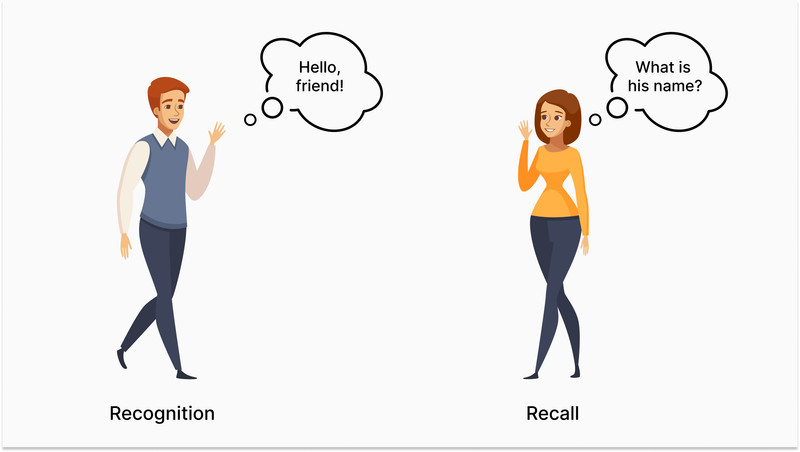
Recall and recognition
In recognition studies, two terms matter:
- Hit = correctly saying an old item is old
- False alarm = incorrectly saying a new item is old
Recognition being easier does not mean it is always more accurate. Distractors can create false recognition.
Recall versus recognition
The same stored information can be tested both ways.
- Recall = generate
- Recognition = identify
Classic AP application: a student cannot produce the answer on an FRQ but can pick it on multiple choice.
Retrieval Cues That Make Memory Easier
Context-dependent memory
Context-dependent memory means retrieval improves when the external environment at testing matches the environment where you learned it.
Examples include the same:
- room
- smell
- sound
- location
The famous Godden and Baddeley diver study found that divers recalled words better when learning and testing happened in matching contexts, either both on land or both underwater. In the graph, the matching conditions are Dry-Dry and Wet-Wet.
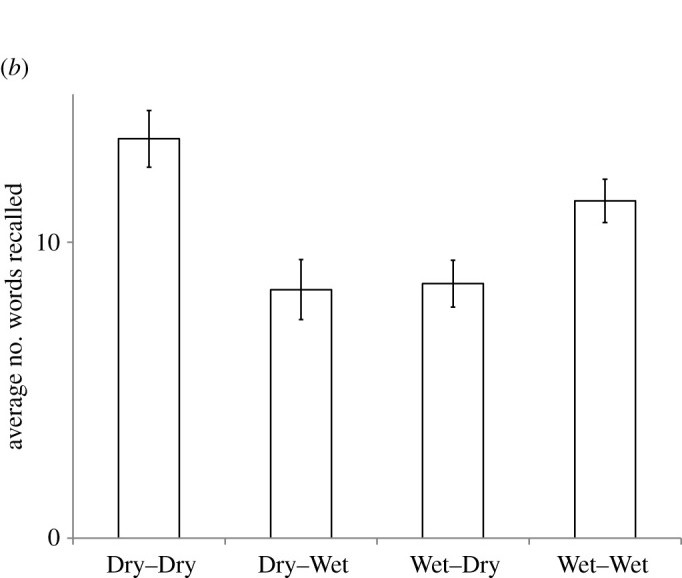
Godden and Baddeley diver study
Mood-congruent memory
Mood-congruent memory means your current mood makes similarly toned memories easier to access.
- happy mood → pleasant memories come up more easily
- sad mood → negative memories come up more easily
Mood acts as an internal retrieval cue, and this can help keep a mood going.
State-dependent memory
State-dependent memory means retrieval improves when your physical or physiological state at recall matches your state during encoding.
Examples:
- alert vs tired
- calm vs highly aroused
- effects of medication
- intoxication
Important detail: matching an impaired state may help relative retrieval, but impaired states do not improve memory overall.
Keep these straight
- Context-dependent = external setting match
- Mood-congruent = current emotion matches memory tone
- State-dependent = internal bodily state match
Retrieval Practice and the Testing Effect
Retrieval practice means actively pulling information out of memory.
It often looks like this:
- You try to produce the answer from memory.
- You see what you got right and wrong.
- You correct errors with feedback.
- You retrieve it again later.
Examples:
- flashcards where you say the answer before flipping
- practice questions
- blurting
- writing what you know from memory
- explaining a concept without notes
This works because successful retrieval strengthens later access and reveals weak spots. Rereading and highlighting do not do the same thing because they can create familiarity without generation.
The testing effect or test-enhanced learning is the finding that self-testing leads to better long-term retention than only restudying. The delayed result is the point. Rereading can feel easier right now, but retrieval practice lasts longer.
Metacognition and Smart Cramming
Metacognition means awareness and regulation of your own thinking and learning.
Metacognitive monitoring
This is judging what you actually know.
- “This looks familiar” is not the same as “I can explain it.”
- Confidence has to be checked against performance.
Metacognitive control
This is changing what you do based on that judgment.
- spend more time on weak topics
- switch from rereading to self-testing
- use spaced retrieval
- check feedback
The danger here is the illusion of mastery. Seeing notes again and again can feel fluent, but fluency is not the same as retrievability.
Key Takeaways
Memory Retrieval
The process of accessing encoded and stored information, making it available for thought, report, or behavior
Retrieval Cue
An external or internal stimulus or condition that helps activate information in memory
Encoding Specificity Principle
Retrieval is more successful when available cues overlap with information or conditions present during encoding
Recall
Retrieval that requires generating previously learned information without the target answer being presented for identification
Recognition
Retrieval that requires identifying previously learned information when it is presented
Context-Dependent Memory
Improved retrieval when the external environment at retrieval matches or contains cues from the environment present during encoding
Mood-Congruent Memory
The tendency for a current emotional mood to make memories with a matching emotional tone more accessible
State-Dependent Memory
Improved retrieval when the internal physiological state at retrieval matches the state present during encoding
Retrieval Practice
The deliberate attempt to bring learned information to mind in order to strengthen later retrieval
Testing Effect (Test-Enhanced Learning)
The finding that retrieving information through testing produces better later retention than spending equivalent time only restudying or rereading
Metacognition
Awareness and regulation of one’s own thinking and learning, including monitoring knowledge and adjusting study strategies
Notes
Memory Retrieval
The process of accessing encoded and stored information, making it available for thought, report, or behavior
Retrieval Cue
An external or internal stimulus or condition that helps activate information in memory
Encoding Specificity Principle
Retrieval is more successful when available cues overlap with information or conditions present during encoding
Recall
Retrieval that requires generating previously learned information without the target answer being presented for identification
Recognition
Retrieval that requires identifying previously learned information when it is presented
Context-Dependent Memory
Improved retrieval when the external environment at retrieval matches or contains cues from the environment present during encoding
Mood-Congruent Memory
The tendency for a current emotional mood to make memories with a matching emotional tone more accessible
State-Dependent Memory
Improved retrieval when the internal physiological state at retrieval matches the state present during encoding
Retrieval Practice
The deliberate attempt to bring learned information to mind in order to strengthen later retrieval
Testing Effect (Test-Enhanced Learning)
The finding that retrieving information through testing produces better later retention than spending equivalent time only restudying or rereading
Metacognition
Awareness and regulation of one’s own thinking and learning, including monitoring knowledge and adjusting study strategies
