Topic 3.6 Notes – Social-Emotional Development Across the Lifespan
Social Environments Shape Development
Bronfenbrenner’s ecological systems theory says development happens inside nested layers of social influence. The key question is how something reaches the person.
This nested-circle model gives you a quick way to sort those influences from direct contact to broad cultural forces over time.
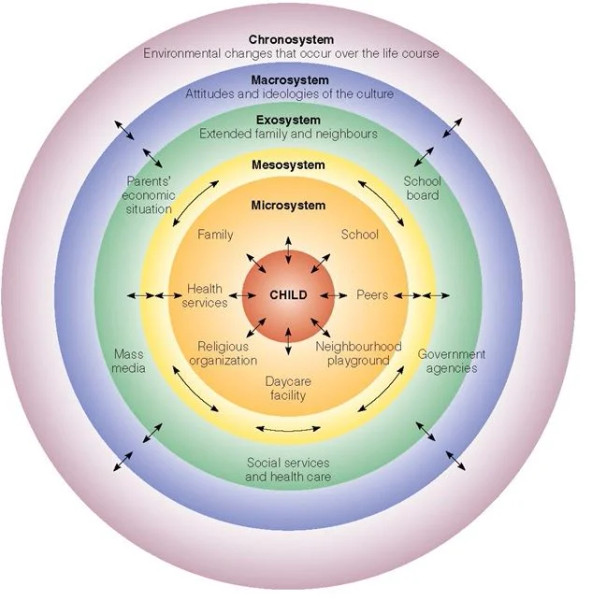
Bronfenbrenner’s ecological systems theory
The Five Systems
Microsystem
Your direct settings. Family, friends, school, teams, caregivers. These are the people and places you interact with face to face.Mesosystem
The links between parts of your microsystem. Parent-teacher communication is the classic example. So is conflict between home and friend group expectations.Exosystem
Indirect influences. You are affected, but you are not directly involved. A caregiver’s work schedule, school board decisions, or local services fit here.Macrosystem
The broad culture. Values, customs, laws, economic systems, and beliefs about family, gender, education, or success.Chronosystem
Time. Your age, life transitions, and historical events matter. Divorce, moving, starting school, or growing up during a recession all fit here.
How to apply the systems
- Classify by the route of influence, not by the institution’s name.
- One situation can involve multiple systems at once.
- Influence is reciprocal. Children are shaped by environments, but their behavior also changes how others respond.
Caregiving and Attachment
Early social-emotional development begins with caregivers, but these experiences shape outcomes in probabilities, not guarantees.
Parenting Styles
| Style | Demandingness | Responsiveness | Usual pattern |
|---|---|---|---|
| Authoritarian | High | Low | Strict, obedience-focused, few explanations |
| Authoritative | High | High | Clear rules, warmth, reasoning |
| Permissive | Low | High | Warm, few limits, inconsistent control |
A common test trap is mixing up authoritarian and authoritative. Authoritative still has rules. It just adds warmth and explanation. Cultural context matters too. The same parenting behavior can mean different things in different communities.
Attachment Styles
Attachment is an emotional bond shown through closeness-seeking, comfort, and using the caregiver as a secure base for exploration.
Ainsworth studied this in the Strange Situation, a lab setup where the caregiver and infant move through brief separations and reunions.
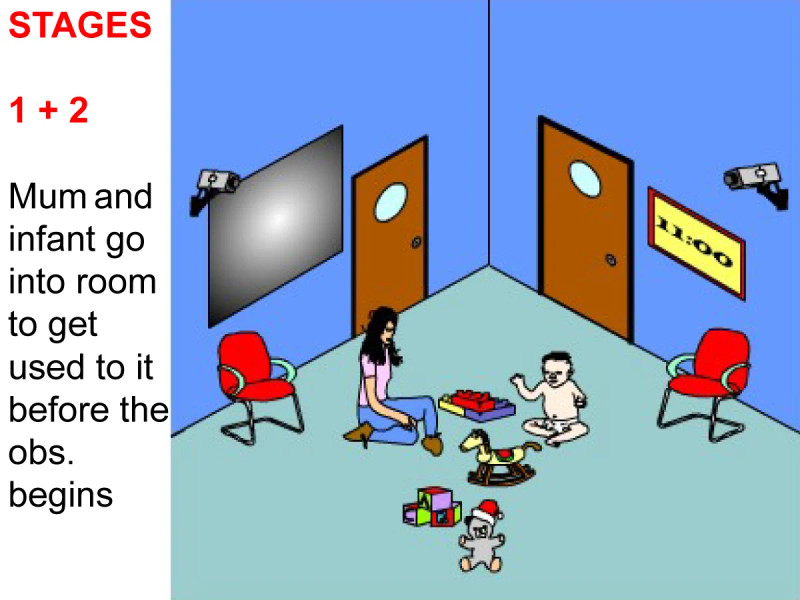
Ainsworth’s Strange Situation setup
Secure
May be upset by separation, then soothed at reunion and returns to exploring.Insecure-avoidant
Minimizes contact or avoids caregiver at reunion.Insecure-anxious
Very distressed, hard to soothe, seeks contact but may resist it too.Insecure-disorganized
Confused, contradictory, fearful behavior with no clear pattern.
What shapes attachment
- Sensitive, responsive caregiving supports secure attachment.
- Temperament affects how attachment behavior looks. A reactive baby may cry more, but crying alone does not tell you attachment type.
- Separation anxiety is fear when away from a caregiver or with a stranger. That is a behavior, not an attachment style.
- Culture changes how attachment is expressed.
Key studies
- Ainsworth’s Strange Situation measured attachment through separation and reunion behavior.
- Harlow’s monkey study showed infant monkeys preferred a soft cloth mother over a wire mother with food. Contact comfort matters.
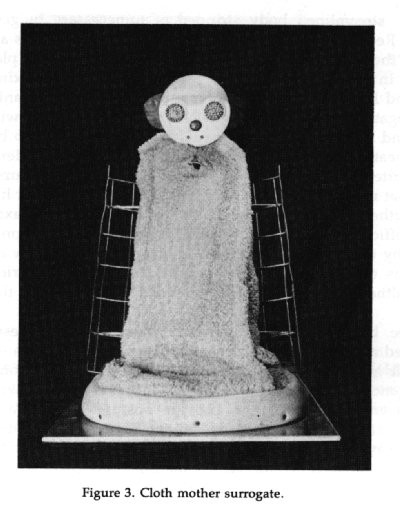
Harlow’s cloth mother surrogate
Peer Relationships and Identity in Childhood and Adolescence
Peers become more important as kids grow. They help shape communication, comparison, belonging, and self-concept.
Peer Interaction and Play
Parallel play
Children play beside each other with little coordination.Pretend play
Role-based symbolic play. This helps perspective-taking and shared meaning.
Adolescent Peer Influence and Egocentrism
Adolescents rely more on peers for approval and identity support.
Imaginary audience
Feeling like everyone is watching and judging you.Personal fable
Believing your feelings are unique, sometimes with a sense of invulnerability.
Identity Development
Erikson said adolescence centers on identity vs role confusion. Marcia broke identity into exploration and commitment.
- Identity achievement = explored and committed
- Moratorium = exploring, not committed
- Foreclosure = committed without exploring
- Diffusion = neither exploring nor committed
Identity can develop in racial/ethnic, gender, sexual orientation, religious, occupational, and familial areas. Possible selves are the future versions of yourself you imagine, and they guide present choices.
Adult Relationships and Lifespan Social Development
Adulthood includes changing roles, close relationships, and cultural expectations about timing.
Adult Social Development
- Social clock means a culture’s expected timeline for life events like marriage, career, or parenthood.
- Emerging adulthood is the transition between adolescence and stable adult roles. It is common in some cultures, not universal.
- Adults form families or family-like relationships built on mutual support and care.
- Childhood attachment can affect adult trust and closeness, but it does not lock in your future.
Erikson’s Eight Psychosocial Stages
Erikson’s model covers the whole lifespan, so for this section, focus most on the later stages that connect to adult relationships and aging.
- Trust vs mistrust
- Autonomy vs shame and doubt
- Initiative vs guilt
- Industry vs inferiority
- Identity vs role confusion
- Intimacy vs isolation
- Generativity vs stagnation
- Ego integrity vs despair
Know the basic conflict at each stage. AP questions often ask you to match a behavior to the stage. For example, mentoring younger people fits generativity, and looking back on life with acceptance fits ego integrity. The older Freud psychosexual stages are outside AP scope here.
Adverse childhood experiences
ACEs are harmful or chronically stressful childhood experiences such as abuse, neglect, violence, or household dysfunction. They are linked to later problems with stress regulation, mental health, and relationships, but again, the effect is probabilistic.
Sociocultural context matters here too:
- what counts as an ACE can vary across settings
- supports and protective factors vary too
- the same adversity can lead to different outcomes in different people
Key Takeaways
Bronfenbrenner’s Ecological Systems Theory
Development reflects interacting influences from nested immediate, institutional, cultural, and temporal social environments
Microsystem
Groups and settings that interact directly with an individual, such as family, friends, and school
Mesosystem
Relationships between parts of an individual’s microsystem, such as communication between family and school
Exosystem
Institutions or circumstances that indirectly affect an individual even though the individual does not participate in them
Macrosystem
The broad cultural and societal context, including values, customs, laws, ideologies, and economic arrangements
Chronosystem
The influence of time, including life stages, personal transitions, changing circumstances, and historical events
Authoritarian Parenting
A parenting style high in demands and control but relatively low in warmth, responsiveness, and negotiation
Authoritative Parenting
A parenting style high in both demands and responsiveness, combining clear limits with warmth, explanation, and appropriate independence
Permissive Parenting
A parenting style high in warmth and responsiveness but relatively low in demands, limits, or consistent enforcement
Attachment
An emotional bond in which a child seeks closeness to a caregiver when distressed and may use the caregiver as a secure base
Strange Situation (Mary Ainsworth)
A structured observation of infant attachment using an unfamiliar room, a stranger, caregiver separations, and reunions
Secure Attachment
Using the caregiver as a base for exploration and seeking and accepting comfort from the caregiver after separation
Insecure-Avoidant Attachment
An attachment pattern marked by apparent indifference to separation and avoidance or minimization of contact at reunion
Insecure-Anxious Attachment (Anxious-Resistant or Ambivalent Attachment)
An attachment pattern marked by intense separation distress and difficulty being soothed, often combining contact-seeking with resistance
Insecure-Disorganized Attachment
An attachment pattern lacking a coherent strategy and showing contradictory, confused, frozen, fearful, or disoriented behavior
Separation Anxiety
Heightened anxiety or fear when a child is away from a caregiver, in an unfamiliar setting, or near a stranger
Temperament
Relatively characteristic patterns of emotional reactivity and self-regulation that appear early in life
Harlow’s Monkey Studies
Infant rhesus monkeys preferred and sought comfort from a soft cloth surrogate over a wire surrogate that supplied milk
Parallel Play
Children play beside one another with similar materials but show little direct coordination
Pretend Play
Play in which a child acts as though objects, people, or situations are something other than they literally are
Adolescent Egocentrism
A heightened adolescent focus on one’s own thoughts, experiences, and social significance
Imaginary Audience
The exaggerated belief that other people are continually observing, noticing, or evaluating oneself
Personal Fable
The belief that one’s experiences are uniquely special or incomprehensible to others, sometimes including exceptionalism or invulnerability
Identity
An organized sense of self involving commitments, values, memberships, goals, relationships, and anticipated roles
Identity Achievement
An identity status involving meaningful exploration followed by commitment
Identity Moratorium
An identity status involving active exploration without a settled commitment
Identity Foreclosure
An identity status involving commitment without substantial prior exploration
Identity Diffusion
An identity status involving neither meaningful exploration nor commitment
Racial and Ethnic Identity
The meaning of racial or ethnic group membership and its place in a person’s self-concept
Gender Identity
A person’s internal sense of gender
Sexual Orientation
A person’s pattern of attraction, which may become part of identity and social belonging
Religious Identity
The place of religious or spiritual beliefs, practices, communities, and commitments in the self-concept
Occupational Identity
The part of identity involving work, education, and anticipated vocational roles
Familial Identity
The part of identity involving one’s place, obligations, relationships, and anticipated roles within a family or family-like group
Possible Selves
Mental representations of what a person might become, hopes to become, or fears becoming
Social Clock
A culturally shaped timetable for when major life events and adult roles are expected to occur
Emerging Adulthood
A culturally contingent transition from adolescence to established adult roles, often involving continued exploration during the late teens and twenties
Erikson’s Psychosocial Stage Theory
A lifespan theory proposing eight stages, each organized around a psychosocial conflict that a person must address
Trust versus Mistrust
Erikson’s infancy conflict in which reliable, sensitive care supports an expectation that others and the environment are dependable
Autonomy versus Shame and Doubt
Erikson’s toddlerhood conflict in which support for age-appropriate independence promotes autonomy rather than shame and self-doubt
Initiative versus Guilt
Erikson’s early-childhood conflict in which encouragement of self-directed plans and activities supports initiative rather than excessive guilt
Industry versus Inferiority
Erikson’s middle-childhood conflict in which learning skills and completing valued work support competence rather than inferiority
Identity versus Role Confusion
Erikson’s adolescent conflict of forming a coherent sense of self rather than remaining directionless or divided among incompatible roles
Intimacy versus Isolation
Erikson’s young-adulthood conflict of forming close, committed, mutually supportive relationships without losing one’s sense of self
Generativity versus Stagnation
Erikson’s middle-adulthood conflict of contributing to future generations and the community rather than remaining narrowly self-focused
Integrity versus Despair
Erikson’s late-adulthood conflict of accepting one’s life as meaningful and coherent rather than viewing it with persistent regret or bitterness
Adverse Childhood Experiences (ACEs)
Potentially traumatic or chronically stressful childhood conditions associated with increased risks to later relationships, health, and well-being
Notes
Bronfenbrenner’s Ecological Systems Theory
Development reflects interacting influences from nested immediate, institutional, cultural, and temporal social environments
Microsystem
Groups and settings that interact directly with an individual, such as family, friends, and school
Mesosystem
Relationships between parts of an individual’s microsystem, such as communication between family and school
Exosystem
Institutions or circumstances that indirectly affect an individual even though the individual does not participate in them
Macrosystem
The broad cultural and societal context, including values, customs, laws, ideologies, and economic arrangements
Chronosystem
The influence of time, including life stages, personal transitions, changing circumstances, and historical events
Authoritarian Parenting
A parenting style high in demands and control but relatively low in warmth, responsiveness, and negotiation
Authoritative Parenting
A parenting style high in both demands and responsiveness, combining clear limits with warmth, explanation, and appropriate independence
Permissive Parenting
A parenting style high in warmth and responsiveness but relatively low in demands, limits, or consistent enforcement
Attachment
An emotional bond in which a child seeks closeness to a caregiver when distressed and may use the caregiver as a secure base
Strange Situation (Mary Ainsworth)
A structured observation of infant attachment using an unfamiliar room, a stranger, caregiver separations, and reunions
Secure Attachment
Using the caregiver as a base for exploration and seeking and accepting comfort from the caregiver after separation
Insecure-Avoidant Attachment
An attachment pattern marked by apparent indifference to separation and avoidance or minimization of contact at reunion
Insecure-Anxious Attachment (Anxious-Resistant or Ambivalent Attachment)
An attachment pattern marked by intense separation distress and difficulty being soothed, often combining contact-seeking with resistance
Insecure-Disorganized Attachment
An attachment pattern lacking a coherent strategy and showing contradictory, confused, frozen, fearful, or disoriented behavior
Separation Anxiety
Heightened anxiety or fear when a child is away from a caregiver, in an unfamiliar setting, or near a stranger
Temperament
Relatively characteristic patterns of emotional reactivity and self-regulation that appear early in life
Harlow’s Monkey Studies
Infant rhesus monkeys preferred and sought comfort from a soft cloth surrogate over a wire surrogate that supplied milk
Parallel Play
Children play beside one another with similar materials but show little direct coordination
Pretend Play
Play in which a child acts as though objects, people, or situations are something other than they literally are
Adolescent Egocentrism
A heightened adolescent focus on one’s own thoughts, experiences, and social significance
Imaginary Audience
The exaggerated belief that other people are continually observing, noticing, or evaluating oneself
Personal Fable
The belief that one’s experiences are uniquely special or incomprehensible to others, sometimes including exceptionalism or invulnerability
Identity
An organized sense of self involving commitments, values, memberships, goals, relationships, and anticipated roles
Identity Achievement
An identity status involving meaningful exploration followed by commitment
Identity Moratorium
An identity status involving active exploration without a settled commitment
Identity Foreclosure
An identity status involving commitment without substantial prior exploration
Identity Diffusion
An identity status involving neither meaningful exploration nor commitment
Racial and Ethnic Identity
The meaning of racial or ethnic group membership and its place in a person’s self-concept
Gender Identity
A person’s internal sense of gender
Sexual Orientation
A person’s pattern of attraction, which may become part of identity and social belonging
Religious Identity
The place of religious or spiritual beliefs, practices, communities, and commitments in the self-concept
Occupational Identity
The part of identity involving work, education, and anticipated vocational roles
Familial Identity
The part of identity involving one’s place, obligations, relationships, and anticipated roles within a family or family-like group
Possible Selves
Mental representations of what a person might become, hopes to become, or fears becoming
Social Clock
A culturally shaped timetable for when major life events and adult roles are expected to occur
Emerging Adulthood
A culturally contingent transition from adolescence to established adult roles, often involving continued exploration during the late teens and twenties
Erikson’s Psychosocial Stage Theory
A lifespan theory proposing eight stages, each organized around a psychosocial conflict that a person must address
Trust versus Mistrust
Erikson’s infancy conflict in which reliable, sensitive care supports an expectation that others and the environment are dependable
Autonomy versus Shame and Doubt
Erikson’s toddlerhood conflict in which support for age-appropriate independence promotes autonomy rather than shame and self-doubt
Initiative versus Guilt
Erikson’s early-childhood conflict in which encouragement of self-directed plans and activities supports initiative rather than excessive guilt
Industry versus Inferiority
Erikson’s middle-childhood conflict in which learning skills and completing valued work support competence rather than inferiority
Identity versus Role Confusion
Erikson’s adolescent conflict of forming a coherent sense of self rather than remaining directionless or divided among incompatible roles
Intimacy versus Isolation
Erikson’s young-adulthood conflict of forming close, committed, mutually supportive relationships without losing one’s sense of self
Generativity versus Stagnation
Erikson’s middle-adulthood conflict of contributing to future generations and the community rather than remaining narrowly self-focused
Integrity versus Despair
Erikson’s late-adulthood conflict of accepting one’s life as meaningful and coherent rather than viewing it with persistent regret or bitterness
Adverse Childhood Experiences (ACEs)
Potentially traumatic or chronically stressful childhood conditions associated with increased risks to later relationships, health, and well-being
