Topic 1.1 Notes – Interaction of Heredity and Environment
What Heredity and Environment Are
Heredity means your inherited predispositions, sometimes called nature. These are built-in tendencies that can influence physical traits, behavior, and mental processes.
A predisposition is a tendency, not a guarantee. You can inherit a higher risk for anxiety, for example, without definitely developing an anxiety disorder.
Environment means the outside conditions and experiences that shape development, also called nurture. In AP Psych, keep this broad. It includes more than parenting.
Environmental influences you should know:
- Prenatal conditions like nutrition or exposure before birth
- Nutrition and physical surroundings such as food, housing, safety
- Family interactions and parenting
- Education and resources
- Peers and social relationships
- Culture and its norms
- Stress and trauma
- Practice, learning, and reinforcement
Reinforcement just means consequences that strengthen behavior.
One easy mistake is treating nature and nurture like opposites. Psychology does not do that. The same heredity can produce different outcomes in different environments, and the same environment can affect people differently because they bring different predispositions to it.
Shared and nonshared environment
Even kids in the same family do not grow up in the exact same environment.
- Shared environment includes things family members have in common
- same household
- same neighborhood
- broad parenting style
- Nonshared environment includes experiences that differ
- different friends
- different teachers
- illnesses
- different treatment
- different life events
How Heredity and Environment Interact
This interaction is the heart of the topic. The sketch below captures the basic idea that traits develop through an ongoing back-and-forth between inherited tendencies and life experience.
- Height potential may be inherited, but it still depends on adequate nutrition.
- Verbal ability can develop differently depending on schooling and language exposure.
- Anxiety vulnerability may be inherited, but chronic stress can trigger it and support can reduce it.
- Outgoing temperament can lead a child to seek social situations, which then builds more social skill.
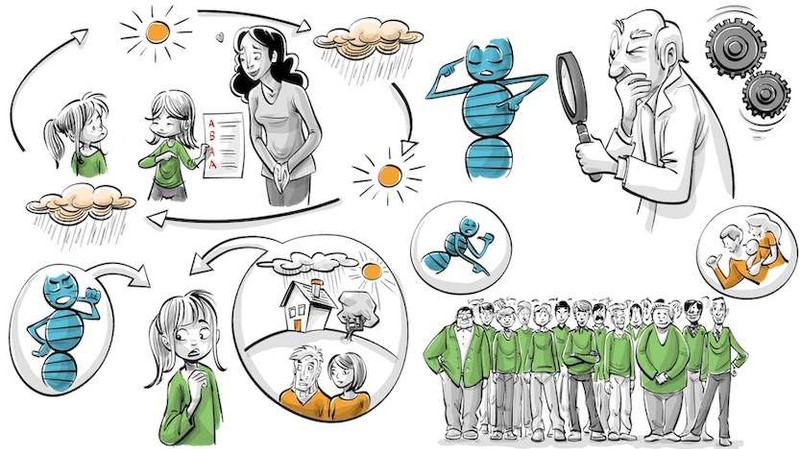
Nature and nurture interacting over development
The conclusions that matter:
- Genetic influence does not make outcomes inevitable.
- Environmental influence does not erase heredity.
- A trait can be heritable and still change through experience or treatment.
- Genetic influence does not mean one simple gene causes the trait.
Heritability and the Evolutionary Perspective
Heritability
Heritability means how much the differences among people in a population are associated with genetic differences.
That population piece is huge. Heritability applies to variation in a group, not to one person. So saying “50% of my intelligence is genetic” is wrong.
Also remember:
- High heritability does not mean fixed
- Heritability can change across groups and environments
Evolutionary perspective
The evolutionary perspective asks how natural selection may have shaped behavioral tendencies over many generations.
- Fitness means reproductive success
- Adaptations are inherited tendencies that became more common because they helped survival or reproduction
Common examples:
- threat detection
- attachment
- cooperation and competition
- mate selection
- parenting and offspring care
- contamination avoidance
This perspective explains why broad human tendencies may exist. Behavioral genetics explains why individuals differ within a population. Those are related, but they are not the same thing.
Be careful with “just-so stories.” A behavior sounding useful is not enough evidence.
Eugenics
Eugenics misused heredity ideas. It treated complex traits as simple, ignored environment, and built prejudice into fake science. It was used to justify racism, ableism, immigration restriction, forced sterilization, and Nazi racial policy. This is not the same as the scientific evolutionary perspective.
Twin, Family, and Adoption Studies
These methods are usually correlational, not experimental. They show association, not clear cause and effect. Researchers often look at correlations or concordance rates. Concordance means both people in a pair show the same trait.
Twin studies
Twin studies compare identical and fraternal twins, which differ in how much genetic material they share.
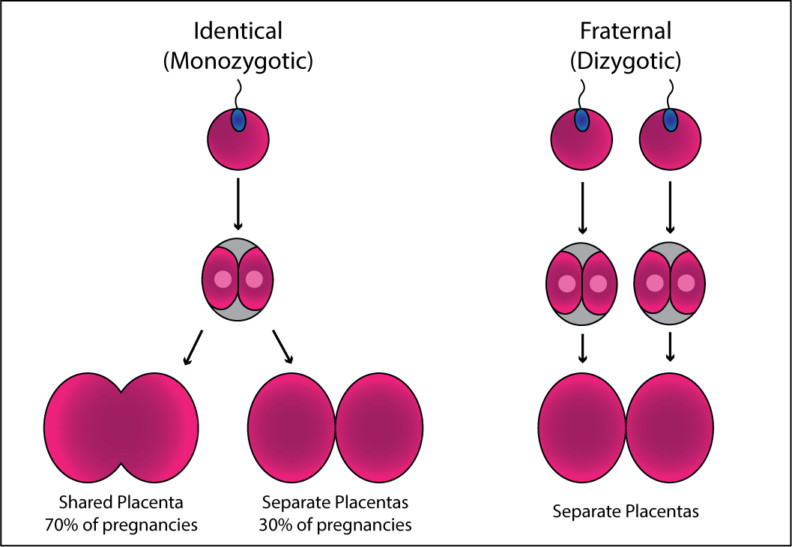
Identical and fraternal twins
- Identical (monozygotic) twins share about 100% of inherited genetic material
- Fraternal (dizygotic) twins share about 50% on average
If identical twins are more similar than fraternal twins, that suggests genetic influence. Twins reared apart are especially useful.
Limits:
- identical twins may be treated more similarly
- twins reared apart may still share prenatal factors, culture, or similar placements
Family studies
These look for traits or disorders clustering among biological relatives. More similarity among closer biological relatives suggests heredity.
Limit: relatives usually share environments too.
Adoption studies
These compare adoptees with biological and adoptive relatives.
- similarity to biological relatives suggests heredity
- similarity to adoptive relatives suggests environment
Limits include prenatal environment, nonrandom placement, possible contact with biological family, and age at adoption.
What the Evidence Lets You Conclude
You can conclude:
- a trait may have a genetic component
- environment also contributes
- several methods together can support nature-nurture interaction
You cannot conclude:
- heredity alone causes behavior
- environment alone causes behavior
- a predisposition guarantees an outcome
- family patterns prove genes
- correlational evidence proves causation
The classic twin/adoption takeaway is simple. If identical twins are more alike than fraternal twins, that supports heredity. If identical twins are still not perfectly alike, environment matters too.
Key Takeaways
Heredity (Nature)
Genetic or otherwise inherited predispositions that influence physical, behavioral, and mental traits and processes
Environment (Nurture)
External conditions and experiences, including prenatal conditions, family, education, culture, and stress, that influence development and behavior
Predisposition
An inherited increased tendency or susceptibility that influences an outcome without making it inevitable
Heredity–Environment Interaction
The principle that inherited predispositions and environmental experiences jointly shape behavior and mental processes, each affecting how the other is expressed
Shared vs. Nonshared Environmental Influences
Shared influences are conditions experienced by family members in common; nonshared influences are distinct experiences that make people raised together differ
Heritability
The extent to which differences among people in a particular population are associated with genetic differences, not the genetic percentage of an individual trait
Evolutionary Perspective
An approach examining how natural selection may have shaped behavioral and mental tendencies that increased survival and reproductive success
Natural Selection
The process by which inherited characteristics that aid survival or reproduction in an environment become more common across generations
Fitness
Reproductive success—the ability to pass inherited characteristics to future generations
Adaptation
An inherited characteristic that became more common because it contributed to survival or reproduction in ancestral environments
Eugenics
A discriminatory program that misused heredity and selective reproduction to encourage reproduction by people labeled desirable and restrict others’ reproduction
Concordance
Both members of a pair displaying the same categorical characteristic, such as both receiving the same diagnosis
Twin Studies
Studies that compare similarities among twins with different degrees of biological relatedness or different rearing environments to investigate hereditary and environmental influence
Identical (Monozygotic) vs. Fraternal (Dizygotic) Twins
Identical twins are treated as sharing 100% of their inherited genetic material, whereas fraternal twins share about 50% on average; greater identical-twin similarity is consistent with genetic influence
Twins-Reared-Apart Design
Comparison of twins raised in separate households; similarities among identical twins are consistent with hereditary influence, while differences are consistent with nonshared environmental influences and other uncontrolled factors
Family Studies
Studies examining whether a characteristic is more common or similar among closer biological relatives than among distant relatives or unrelated people
Adoption Studies
Studies comparing adopted people with biological relatives to assess hereditary influence and with adoptive relatives to assess environmental influence
Notes
Heredity (Nature)
Genetic or otherwise inherited predispositions that influence physical, behavioral, and mental traits and processes
Environment (Nurture)
External conditions and experiences, including prenatal conditions, family, education, culture, and stress, that influence development and behavior
Predisposition
An inherited increased tendency or susceptibility that influences an outcome without making it inevitable
Heredity–Environment Interaction
The principle that inherited predispositions and environmental experiences jointly shape behavior and mental processes, each affecting how the other is expressed
Shared vs. Nonshared Environmental Influences
Shared influences are conditions experienced by family members in common; nonshared influences are distinct experiences that make people raised together differ
Heritability
The extent to which differences among people in a particular population are associated with genetic differences, not the genetic percentage of an individual trait
Evolutionary Perspective
An approach examining how natural selection may have shaped behavioral and mental tendencies that increased survival and reproductive success
Natural Selection
The process by which inherited characteristics that aid survival or reproduction in an environment become more common across generations
Fitness
Reproductive success—the ability to pass inherited characteristics to future generations
Adaptation
An inherited characteristic that became more common because it contributed to survival or reproduction in ancestral environments
Eugenics
A discriminatory program that misused heredity and selective reproduction to encourage reproduction by people labeled desirable and restrict others’ reproduction
Concordance
Both members of a pair displaying the same categorical characteristic, such as both receiving the same diagnosis
Twin Studies
Studies that compare similarities among twins with different degrees of biological relatedness or different rearing environments to investigate hereditary and environmental influence
Identical (Monozygotic) vs. Fraternal (Dizygotic) Twins
Identical twins are treated as sharing 100% of their inherited genetic material, whereas fraternal twins share about 50% on average; greater identical-twin similarity is consistent with genetic influence
Twins-Reared-Apart Design
Comparison of twins raised in separate households; similarities among identical twins are consistent with hereditary influence, while differences are consistent with nonshared environmental influences and other uncontrolled factors
Family Studies
Studies examining whether a characteristic is more common or similar among closer biological relatives than among distant relatives or unrelated people
Adoption Studies
Studies comparing adopted people with biological relatives to assess hereditary influence and with adoptive relatives to assess environmental influence
