Topic 4.2 Notes – Attitude Formation and Attitude Change
Attitudes, Stereotypes, Prejudice, and Discrimination
An attitude is an evaluation of a person, group, object, issue, or behavior. You can like it, dislike it, or feel mixed about it.
Its three parts often show up together:
- Cognitive component = beliefs or thoughts
- “That group is hardworking.”
- Affective component = feelings or emotional reactions
- “I feel uneasy around them.”
- Behavioral component = actions or tendencies to act
- avoiding, helping, trusting, excluding
A stereotype is a generalized concept about a group. It’s the belief part. A prejudice is an unjustifiable, usually negative attitude toward a group. Discrimination is unjustifiable negative behavior toward people because of their group membership.
One easy way to organize those terms is to match them to the three components of attitudes.
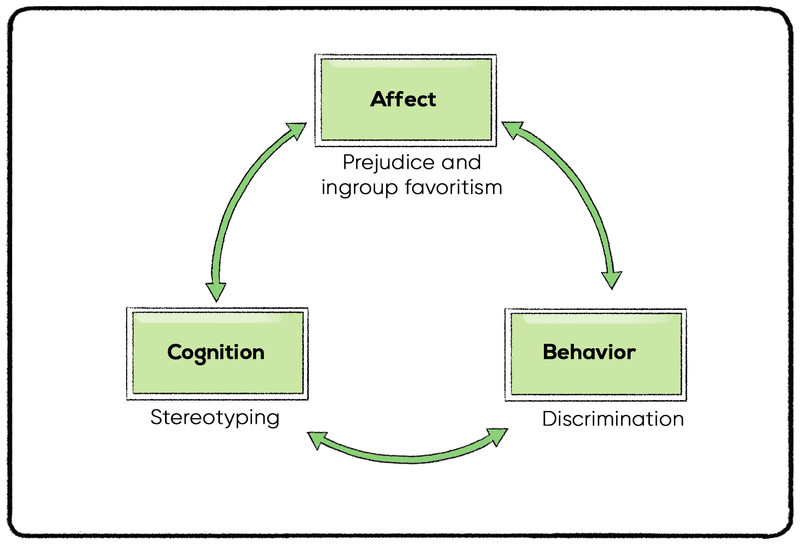
Attitude components linked to stereotyping, prejudice, and discrimination
Keep the relationship straight:
- stereotype → prejudice → discrimination
- The arrows also go backward because behavior and experience can reinforce the original belief.
Why stereotypes happen at all:
- your brain uses categorization and schemas to reduce cognitive load
- that makes quick judgments easier
- but it can also distort judgment by treating group patterns as if they describe every person
Stereotypes can be:
- negative
- positive
- “neutral” seeming
All three still overgeneralize.
Common sources of attitudes and stereotypes include cultural norms, family and peers, schools and institutions, media portrayals, direct experience, and observational learning or conditioning.
Explicit and Implicit Attitudes and the Biases They Produce
Explicit attitudes are conscious and reportable. Researchers usually measure them with surveys, interviews, or rating scales. One problem is social desirability, which means people may answer in a way that looks acceptable.
Implicit attitudes are automatic evaluations a person may not recognize or may not admit. They can differ from explicit beliefs. They’re often studied with indirect measures such as the Implicit Association Test.
Important AP caution: implicit measures show patterns and probabilities, not certainty about one person or one action.
Bias patterns
- Just-world phenomenon
- belief that people get what they deserve and deserve what they get
- this often leads to victim blaming
- Out-group homogeneity bias
- seeing out-group members as more alike than in-group members
- “they’re all the same”
- In-group bias
- favoring your own group in trust, help, rewards, or judgments
- Tajfel’s minimal-group studies showed even random group assignment can create favoritism
- Ethnocentrism
- judging other cultures by your own culture’s standards
- treating your own culture as normal or superior
How Stereotypes and Implicit Attitudes Shape Thinking and Behavior
These attitudes can affect:
- attention you notice stereotype-consistent info
- interpretation ambiguous behavior gets filtered through expectations
- memory stereotype-consistent examples may stick better
- decision-making especially in hiring, discipline, and opportunity
They matter most when:
- decisions are fast
- information is ambiguous
- clear criteria are missing
They can also change how much evidence someone needs before judging a person. That helps create a self-reinforcing cycle:
- expectations shape treatment
- treatment shapes outcomes
- outcomes seem to confirm the stereotype
Reducing biased effects usually means slowing decisions, setting objective criteria in advance, using individuating information, and checking outcomes for patterns.
Belief Perseverance and Confirmation Bias
Belief perseverance means holding onto a belief even after evidence shows it is wrong or the original evidence is discredited.
Confirmation bias means seeking, noticing, interpreting, and remembering information that supports what you already believe.
The distinction is tested a lot:
- confirmation bias = biased information processing
- belief perseverance = continued belief despite contrary evidence
Stereotypes often survive because people treat counterexamples as “exceptions.” Classic findings showed that when people got false evidence, then later learned it was fabricated, they often kept part of the belief anyway, especially after generating their own explanation. Correction works better when people get an alternative explanation, not just “that was false.”
Cognitive Dissonance and Attitude Change
Cognitive dissonance is mental discomfort from inconsistency between attitudes, beliefs, and behavior.
People reduce it by:
- changing behavior
- changing attitude
- adding justification
- minimizing the inconsistency
- avoiding dissonance-producing information
Dissonance is stronger when the issue matters, the behavior feels freely chosen, and there is insufficient external justification.
A simple way to picture it is that a mismatch between belief and action raises dissonance, and people then try to bring it back down by changing the belief, changing the action, or reinterpreting the action.
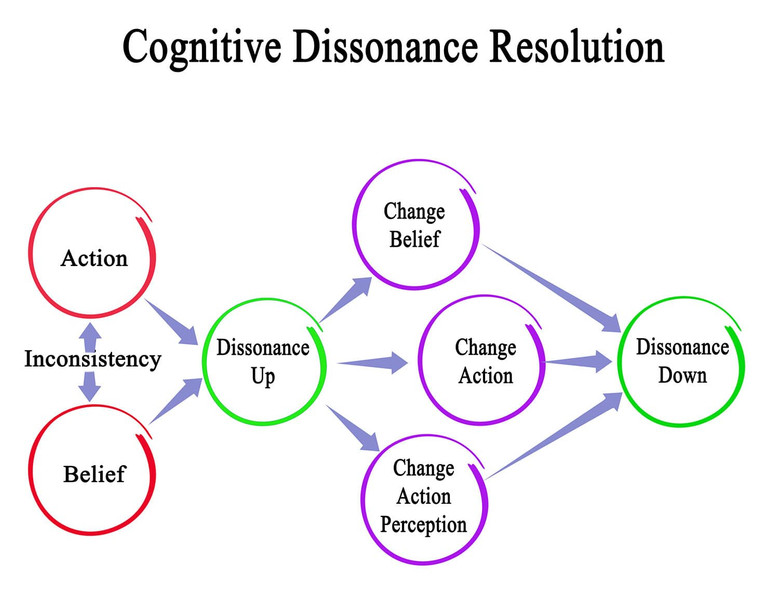
Cognitive dissonance resolution
Festinger and Carlsmith, 1959:
- Participants did a boring task.
- They told someone it was enjoyable.
- They were paid either $1 or $20.
- The $1 group later rated the task as more enjoyable.
Why? $1 was not enough external justification, so they changed their attitude to reduce dissonance. The $20 group had enough outside reason.
Related forms you should know:
- postdecision dissonance after choosing between two attractive options
- effort justification when people value something more after working hard for it
Belief perseverance and dissonance can both keep attitudes in place, but they are different. Belief perseverance is failure to update a belief. Cognitive dissonance is the push to restore internal consistency.
Key Takeaways
Attitude
An evaluation of a person, group, object, issue, or behavior that includes beliefs, feelings, and tendencies to act
Cognitive Component of an Attitude
The beliefs or thoughts a person has about the object of an attitude
Affective Component of an Attitude
The feelings or emotional evaluations a person has toward the object of an attitude
Behavioral Component of an Attitude
A person’s actions or inclinations to act toward the object of an attitude
Stereotype
A generalized concept about a group that assigns presumed characteristics to individuals based on group membership
Prejudice
An unjustifiable, usually negative attitude toward a group and its members
Discrimination
Unjustifiable negative behavior toward people because of their group membership
Explicit Attitude
An attitude that a person consciously recognizes and can report
Implicit Attitude
An evaluation or association a person holds but may not consciously recognize or acknowledge
Just-World Phenomenon
The tendency to believe that people generally get what they deserve and deserve what they get
Out-Group Homogeneity Bias
The tendency to perceive members of an out-group as more similar to one another than members of one’s own group
In-Group Bias / In-Group Favoritism
The tendency to evaluate or treat members of one’s own group more favorably than members of an out-group
Ethnocentrism
The tendency to judge other cultures by one’s own culture’s standards and treat one’s own culture as normal or superior
Belief Perseverance
The persistence of a belief after evidence suggests it is inaccurate or its original supporting evidence has been discredited
Confirmation Bias
The tendency to seek, notice, interpret, and remember information that supports an existing belief while discounting challenges
Cognitive Dissonance
Mental discomfort caused by inconsistency between actions and attitudes or among important beliefs, motivating greater alignment
Notes
Attitude
An evaluation of a person, group, object, issue, or behavior that includes beliefs, feelings, and tendencies to act
Cognitive Component of an Attitude
The beliefs or thoughts a person has about the object of an attitude
Affective Component of an Attitude
The feelings or emotional evaluations a person has toward the object of an attitude
Behavioral Component of an Attitude
A person’s actions or inclinations to act toward the object of an attitude
Stereotype
A generalized concept about a group that assigns presumed characteristics to individuals based on group membership
Prejudice
An unjustifiable, usually negative attitude toward a group and its members
Discrimination
Unjustifiable negative behavior toward people because of their group membership
Explicit Attitude
An attitude that a person consciously recognizes and can report
Implicit Attitude
An evaluation or association a person holds but may not consciously recognize or acknowledge
Just-World Phenomenon
The tendency to believe that people generally get what they deserve and deserve what they get
Out-Group Homogeneity Bias
The tendency to perceive members of an out-group as more similar to one another than members of one’s own group
In-Group Bias / In-Group Favoritism
The tendency to evaluate or treat members of one’s own group more favorably than members of an out-group
Ethnocentrism
The tendency to judge other cultures by one’s own culture’s standards and treat one’s own culture as normal or superior
Belief Perseverance
The persistence of a belief after evidence suggests it is inaccurate or its original supporting evidence has been discredited
Confirmation Bias
The tendency to seek, notice, interpret, and remember information that supports an existing belief while discounting challenges
Cognitive Dissonance
Mental discomfort caused by inconsistency between actions and attitudes or among important beliefs, motivating greater alignment
