Topic 2.2 Notes – Thinking, Problem-Solving, Judgments, and Decision-Making
How Thinking Organizes Information
Thinking means mentally manipulating information. You use it to interpret what’s happening, solve problems, judge options, and make decisions.
A lot of that begins with concepts, which are mental categories. If you know the concept bird, you can group robins, eagles, and ostriches together instead of treating each as totally new.
- A prototype is the most typical example of a concept.
- For many people, a robin is a more typical bird than an ostrich.
- This helps with quick classification.
- Don’t mix up prototype and stereotype. A prototype is a typical example of a category. A stereotype is a belief about a social group.
A schema is broader than a concept. It’s a mental framework for how something usually works.
- Restaurant schema
- enter
- get seated or order
- eat
- pay
- leave
Schemas shape what you notice, how you interpret events, and what you expect to happen. They also get updated as you meet new examples, like a child learning that very different-looking animals can still fit the same category.
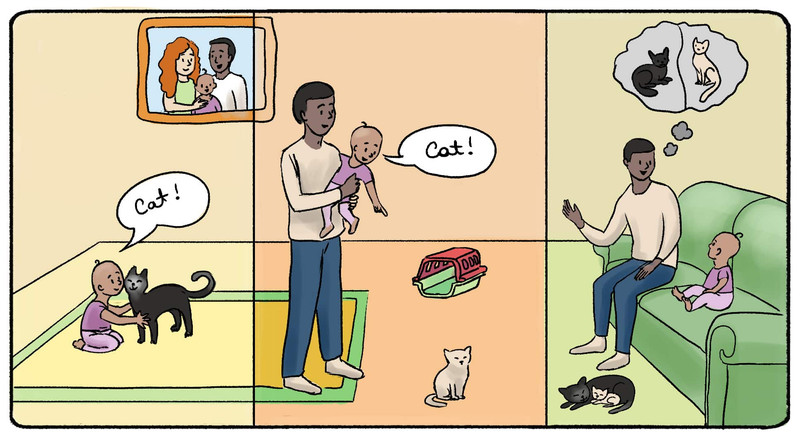
Schema formation and category learning
Schemas change in two ways:
- Assimilation means fitting new information into an existing schema.
- A child sees a fox and calls it a dog.
- Accommodation means changing the schema or making a new one.
- The child learns foxes are a different category and updates the mental framework.
Problem-Solving Strategies
There are two main ways people solve problems.
Algorithms
An algorithm is a step-by-step method that tests possibilities until the right answer is found.
- It guarantees a solution if one exists and you use the procedure correctly.
- It is accurate but slow.
- Example: trying every possible 4-digit lock code.
Heuristics
A heuristic is a mental shortcut or rule of thumb.
- It is fast and efficient.
- It does not guarantee the right answer.
- You use heuristics constantly because real life usually gives you limited time and incomplete information.
Representativeness and availability
| Heuristic | What it uses | Common error | Example |
|---|---|---|---|
| Representativeness | resemblance to a prototype or stereotype | ignores base rates or actual frequency | assuming a quiet, detail-focused person is an engineer |
| Availability | how easily examples come to mind | vivid events feel more common than they are | overestimating shark attacks after news coverage |
What Influences Judgment and Decision-Making
Past experience and presentation both matter.
- Mental set means sticking with a strategy that worked before, even when a better one exists.
- Classic example: Luchins water-jar study.
- Priming means earlier exposure activates related ideas.
- Seeing doctor can make nurse come to mind faster.
- Framing means the wording of choices changes decisions, even when the facts are equivalent.
- In the Asian disease problem, people were more risk-avoidant with gain wording and more risk-seeking with loss wording.
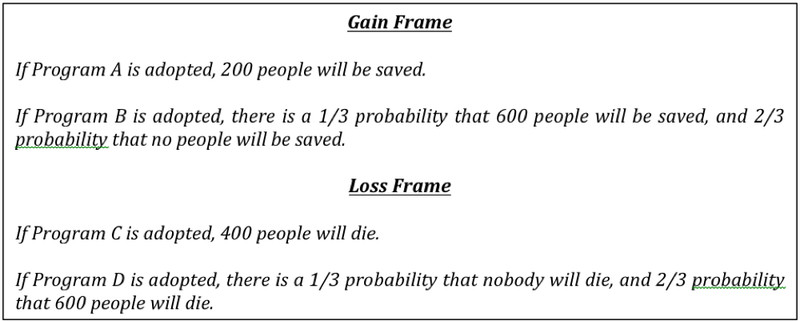
Asian disease framing problem
This classic example shows how the same outcome can push people toward different choices depending on whether it is framed as lives saved or lives lost.
Some biases make decisions worse:
- Confirmation bias means favoring evidence that supports what you already believe.
- Overconfidence means your certainty is higher than your actual accuracy.
- Gambler’s fallacy means thinking earlier random outcomes affect the next independent one.
- After five heads, a fair coin is still 50/50 on the next flip.
- Sunk-cost fallacy means continuing because of past time, money, or effort already spent.
- Good decisions should be based on future costs and benefits.
Executive Functions and Critical Thinking
Executive functions are the control processes that let you carry out goal-directed behavior.
Core parts:
- Working memory keeps information active and lets you mentally use it.
- Inhibitory control helps you resist distractions or impulses.
- Cognitive flexibility lets you shift strategies, rules, or viewpoints.
These support planning, self-monitoring, time management, and fixing mistakes. They also support critical thinking, which means pausing, checking intuition against evidence, and revising conclusions when evidence changes.
Creativity and What Blocks It
Creativity means producing ideas or solutions that are both novel and useful.
- Divergent thinking generates many possible ideas.
- brainstorming
- many uses for a paperclip
- Convergent thinking narrows options to the single best answer.
Real problem-solving often uses both. You generate possibilities, then evaluate them.
Functional fixedness blocks creativity by making you see an object only in its usual use.
- Classic example: Duncker’s candle problem.
- The diagram below shows the key insight. The box that holds the tacks can also be used as a platform, but many people miss that.
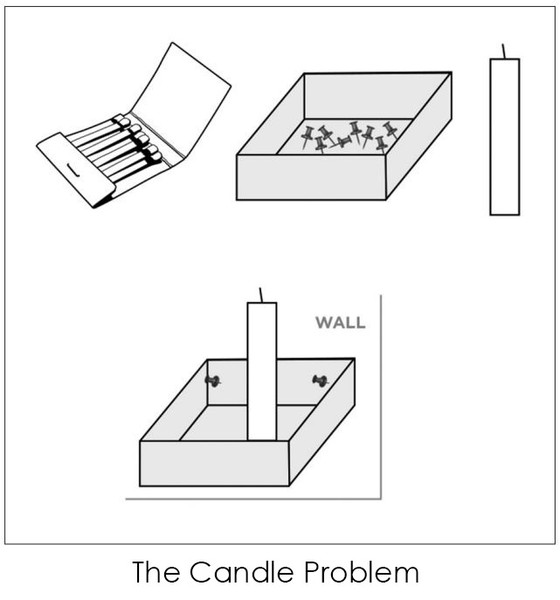
Duncker’s candle problem
Lock in this difference:
- Mental set = stuck on an old strategy.
- Functional fixedness = stuck on an object’s usual function.
Key Takeaways
Thinking
The cognitive manipulation of information and mental representations to interpret, solve problems, pursue goals, and make decisions
Concept
A mental category that groups objects, events, ideas, or people sharing relevant features
Prototype
The ideal or most typical example of a concept, used as a standard for categorization
Schema
A mental framework that organizes related knowledge, expectations, and relationships
Assimilation
Interpreting new information through an existing schema without changing the schema
Accommodation
Modifying an existing schema or creating a new one to incorporate new information
Algorithm
A systematic, step-by-step procedure that attempts possible solutions according to a rule until the correct one is found
Heuristic
A mental shortcut or rule of thumb that finds a likely answer efficiently but does not guarantee correctness
Representativeness Heuristic
Judging likelihood by resemblance to a prototype, expectation, or stereotype, often while neglecting base rates
Availability Heuristic
Judging probability, frequency, or importance by how easily examples come to mind
Mental Set
The tendency to approach a new problem with a strategy that worked on previous problems
Priming
The influence of exposure to one stimulus on the processing of or response to a later stimulus
Framing
The influence of how logically equivalent information or choices are presented, such as as gains or losses
Confirmation Bias
The tendency to favor evidence supporting an existing belief while discounting contradictory evidence
Overconfidence Effect
The tendency for confidence in beliefs, estimates, or predictions to exceed their actual accuracy
Gambler’s Fallacy
The mistaken belief that previous independent outcomes change the probability of the next random event
Sunk-Cost Fallacy
Allowing an irrecoverable past investment to improperly influence whether to continue a present course of action
Executive Functions
Cognitive control processes used to generate, organize, plan, monitor, and carry out goal-directed behavior
Creativity
Thinking that generates ideas, approaches, or products that are both novel and useful or appropriate
Divergent Thinking
Generating many possible ideas or solutions from a single starting point
Convergent Thinking
Narrowing possibilities to identify a single best or correct answer
Functional Fixedness
A cognitive bias that limits an object to its usual function, preventing consideration of alternative uses
Notes
Thinking
The cognitive manipulation of information and mental representations to interpret, solve problems, pursue goals, and make decisions
Concept
A mental category that groups objects, events, ideas, or people sharing relevant features
Prototype
The ideal or most typical example of a concept, used as a standard for categorization
Schema
A mental framework that organizes related knowledge, expectations, and relationships
Assimilation
Interpreting new information through an existing schema without changing the schema
Accommodation
Modifying an existing schema or creating a new one to incorporate new information
Algorithm
A systematic, step-by-step procedure that attempts possible solutions according to a rule until the correct one is found
Heuristic
A mental shortcut or rule of thumb that finds a likely answer efficiently but does not guarantee correctness
Representativeness Heuristic
Judging likelihood by resemblance to a prototype, expectation, or stereotype, often while neglecting base rates
Availability Heuristic
Judging probability, frequency, or importance by how easily examples come to mind
Mental Set
The tendency to approach a new problem with a strategy that worked on previous problems
Priming
The influence of exposure to one stimulus on the processing of or response to a later stimulus
Framing
The influence of how logically equivalent information or choices are presented, such as as gains or losses
Confirmation Bias
The tendency to favor evidence supporting an existing belief while discounting contradictory evidence
Overconfidence Effect
The tendency for confidence in beliefs, estimates, or predictions to exceed their actual accuracy
Gambler’s Fallacy
The mistaken belief that previous independent outcomes change the probability of the next random event
Sunk-Cost Fallacy
Allowing an irrecoverable past investment to improperly influence whether to continue a present course of action
Executive Functions
Cognitive control processes used to generate, organize, plan, monitor, and carry out goal-directed behavior
Creativity
Thinking that generates ideas, approaches, or products that are both novel and useful or appropriate
Divergent Thinking
Generating many possible ideas or solutions from a single starting point
Convergent Thinking
Narrowing possibilities to identify a single best or correct answer
Functional Fixedness
A cognitive bias that limits an object to its usual function, preventing consideration of alternative uses
