Topic 3.1 Notes – Themes and Methods in Developmental Psychology
What Developmental Psychology Studies
Developmental psychology studies age-related patterns of stability and change across the lifespan. That means from prenatal development all the way through old age.
A few core ideas matter here:
- Development is not just childhood. It includes infancy, adolescence, adulthood, and aging.
- Development is not always improvement. It can mean:
- growth like learning more words
- maintenance like keeping a skill steady
- reorganization like changing how you think
- decline like slower memory in later life
- Psychologists can organize development by:
- chronological order which asks what tends to happen at different ages
- themes which ask recurring questions across the whole lifespan
One easy trap is treating age as the cause of everything. Age often helps organize research, but age itself does not explain much. A difference between younger and older adults could reflect biology, education, culture, health, or historical experience.
The Three Big Themes in Development
These themes are three different questions, not three competing answers.
Stability and Change
Stability means a trait stays relatively consistent over time. Usually this is relative stability, not perfect sameness.
- A highly reactive child may still be more reactive than peers as an adult.
- The behavior can look different across ages, but the person’s relative position stays similar.
Change means systematic developmental differences happen over time.
- Causes can include maturation, experience, culture, education, health, and relationships.
- A person can stay recognizable and still change a lot in expression.
So a trait can show both stability and change at once.
Nature and Nurture
Nature refers to biological influences like:
- genes
- hormones
- brain development
- maturation
Nurture refers to environmental influences like:
- prenatal environment
- caregiving
- nutrition
- education
- culture
- peers
- socioeconomic status
- life experiences
The modern view is interaction. Inherited tendencies can be shaped by experience. For example, a child with a biological tendency toward emotional reactivity may be affected by parenting and culture. AP Psych wants you to avoid genetic determinism and environmental determinism.
Continuous and Discontinuous Development
Continuous development is gradual and cumulative. It looks like a smooth progression over time.
Discontinuous development is stage-like. People move into qualitatively different ways of thinking or functioning.
Standard stage examples you should know by name include Piaget’s cognitive stages and Erikson’s psychosocial stages.
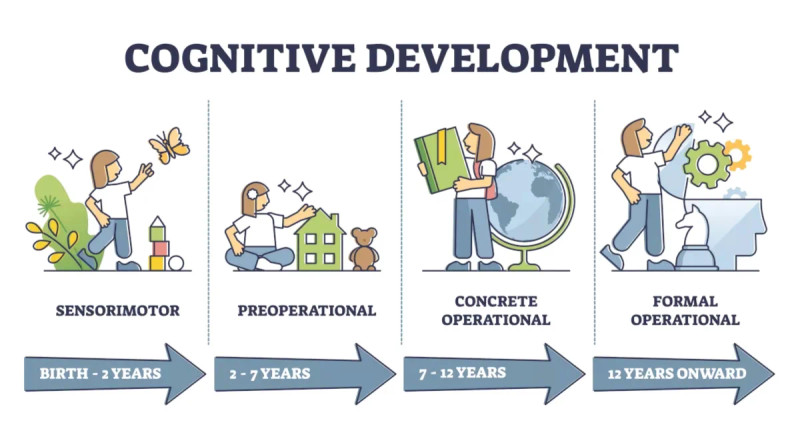
Piaget’s stages of cognitive development
Piaget is a classic example of discontinuous development because the theory proposes distinct stages such as sensorimotor, preoperational, concrete operational, and formal operational.
One common mistake is thinking age groups automatically prove stages. They do not. Stage evidence requires a real shift in kind, not just people being sorted by age.
How the Themes Relate
These themes ask different things:
- stability vs. change asks whether a trait persists
- continuous vs. discontinuous asks what the pattern of development looks like
- nature vs. nurture asks what influences development
That means one characteristic can be:
- stable in relative position
- changing in expression
- continuous in growth
- discontinuous in shifts
- influenced by both biology and environment
The best AP wording is that developmental outcomes usually reflect interaction and depend on conditions.
Cross-Sectional Research
Cross-sectional research compares different age groups at the same time. Each person is usually measured once.
Example: compare 20-, 50-, and 80-year-olds on a memory task. In the graph, each point is the average score for one age group, so you're seeing a snapshot across groups at one moment in time.
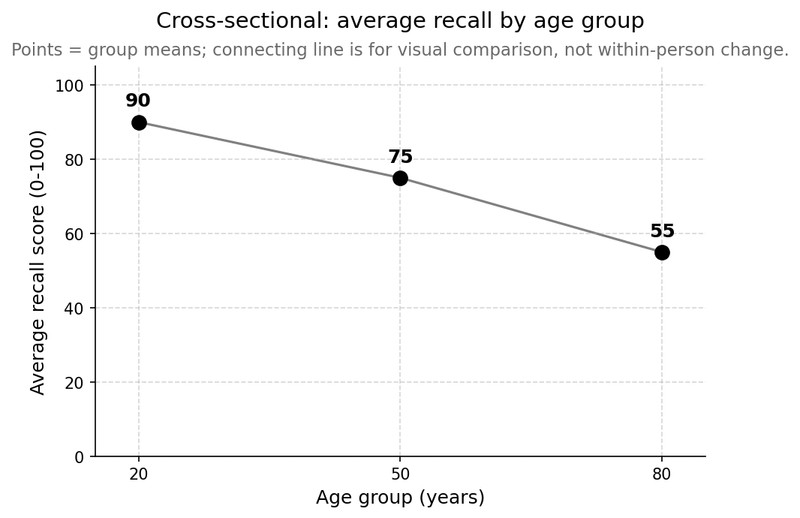
Cross-sectional recall scores by age group
Strengths
- fast
- less expensive
- compares several age groups at once
- avoids long waiting periods and attrition
Limits
- cohort effects can confuse results
- A cohort is a group born in the same historical period.
- Differences may come from schooling, nutrition, health care, or technology exposure rather than aging.
- It shows age-group differences, not change within the same people.
- Narrow samples may not generalize well.
Longitudinal Research
Longitudinal research follows the same people over time and measures them repeatedly.
Example: test the same adults’ memory every five years from age 55 to 75. In a graph like this one, each lighter line represents one participant across time, and the darker line shows the overall average trend.
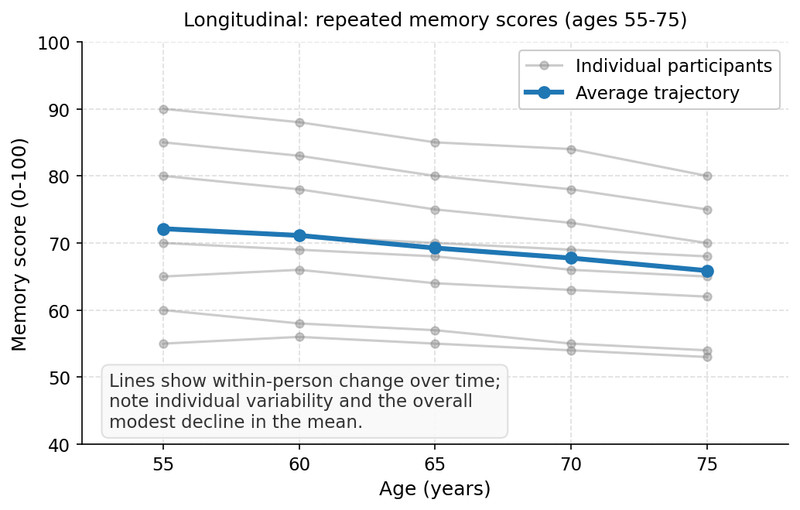
Longitudinal study of memory scores over time
Strengths
It is best for tracking developmental trajectories because researchers can see:
- where a person starts
- how that person changes over time
- whether people stay relatively high or low compared with peers
It also helps with temporal order, meaning you know which measured event happened first.
Limits
- time-consuming and expensive
- attrition means participants drop out
- systematic attrition biases results if the people who stay differ from the people who leave
- practice effects can raise scores just from repeated testing
- one cohort may reflect unique historical events
What Researchers Can Conclude
- Cross-sectional studies show differences between age groups.
- Longitudinal studies show change within the people studied.
- Neither design alone proves causation. Causation requires experimental control, such as manipulation and random assignment.
Key Takeaways
Developmental Psychology
Study of age-related stability and change in behavior and mental processes across the entire lifespan
Chronological vs. Thematic Accounts of Development
Chronological accounts examine what occurs across successive life periods; thematic accounts follow recurring developmental questions across the lifespan
Stability and Change
The theme asking which characteristics remain relatively consistent over time and which are systematically altered by maturation and experience
Nature and Nurture
The theme concerning how biological inheritance and environmental experience interact to influence development
Continuous vs. Discontinuous Development
Continuous development is gradual and cumulative; discontinuous development involves distinct stages or qualitative changes in functioning
Stage Theory
A theory proposing that development proceeds through an ordered sequence of stages with qualitatively different forms of functioning
Cross-Sectional Design
A design comparing different groups, usually different age groups, at approximately the same time, with each participant ordinarily measured once
Longitudinal Design
A design that repeatedly measures the same individuals over an extended period to observe within-person stability and change
Cohort Effect
An age-group difference caused by generations' differing historical or cultural experiences rather than by aging itself
Attrition
Participant dropout over time in a longitudinal study, which can bias results when those who remain differ from those who leave
Practice Effects
Changes in performance caused by repeated exposure to a task rather than by development in the underlying ability
Notes
Developmental Psychology
Study of age-related stability and change in behavior and mental processes across the entire lifespan
Chronological vs. Thematic Accounts of Development
Chronological accounts examine what occurs across successive life periods; thematic accounts follow recurring developmental questions across the lifespan
Stability and Change
The theme asking which characteristics remain relatively consistent over time and which are systematically altered by maturation and experience
Nature and Nurture
The theme concerning how biological inheritance and environmental experience interact to influence development
Continuous vs. Discontinuous Development
Continuous development is gradual and cumulative; discontinuous development involves distinct stages or qualitative changes in functioning
Stage Theory
A theory proposing that development proceeds through an ordered sequence of stages with qualitatively different forms of functioning
Cross-Sectional Design
A design comparing different groups, usually different age groups, at approximately the same time, with each participant ordinarily measured once
Longitudinal Design
A design that repeatedly measures the same individuals over an extended period to observe within-person stability and change
Cohort Effect
An age-group difference caused by generations' differing historical or cultural experiences rather than by aging itself
Attrition
Participant dropout over time in a longitudinal study, which can bias results when those who remain differ from those who leave
Practice Effects
Changes in performance caused by repeated exposure to a task rather than by development in the underlying ability
