Topic 1.6 Notes – Sensation
What Sensation Is
Sensation means detecting stimulation from the environment and transducing it into neural signals. Transduction happens in every sense. Light, sound waves, pressure, and chemicals do not go into the brain unchanged. Receptors convert them into the nervous system’s language.
Perception is the next step. It organizes and interprets those signals. If light hits your retina, that is sensation. Realizing it is your friend’s face is perception.
Psychophysics studies the link between physical stimuli and what you experience.
Thresholds and Sensory Change
- Absolute threshold is the minimum stimulation you can detect 50% of the time.
- Subliminal stimuli are below that threshold.
- Difference threshold or just-noticeable difference (JND) is the smallest change you can detect, also 50% of the time.
Weber’s law says the JND is a proportion of the original stimulus, not a fixed amount.
If the starting stimulus is bigger, the change needed to notice it is also bigger.
- Sensory adaptation means reduced sensitivity to constant stimulation.
- You stop noticing your hoodie on your skin.
- You notice a new smell at first, then awareness fades.
- This helps you pay attention to change, which is usually more useful.
Sensory Interaction
Your senses work together.
- Flavor depends heavily on taste + smell.
- Seeing lip movements can change what sound you think you heard.
- Synesthesia is when one kind of stimulation automatically triggers another sensory experience, like hearing music and seeing colors.
How Vision Works
Visible light is electromagnetic energy. Wavelength relates to hue or color. Amplitude/intensity relates to brightness.
A quick cross-section of the eye helps you place the main structures before you trace the path of light.
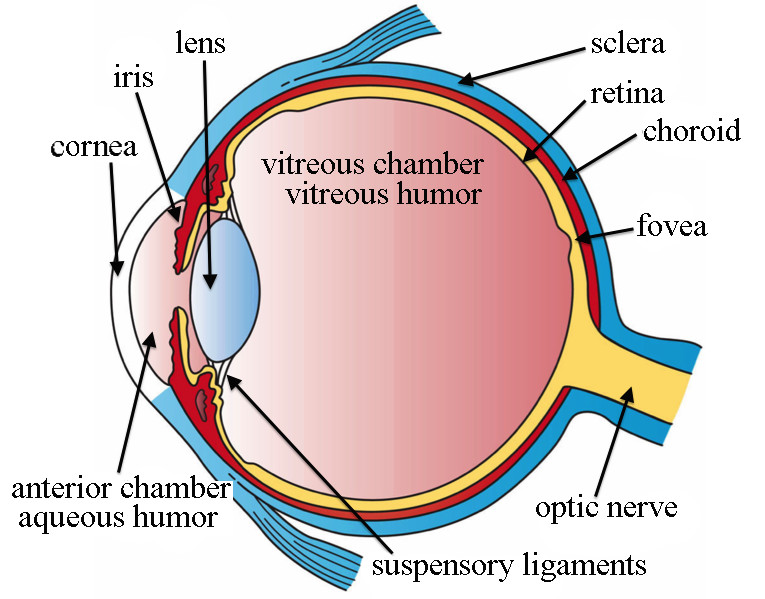
Light follows this path through the eye:
- Cornea
- Pupil
- Iris adjusts pupil size
- Lens
- Retina
The lens changes shape by accommodation so images focus on the retina.
- Myopia means distant images focus in front of the retina.
- Hyperopia means near images would focus behind the retina.
Retina and Visual Cells
The retina is the light-sensitive surface where visual transduction begins.
| Cell type | Where | Best at | Light level |
|---|---|---|---|
| Rods | Peripheral retina | Shape, movement | Dim light |
| Cones | Fovea | Color, fine detail | Bright light |
- Rods matter for dark adaptation.
- Axons of ganglion cells form the optic nerve.
- The blind spot is where the optic nerve leaves the eye. There are no receptors there.
- You do not see a hole because the brain fills in missing information.
Color Vision
These two theories fit together. The cone types are shown across the top, and the opponent color channels are shown below.
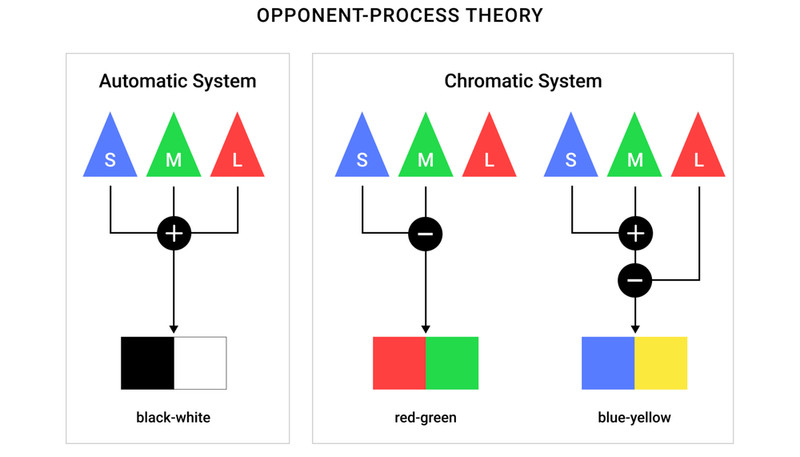
Two theories explain color vision at different stages:
- Trichromatic theory says you have three cone types sensitive to
- short wavelengths blue
- medium wavelengths green
- long wavelengths red
- Opponent-process theory says color is processed in opposing pairs
- red/green
- blue/yellow
- black/white
This explains afterimages. Stare at one color, then look at white, and the opponent color appears.
- Dichromatism means one cone system is missing or impaired.
- Monochromatism means little or no color discrimination.
Visual Brain Problems
Vision also depends on the brain, especially the occipital lobe.
- Prosopagnosia means face blindness.
- Blindsight means responding to visual stimuli without conscious awareness of seeing them.
How Hearing Works
Sound is pressure waves in air. Frequency relates to pitch. Amplitude relates to loudness.
To follow the process, it helps to picture the sound pathway through the outer, middle, and inner ear.
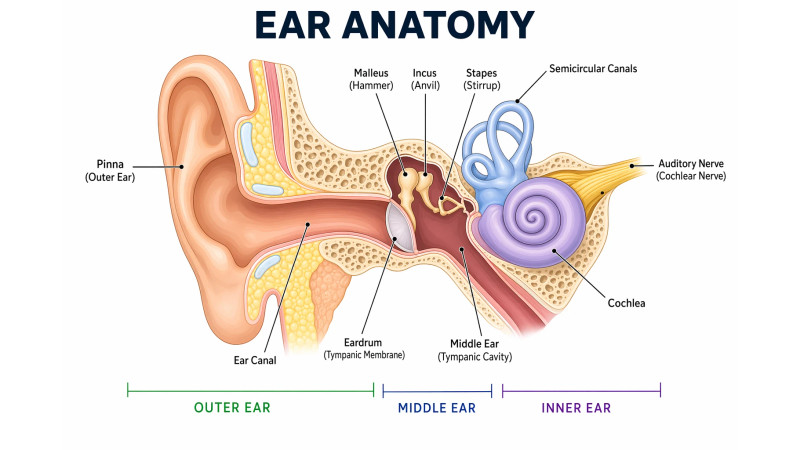
Path of sound:
- Pinna
- Ear canal
- Eardrum
- Hammer, anvil, stirrup
- Oval window
- Cochlea
- Basilar membrane bends hair cells
- Auditory nerve → thalamus → temporal lobe
Pitch and Location
- Place theory says pitch depends on where the basilar membrane vibrates most. Best for high pitches.
- Frequency theory says firing rate matches sound frequency. Best for low pitches.
- Volley theory says groups of neurons take turns firing. Best for middle ranges.
Sound localization happens because the brain compares tiny differences in timing and loudness between the two ears.
Hearing Loss
- Conduction deafness comes from problems transmitting sound in the outer or middle ear.
- Sensorineural deafness comes from damage to hair cells or the auditory nerve.
- Aging and loud noise often cause sensorineural loss.
- Cochlear implants can help some people with sensorineural loss.
The Other Senses
Smell and Taste
- Olfaction is smell. Airborne molecules activate receptors in nasal tissue.
- Smell is the only sense that does not first route through the thalamus.
- Pheromones are chemical signals, clearly established in many nonhuman species.
- Gustation is taste from chemicals dissolved in saliva.
- The six tastes are sweet, sour, salty, bitter, umami, and oleogustus.
- There is no true tongue map.
- Supertasters, medium tasters, and nontasters differ in receptor sensitivity.
- Flavor depends strongly on smell + taste together.
Touch and Pain
- Skin receptors detect pressure, warmth, and cold.
- Touch is processed in the somatosensory cortex.
- Feeling hot can come from warm and cold receptors firing together.
- Nociceptors detect possible tissue damage.
Gate control theory says the spinal cord has a “gate” that can increase or reduce pain signals. That is why rubbing an injured spot can lessen pain.
Pain is shaped by attention, emotion, and expectation, not just injury.
- Phantom limb sensation is feeling an amputated limb. Sometimes it is painful.
Balance and Body Position
- The vestibular sense helps with balance, head movement, and orientation.
- Semicircular canals detect rotational movement.
- Kinesthesis is awareness of body-part position and movement.
- Smooth movement depends on vestibular, kinesthetic, visual, and touch input working together.
Key Takeaways
Sensation
The detection of physical or chemical stimulation by sensory receptors and its conversion into neural or neurochemical signals
Transduction
The conversion of stimulus energy into neural or neurochemical messages used by the nervous system
Psychophysics
The study of relationships between the physical characteristics of stimuli and the sensations they produce
Absolute Threshold
The minimum stimulus intensity that can be detected at least 50 percent of the time
Subliminal Stimulus
A stimulus presented below the absolute threshold for conscious detection
Difference Threshold (Just-Noticeable Difference, JND)
The minimum difference between two stimuli that can be detected at least 50 percent of the time
Weber’s Law
The just-noticeable difference is a constant proportion of the original stimulus intensity: ΔI/I = k
Sensory Adaptation
Diminished sensitivity to a constant, unchanging stimulus after continued exposure
Sensory Interaction
The process through which sensory systems work together and influence one another
Synesthesia
Automatic, consistent production of an additional sensory experience when another sensory or cognitive system is stimulated
Wavelength and Hue
Wavelength is the distance between wave peaks; visible-light wavelength is associated with experienced hue, or color
Light Intensity and Brightness
Light intensity is the amount or amplitude of light energy and contributes to experienced brightness
Cornea
The transparent outer covering of the eye that begins focusing incoming light
Pupil
The opening in the eye through which light passes and whose size is controlled by the iris
Iris
The colored muscular structure that controls the size of the pupil
Lens
The transparent eye structure that changes shape to focus light onto the retina
Accommodation
The process by which the lens changes shape to focus objects at different distances onto the retina
Nearsightedness (Myopia)
A refractive error in which distant images focus in front of the retina, making nearby objects clearer
Farsightedness (Hyperopia)
A refractive error in which nearby images would focus behind the retina, making distant objects clearer
Retina
The photosensitive surface at the back of the eye containing photoreceptors that transduce light into neural signals
Rods
Retinal photoreceptors concentrated toward the periphery that detect dim light, shapes, and movement but not color
Cones
Retinal photoreceptors concentrated in the fovea that function best in bright light and provide color vision and fine detail
Fovea
The central, cone-rich area of the retina associated with the sharpest vision
Optic Nerve
The bundle of ganglion-cell axons that carries visual information from the retina toward the brain
Blind Spot
The retinal location where the optic nerve exits and no rods or cones are present
Dark Adaptation
The gradual increase in visual sensitivity after moving from a bright environment into darkness
Light Adaptation
The reduction in visual sensitivity after moving from darkness into bright light
Trichromatic Theory (Young–Helmholtz Theory)
Color vision begins with three cone types most sensitive to short, medium, and long wavelengths
Opponent-Process Theory
Color information is organized into opposing red–green, blue–yellow, and black–white channels
Negative Afterimage
A lingering image in opponent colors produced when adaptation weakens one color process and its opponent responds more strongly
Color Vision Deficiency
Reduced color discrimination caused by missing, damaged, or irregular cone systems or opponent-processing mechanisms
Dichromatism
A color vision deficiency in which only two cone systems function normally
Monochromatism
A rare color vision deficiency involving little or no functional color discrimination
Prosopagnosia (Face Blindness)
The inability or severe difficulty in recognizing familiar faces despite seeing their visual features
Blindsight
The ability to respond to visual information without conscious visual experience after damage to visual cortex
Frequency and Pitch
Frequency is the number of sound-wave cycles per second; higher frequencies are generally experienced as higher pitches
Amplitude and Loudness
Amplitude is the height or strength of a sound wave; greater amplitude is generally experienced as greater loudness
Pinna
The external-ear structure that collects sound and directs it into the auditory canal
Auditory Canal
The passage that carries sound from the pinna to the eardrum
Eardrum (Tympanic Membrane)
A membrane that vibrates in response to sound waves and transfers movement to the middle-ear bones
Hammer, Anvil, and Stirrup (Ossicles)
Three middle-ear bones that transmit and amplify vibrations from the eardrum to the inner ear
Oval Window
A membrane through which the stirrup transfers vibration into the fluid of the cochlea
Cochlea
A coiled inner-ear structure whose fluid movement stimulates the basilar membrane and auditory hair cells
Basilar Membrane
A membrane within the cochlea whose location of greatest vibration helps code sound frequency
Cochlear Hair Cells
Inner-ear receptor cells that transduce mechanical movement in the cochlea into neural signals
Auditory Nerve
The nerve that carries transduced auditory information from the cochlea toward the brain
Place Theory
Pitch depends on the location along the basilar membrane where vibration is greatest, especially for high frequencies
Frequency Theory
Pitch is coded by a neural firing rate that corresponds to the sound-wave frequency, especially for low frequencies
Volley Theory
Groups of auditory neurons alternate firing so their combined rate represents frequencies too high for one neuron to match
Sound Localization
The ability to identify a sound’s direction by comparing its arrival time and intensity at the two ears
Conduction Deafness (Conductive Hearing Loss)
Hearing loss caused by impaired transmission of sound through the outer or middle ear to the cochlea
Sensorineural Deafness
Hearing loss caused by damage to cochlear hair cells, the auditory nerve, or related neural structures
Olfaction
The sense of smell, in which airborne molecules activate nasal receptors whose signals reach cortex without first passing through the thalamus
Olfactory Nerve
The nerve that carries smell information from olfactory receptors toward the olfactory bulb and brain
Olfactory Bulb
A brain structure that receives and processes signals arriving from olfactory receptors
Pheromones
Chemical signals released by an organism that affect members of the same species through olfactory or related chemical systems
Gustation
The sense of taste; its basic qualities are sweet, sour, salty, bitter, umami, and oleogustus
Taste Buds
Structures primarily on the tongue that contain receptor cells for transducing dissolved chemicals into taste signals
Umami
The savory basic taste associated with substances such as glutamate
Oleogustus
The basic taste quality associated with fatty acids
Pain
A sensory and psychological experience shaped by damaging stimulation, neural processing, attention, emotion, expectations, and context
Nociceptors
Sensory receptors that respond to potentially damaging stimulation and send signals toward the spinal cord and brain
Gate Control Theory
Pain transmission is regulated by spinal-cord mechanisms that can increase or decrease the flow of pain signals to the brain
Phantom Limb Sensation
Touch, movement, pressure, itching, or pain experienced in a limb that has been amputated
Vestibular Sense
The sense of balance, head movement, and orientation relative to gravity, detected mainly by inner-ear structures
Semicircular Canals
Three fluid-filled inner-ear structures that detect rotational head movement when fluid bends receptor cells
Kinesthesis
The sense of the position and movement of body parts, using receptors in muscles, tendons, and joints
Touch
The skin sense in which receptors transduce pressure, warmth, cold, and related stimulation; simultaneous activation of warm and cold receptors can produce intense "hot."
Supertaster
A person with relatively high taste sensitivity who often experiences certain tastes, especially bitterness, as unusually intense
Medium Taster
A person whose taste sensitivity falls between that of supertasters and nontasters
Nontaster
A person with relatively low sensitivity to some taste compounds, not a person with no sense of taste
Notes
Sensation
The detection of physical or chemical stimulation by sensory receptors and its conversion into neural or neurochemical signals
Transduction
The conversion of stimulus energy into neural or neurochemical messages used by the nervous system
Psychophysics
The study of relationships between the physical characteristics of stimuli and the sensations they produce
Absolute Threshold
The minimum stimulus intensity that can be detected at least 50 percent of the time
Subliminal Stimulus
A stimulus presented below the absolute threshold for conscious detection
Difference Threshold (Just-Noticeable Difference, JND)
The minimum difference between two stimuli that can be detected at least 50 percent of the time
Weber’s Law
The just-noticeable difference is a constant proportion of the original stimulus intensity: ΔI/I = k
Sensory Adaptation
Diminished sensitivity to a constant, unchanging stimulus after continued exposure
Sensory Interaction
The process through which sensory systems work together and influence one another
Synesthesia
Automatic, consistent production of an additional sensory experience when another sensory or cognitive system is stimulated
Wavelength and Hue
Wavelength is the distance between wave peaks; visible-light wavelength is associated with experienced hue, or color
Light Intensity and Brightness
Light intensity is the amount or amplitude of light energy and contributes to experienced brightness
Cornea
The transparent outer covering of the eye that begins focusing incoming light
Pupil
The opening in the eye through which light passes and whose size is controlled by the iris
Iris
The colored muscular structure that controls the size of the pupil
Lens
The transparent eye structure that changes shape to focus light onto the retina
Accommodation
The process by which the lens changes shape to focus objects at different distances onto the retina
Nearsightedness (Myopia)
A refractive error in which distant images focus in front of the retina, making nearby objects clearer
Farsightedness (Hyperopia)
A refractive error in which nearby images would focus behind the retina, making distant objects clearer
Retina
The photosensitive surface at the back of the eye containing photoreceptors that transduce light into neural signals
Rods
Retinal photoreceptors concentrated toward the periphery that detect dim light, shapes, and movement but not color
Cones
Retinal photoreceptors concentrated in the fovea that function best in bright light and provide color vision and fine detail
Fovea
The central, cone-rich area of the retina associated with the sharpest vision
Optic Nerve
The bundle of ganglion-cell axons that carries visual information from the retina toward the brain
Blind Spot
The retinal location where the optic nerve exits and no rods or cones are present
Dark Adaptation
The gradual increase in visual sensitivity after moving from a bright environment into darkness
Light Adaptation
The reduction in visual sensitivity after moving from darkness into bright light
Trichromatic Theory (Young–Helmholtz Theory)
Color vision begins with three cone types most sensitive to short, medium, and long wavelengths
Opponent-Process Theory
Color information is organized into opposing red–green, blue–yellow, and black–white channels
Negative Afterimage
A lingering image in opponent colors produced when adaptation weakens one color process and its opponent responds more strongly
Color Vision Deficiency
Reduced color discrimination caused by missing, damaged, or irregular cone systems or opponent-processing mechanisms
Dichromatism
A color vision deficiency in which only two cone systems function normally
Monochromatism
A rare color vision deficiency involving little or no functional color discrimination
Prosopagnosia (Face Blindness)
The inability or severe difficulty in recognizing familiar faces despite seeing their visual features
Blindsight
The ability to respond to visual information without conscious visual experience after damage to visual cortex
Frequency and Pitch
Frequency is the number of sound-wave cycles per second; higher frequencies are generally experienced as higher pitches
Amplitude and Loudness
Amplitude is the height or strength of a sound wave; greater amplitude is generally experienced as greater loudness
Pinna
The external-ear structure that collects sound and directs it into the auditory canal
Auditory Canal
The passage that carries sound from the pinna to the eardrum
Eardrum (Tympanic Membrane)
A membrane that vibrates in response to sound waves and transfers movement to the middle-ear bones
Hammer, Anvil, and Stirrup (Ossicles)
Three middle-ear bones that transmit and amplify vibrations from the eardrum to the inner ear
Oval Window
A membrane through which the stirrup transfers vibration into the fluid of the cochlea
Cochlea
A coiled inner-ear structure whose fluid movement stimulates the basilar membrane and auditory hair cells
Basilar Membrane
A membrane within the cochlea whose location of greatest vibration helps code sound frequency
Cochlear Hair Cells
Inner-ear receptor cells that transduce mechanical movement in the cochlea into neural signals
Auditory Nerve
The nerve that carries transduced auditory information from the cochlea toward the brain
Place Theory
Pitch depends on the location along the basilar membrane where vibration is greatest, especially for high frequencies
Frequency Theory
Pitch is coded by a neural firing rate that corresponds to the sound-wave frequency, especially for low frequencies
Volley Theory
Groups of auditory neurons alternate firing so their combined rate represents frequencies too high for one neuron to match
Sound Localization
The ability to identify a sound’s direction by comparing its arrival time and intensity at the two ears
Conduction Deafness (Conductive Hearing Loss)
Hearing loss caused by impaired transmission of sound through the outer or middle ear to the cochlea
Sensorineural Deafness
Hearing loss caused by damage to cochlear hair cells, the auditory nerve, or related neural structures
Olfaction
The sense of smell, in which airborne molecules activate nasal receptors whose signals reach cortex without first passing through the thalamus
Olfactory Nerve
The nerve that carries smell information from olfactory receptors toward the olfactory bulb and brain
Olfactory Bulb
A brain structure that receives and processes signals arriving from olfactory receptors
Pheromones
Chemical signals released by an organism that affect members of the same species through olfactory or related chemical systems
Gustation
The sense of taste; its basic qualities are sweet, sour, salty, bitter, umami, and oleogustus
Taste Buds
Structures primarily on the tongue that contain receptor cells for transducing dissolved chemicals into taste signals
Umami
The savory basic taste associated with substances such as glutamate
Oleogustus
The basic taste quality associated with fatty acids
Pain
A sensory and psychological experience shaped by damaging stimulation, neural processing, attention, emotion, expectations, and context
Nociceptors
Sensory receptors that respond to potentially damaging stimulation and send signals toward the spinal cord and brain
Gate Control Theory
Pain transmission is regulated by spinal-cord mechanisms that can increase or decrease the flow of pain signals to the brain
Phantom Limb Sensation
Touch, movement, pressure, itching, or pain experienced in a limb that has been amputated
Vestibular Sense
The sense of balance, head movement, and orientation relative to gravity, detected mainly by inner-ear structures
Semicircular Canals
Three fluid-filled inner-ear structures that detect rotational head movement when fluid bends receptor cells
Kinesthesis
The sense of the position and movement of body parts, using receptors in muscles, tendons, and joints
Touch
The skin sense in which receptors transduce pressure, warmth, cold, and related stimulation; simultaneous activation of warm and cold receptors can produce intense "hot."
Supertaster
A person with relatively high taste sensitivity who often experiences certain tastes, especially bitterness, as unusually intense
Medium Taster
A person whose taste sensitivity falls between that of supertasters and nontasters
Nontaster
A person with relatively low sensitivity to some taste compounds, not a person with no sense of taste
