Topic 5.3 Notes – Explaining and Classifying Psychological Disorders
What Makes a Pattern a Psychological Disorder
There is no single test for “disorder.” Clinicians look at several indicators together and always in context.
The three indicators
- Distress means significant emotional suffering, like intense fear, sadness, guilt, or confusion.
- Distress by itself does not prove a disorder. Grief after a death or anxiety before a big exam can be normal.
- Some people report little distress because they lack insight into the problem.
- Dysfunction means the pattern interferes with daily life.
- It can affect school, work, relationships, self-care, or decision-making.
- What matters is severity, persistence, and impairment. A normal reaction becomes disordered when it seriously disrupts functioning.
- Deviation from social norms means behavior differs from what a culture or situation expects.
- Unusual does not automatically mean disordered.
- Norms vary by culture, age, time period, and setting, so context matters a lot.
A possible psychological disorder is often understood as involving some combination of distress, dysfunction, and deviation from social norms.
One common mistake is thinking dangerousness defines disorder. It does not. Many people with psychological disorders are not dangerous.
A quick distinction helps here:
- Definition asks whether behavior counts as disordered.
- Classification asks what category it fits.
- Explanation asks what caused or maintains it.
Diagnosis and Classification
A diagnosis is a trained professional’s judgment using evidence-based assessment. It is not self-diagnosis, one odd behavior, or an online checklist.
Clinicians use multiple sources of evidence:
- clinical or structured interviews
- behavioral observation
- psychological tests and symptom measures
- medical, developmental, educational, and family history when relevant
- ruling out substances, sleep deprivation, injury, or medical conditions
Good diagnosis aims for two things:
| Term | What it means |
|---|---|
| Reliability | Trained clinicians should reach similar conclusions |
| Validity | The diagnosis should actually identify the condition it claims to identify |
DSM
DSM stands for Diagnostic and Statistical Manual of Mental Disorders.
- Made by the American Psychiatric Association
- Main system used in the United States
- Gives diagnostic categories and criteria
ICD
ICD stands for International Classification of Diseases.
- Made by the World Health Organization
- Used internationally
- Includes mental and behavioral disorders
Both systems are revised as research improves reliability, validity, and cultural fit.
Why Diagnosis Helps and Why It Can Harm
A diagnosis can help because it:
- gives a name for a pattern of symptoms
- improves communication among professionals
- guides treatment and support
- helps research
- increases access to insurance, accommodations, and services
- can reduce self-blame
It can also harm because it may lead to:
- stigma and stereotyping
- shame or discrimination
- reducing a person to a label
- overdiagnosis, underdiagnosis, or misdiagnosis
- treating the label like a full explanation of cause
- self-fulfilling expectations
Culture and bias matter the whole time. Racism, sexism, ageism, class bias, and ableism can affect who gets diagnosed and how symptoms are interpreted. Culturally accepted practices should not be mislabeled as pathology, and fear of stigma can keep people from reporting symptoms.
Perspectives on the Causes of Psychological Disorders
Most psychologists use an eclectic approach, which means combining more than one perspective.
- Behavioral: symptoms come from maladaptive learned associations and reinforcement
(classical conditioning and operant conditioning) - Psychodynamic: symptoms grow from unconscious conflicts and childhood experiences
(Freud background) - Humanistic: lack of social support or blocked personal growth contributes to problems
(Rogers and Maslow background) - Cognitive: maladaptive thoughts, beliefs, and interpretations drive distress
- Biological: genes, brain function, neurotransmitters, hormones, illness, or prenatal factors matter
- Sociocultural: family, discrimination, poverty, cultural expectations, and social conditions shape disorders
- Evolutionary: some problems may reflect behaviors or mental processes that reduce survival, or overactive systems that were once adaptive
Interaction Models
These models reject one-cause explanations.
Biopsychosocial model
The biopsychosocial model says disorders can come from interacting biological, psychological, and social factors, as in the overlapping-circle diagram here.
- biological factors like genes, brain chemistry, hormones, health
- psychological factors like thoughts, emotions, learning history, coping
- sociocultural factors like family, peers, culture, discrimination, community stress
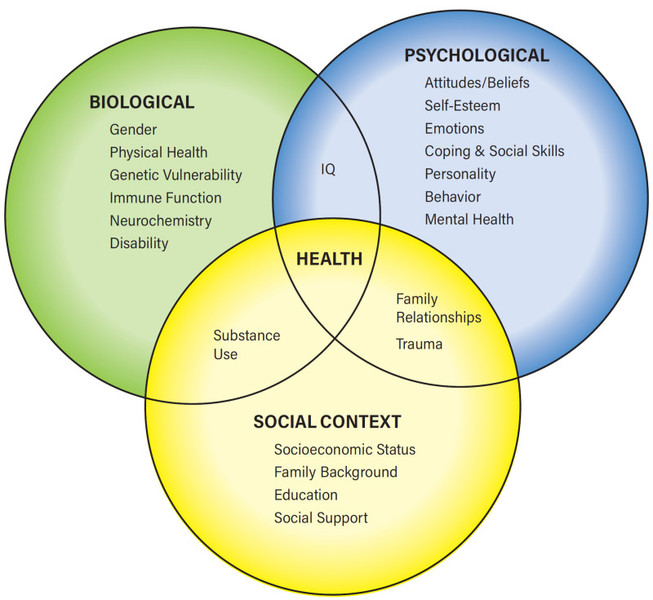
Biopsychosocial model
Diathesis-stress model
The diathesis-stress model is more specific. It says a genetic vulnerability plus stressful life experiences increases risk.
- Vulnerability alone does not guarantee a disorder.
- Stress alone does not affect everyone the same way.
- The phrase to remember is genes load the gun, environment pulls the trigger.
So the distinction is simple:
- Biopsychosocial is the broader model.
- Diathesis-stress is one specific gene-environment interaction model.
Key Takeaways
Psychological Disorder
A pattern of thoughts, emotions, or behavior evaluated in context because it causes significant distress, impairs functioning, or substantially deviates from social and cultural expectations
Level of Dysfunction
The degree to which a pattern interferes with work, learning, relationships, self-care, decisions, or other important daily functioning
Perception of Distress
A person’s subjective experience of significant emotional or psychological suffering; it is an indicator but is neither necessary nor sufficient by itself for diagnosis
Deviation From Social Norms
A substantial departure from a group’s social or cultural expectations, interpreted according to culture, age, historical period, and situation
Diagnosis
The professional determination, using evidence-based assessment and established criteria, that a person’s symptoms and functioning meet the criteria for a psychological disorder
Classification
Placing a diagnosed disorder within an organized category that gives professionals shared criteria and terminology
Diagnostic and Statistical Manual of Mental Disorders (DSM)
The American Psychiatric Association’s principal U.S. manual of categories and diagnostic criteria for psychological disorders
International Classification of Diseases (ICD)
The World Health Organization’s international system for classifying diseases and health conditions, including mental, behavioral, and neurodevelopmental disorders
Behavioral Perspective
Explains psychological disorders through maladaptive learned associations among stimuli, responses, and consequences
Psychodynamic Perspective
Explains psychological disorders through unconscious thoughts, conflicts, motives, and experiences, often originating in childhood
Humanistic Perspective
Explains psychological disorders through unmet needs, inadequate social support, barriers to personal growth, and inability to fulfill one’s potential
Cognitive Perspective
Explains psychological disorders through maladaptive thoughts, beliefs, attitudes, interpretations, expectations, and related emotions
Evolutionary Perspective
Explains psychological disorders as patterns whose operation reduces survival or interferes with successful adaptation
Sociocultural Perspective
Explains psychological disorders through social relationships, cultural expectations, institutions, living conditions, and unequal power and resources
Biological Perspective
Explains psychological disorders through physiological and genetic influences such as inherited predispositions, brain processes, hormones, and physical health
Eclectic Approach
Using ideas and methods from more than one psychological perspective according to the evidence, individual, and context
Biopsychosocial Model
The model that psychological problems may result from interacting biological, psychological, and sociocultural factors
Diathesis-Stress Model
The model that a psychological disorder develops when a genetic vulnerability, or diathesis, combines with stressful life experiences
Notes
Psychological Disorder
A pattern of thoughts, emotions, or behavior evaluated in context because it causes significant distress, impairs functioning, or substantially deviates from social and cultural expectations
Level of Dysfunction
The degree to which a pattern interferes with work, learning, relationships, self-care, decisions, or other important daily functioning
Perception of Distress
A person’s subjective experience of significant emotional or psychological suffering; it is an indicator but is neither necessary nor sufficient by itself for diagnosis
Deviation From Social Norms
A substantial departure from a group’s social or cultural expectations, interpreted according to culture, age, historical period, and situation
Diagnosis
The professional determination, using evidence-based assessment and established criteria, that a person’s symptoms and functioning meet the criteria for a psychological disorder
Classification
Placing a diagnosed disorder within an organized category that gives professionals shared criteria and terminology
Diagnostic and Statistical Manual of Mental Disorders (DSM)
The American Psychiatric Association’s principal U.S. manual of categories and diagnostic criteria for psychological disorders
International Classification of Diseases (ICD)
The World Health Organization’s international system for classifying diseases and health conditions, including mental, behavioral, and neurodevelopmental disorders
Behavioral Perspective
Explains psychological disorders through maladaptive learned associations among stimuli, responses, and consequences
Psychodynamic Perspective
Explains psychological disorders through unconscious thoughts, conflicts, motives, and experiences, often originating in childhood
Humanistic Perspective
Explains psychological disorders through unmet needs, inadequate social support, barriers to personal growth, and inability to fulfill one’s potential
Cognitive Perspective
Explains psychological disorders through maladaptive thoughts, beliefs, attitudes, interpretations, expectations, and related emotions
Evolutionary Perspective
Explains psychological disorders as patterns whose operation reduces survival or interferes with successful adaptation
Sociocultural Perspective
Explains psychological disorders through social relationships, cultural expectations, institutions, living conditions, and unequal power and resources
Biological Perspective
Explains psychological disorders through physiological and genetic influences such as inherited predispositions, brain processes, hormones, and physical health
Eclectic Approach
Using ideas and methods from more than one psychological perspective according to the evidence, individual, and context
Biopsychosocial Model
The model that psychological problems may result from interacting biological, psychological, and sociocultural factors
Diathesis-Stress Model
The model that a psychological disorder develops when a genetic vulnerability, or diathesis, combines with stressful life experiences
