Topic 1.1 Notes – Scarcity
1. Scarcity and Why It Exists
Scarcity means we have limited resources but unlimited wants.
People always want more goods and services than can be produced with the resources available. That gap is the fundamental economic problem.
This is true in every system:
- Market economies
- Command economies
- Mixed economies (like the United States)
No country escapes scarcity.
Factors of Production
The resources that are scarce are called the factors of production. You need to know these cold.
- Land
All natural resources: oil, water, minerals, farmland, forests. - Labor
Human effort, physical and mental. Workers, engineers, teachers. - Capital
Tools and equipment used to produce other goods.
Examples: factories, machines, computers.
(This is physical capital, not money.) - Entrepreneurship
The risk-taking and innovation that organizes land, labor, and capital.
Think of people like Henry Ford organizing factories for mass production.
Why Are Resources Scarce?
Scarcity exists because:
- Physical limits
There is only so much oil, land, or labor hours available. - Time is limited
Everyone gets 24 hours a day. - Technology limits production
At any moment, we can only produce what our current technology allows.
For example, during World War II, U.S. factories shifted from consumer goods to military production. The same factories couldn’t fully produce both at once.
Rival vs. Non-Rival Resources
Most factors of production are rival:
- If one person uses a machine, someone else cannot use it at the same time.
Some knowledge is non-rival:
- A mathematical formula or coding language can be used by millions at once without running out.
That is why established knowledge can spread widely without becoming scarce in the same way physical resources are.
Core idea: Scarcity is unavoidable because most productive resources are rival and limited.
2. Trade-Offs and Opportunity Cost
Because resources are scarce, every choice involves a trade-off.
Trade-Offs
A trade-off is all the alternatives you give up when you choose something.
Examples:
- If the government increases military spending, it may reduce funding for education.
- If you work more hours, you give up leisure time.
Scarcity forces these choices. Limited resources and unlimited wants push individuals, firms, and governments to make decisions, and each decision creates a trade-off.
Here’s the basic logic economists use:
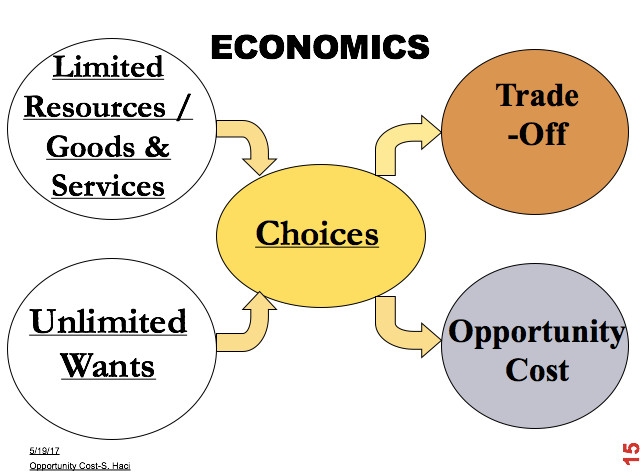
Scarcity, choices, trade-offs, and opportunity cost
Opportunity Cost
Opportunity cost is the value of the next best alternative you give up.
Two key rules students miss:
- It is only the second-best option, not every option.
- It is measured in whatever you value most (money, time, enjoyment).
Individual Examples
- If you spend Saturday studying instead of working 8 hours at 15 dollars per hour, your opportunity cost is 120 dollars.
- If you attend college, your opportunity cost includes forgone wages.
Firm Example
- A factory uses steel to make SUVs instead of sedans.
The opportunity cost is the profit from the sedans not produced.
Government Example
- During World War II, the U.S. reduced car production to make tanks and planes.
The opportunity cost of military goods was fewer consumer goods.
On tests, they love giving multiple alternatives. Only the next best one counts.
3. The Three Economic Questions
Scarcity forces every society to answer three questions:
- What to produce?
Consumer goods or capital goods?
Military goods or civilian goods? - How to produce?
Labor-intensive or capital-intensive?
Old technology or new? - For whom to produce?
Based on income? Need? Equal shares?
Different systems answer differently:
- Market economy → Prices and profit guide decisions.
- Command economy → Central planners decide.
- Mixed economy → Combination (U.S.).
These questions exist because scarcity exists.
4. Microeconomics vs. Macroeconomics
Both study scarcity. They just zoom in at different levels.
Microeconomics
Focuses on individuals and firms.
- How does price affect quantity demanded?
- How does a firm decide how much to produce?
That is what AP Micro is about.
Macroeconomics
Focuses on the whole economy.
- Inflation
- Unemployment
- Economic growth
For example, during the Great Depression, policymakers used government spending to try to address massive unemployment. That is macro.
Micro stays at the decision-making level of consumers and firms.
5. Why Scarcity Matters for Everything
Here’s the chain you need to see clearly:
Scarcity → Trade-offs → Opportunity Cost → Decision-making → Supply and Demand
If resources were unlimited:
- No trade-offs
- No opportunity cost
- No prices
- No economics
Everything in this course builds on this idea.
Key Takeaways
Scarcity
Limited resources relative to unlimited wants and needs.
Human Capital and Physical Capital
Human capital is workers' skills and knowledge; physical capital is tools, machines, and buildings used to produce.
Trade-Offs
Choices between alternatives that require giving up one thing to get another.
Opportunity Cost
The value of the next best alternative given up when a choice is made.
Unlimited Wants and Needs
The idea that people desire more goods and services than available resources can provide.
Non-Rival Resource
A resource one person's use does not reduce another person's ability to use.
Established Knowledge
Existing ideas and information that can often be shared widely without being used up.
Factors of Production
Inputs used to produce goods and services: land, labor, capital, and entrepreneurship.
Notes
Scarcity
Limited resources relative to unlimited wants and needs.
Human Capital and Physical Capital
Human capital is workers' skills and knowledge; physical capital is tools, machines, and buildings used to produce.
Trade-Offs
Choices between alternatives that require giving up one thing to get another.
Opportunity Cost
The value of the next best alternative given up when a choice is made.
Unlimited Wants and Needs
The idea that people desire more goods and services than available resources can provide.
Non-Rival Resource
A resource one person's use does not reduce another person's ability to use.
Established Knowledge
Existing ideas and information that can often be shared widely without being used up.
Factors of Production
Inputs used to produce goods and services: land, labor, capital, and entrepreneurship.
