Topic 6.3 Notes – Public and Private Goods
1. Rivalry and Excludability
Everything in this topic starts with two questions.
Is the good rival?
- Rival means one person’s use reduces what’s available for others.
- If you eat a slice of pizza, no one else can eat that slice.
- Non-rival means your use does not reduce availability.
- Your use of a streetlight doesn’t make it dimmer for others.
Is the good excludable?
- Excludable means non-payers can be prevented from using it.
- Movie tickets, iPhones, private tutoring.
- Non-excludable means it’s difficult or impossible to prevent non-payers.
- National defense, clean air, many public parks.
These two traits shape incentives. When goods are non-excludable or non-rival, private firms struggle to charge people, and that’s where market failure can happen.
2. The Four Types of Goods
Here’s the full breakdown:
| Type of Good | Rival? | Excludable? | Examples | Key Issue |
|---|---|---|---|---|
| Private Goods | Yes | Yes | Food, clothing, cars | Market works well |
| Public Goods | No | No | National defense, streetlights, lighthouse, basic research | Free rider problem → underproduction |
| Common Resources | Yes | No | Fish in the ocean, grazing land, clean air | Tragedy of the commons → overuse |
| Club Goods (Low-Congestion Goods) | No (at first) | Yes | Netflix, toll roads, cable TV | Congestion possible |
Private Goods
Rival and excludable. Firms can charge consumers, so markets usually allocate them efficiently.
Public Goods
Non-rival and non-excludable. These create the biggest incentive problem.
Common Resources
Rival but non-excludable. Anyone can access them, but each use reduces supply.
Club Goods
Excludable but non-rival until congestion sets in. A toll road is non-rival when empty but becomes rival during rush hour.
Here’s the standard 2×2 visual you’ve probably seen in class. Notice how the columns separate excludable from non-excludable goods, and the rows separate rival from non-rival goods. Each quadrant matches one of the four categories in the table above.

Four types of goods by rivalry and excludability
3. The Free Rider Problem
The free rider problem happens with public goods.
Because they are non-excludable, people can benefit without paying. Since they are non-rival, one extra user costs almost nothing.
So what does a rational person do?
They understate their willingness to pay and hope others cover the cost.
If everyone does this:
- Firms can’t earn profit.
- The good is underproduced or not produced at all.
- This is a market failure.
Classic example: national defense. You cannot exclude someone from being defended. If funding depended on voluntary donations, many people would refuse to contribute.
Government solution:
- Taxation forces payment.
- The public sector (federal, state, local governments) provides the good.
- This solves the incentive problem.
Basic scientific research funded by the federal government is another real-world example because private firms cannot capture all the benefits.
4. The Tragedy of the Commons
Common resources are rival and non-excludable.
Each person thinks, “If I don’t use it, someone else will.”
So they consume more than is socially optimal.
Result:
- Overconsumption
- Resource depletion
- Inefficiency
This is the tragedy of the commons.
Examples:
- Overfishing in international waters
- Deforestation
- Air pollution
The difference from free riding is huge:
- Public goods → underproduction
- Common resources → overuse
Solutions:
- Assign property rights (privatization)
- Government regulation (fishing quotas)
- Tradable permits (like carbon markets)
On exams, they love giving a fishing or pollution scenario and asking you to identify which problem it is. If it’s depletion from overuse, think commons.
5. Efficient Provision of Public Goods
For any good, efficiency occurs where:
For public goods, the key twist is how we find marginal social benefit.
Because everyone consumes the same quantity, we add demand curves vertically.
Private goods use horizontal addition. Public goods use vertical addition.
The graph below shows two individual demand curves for a public good and their vertical sum. At a given quantity, you add each person’s willingness to pay to get the total marginal social benefit. The efficient quantity occurs where that vertically summed demand curve intersects the supply curve.
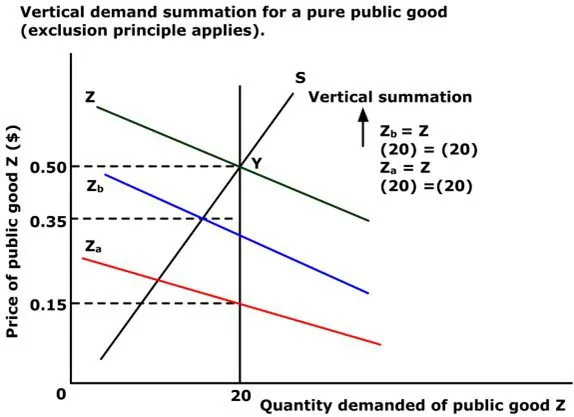
Vertical summation of demand for a public good
Governments sometimes also provide private goods, like public education. Education is technically rival and excludable, but governments provide it because of positive externalities and equity goals.
Key Takeaways
Rivalry and Excludability
Rival means one person’s use reduces others’ use; excludable means nonpayers can be prevented from consuming.
Private Goods
Goods that are both rival and excludable, usually produced through normal market transactions.
Public Goods
Goods that are non-rival and non-excludable, so one person’s use does not limit others’ use.
Free-Rider Problem
When people benefit from a non-excludable good without paying, reducing private incentives to provide it.
Market Failure in Public Goods
A situation where markets underproduce socially desired goods because private incentives do not match social benefits.
Tragedy of the Commons
Overuse of a rival, non-excludable resource because individuals act in their own self-interest.
Club Goods / Low-Congestion Goods
Goods that are excludable but non-rival over some range of use, like streaming services or cable.
Government Provision of Public Goods
Public production funded mainly by taxes because private firms usually cannot profitably supply non-excludable goods.
Government Provision of Private Goods
Government sometimes supplies rival, excludable goods and makes them freely available, such as education.
Efficient Quantity of a Public Good
The socially optimal amount occurs where marginal social benefit equals marginal social cost.
Common Resources / Open-Access Resources
Resources that are rival and non-excludable, so overuse occurs because access is open.
Notes
Rivalry and Excludability
Rival means one person’s use reduces others’ use; excludable means nonpayers can be prevented from consuming.
Private Goods
Goods that are both rival and excludable, usually produced through normal market transactions.
Public Goods
Goods that are non-rival and non-excludable, so one person’s use does not limit others’ use.
Free-Rider Problem
When people benefit from a non-excludable good without paying, reducing private incentives to provide it.
Market Failure in Public Goods
A situation where markets underproduce socially desired goods because private incentives do not match social benefits.
Tragedy of the Commons
Overuse of a rival, non-excludable resource because individuals act in their own self-interest.
Club Goods / Low-Congestion Goods
Goods that are excludable but non-rival over some range of use, like streaming services or cable.
Government Provision of Public Goods
Public production funded mainly by taxes because private firms usually cannot profitably supply non-excludable goods.
Government Provision of Private Goods
Government sometimes supplies rival, excludable goods and makes them freely available, such as education.
Efficient Quantity of a Public Good
The socially optimal amount occurs where marginal social benefit equals marginal social cost.
Common Resources / Open-Access Resources
Resources that are rival and non-excludable, so overuse occurs because access is open.
