Topic 4.4 Notes – Monopolistic Competition
1. What Monopolistic Competition Is
Monopolistic competition sits between perfect competition and monopoly.
Core characteristics
- Many, various-sized firms → no single firm dominates the market.
- Product differentiation → goods are similar but not identical (brand, quality, location, service).
- Price makers → each firm faces a downward-sloping demand curve, so it chooses its price.
- Low barriers to entry and exit → firms can enter when profits exist and leave when losses persist.
- Non-price competition → advertising, branding, packaging, customer experience.
- Long-run normal profit → economic profit equals zero after entry and exit.
Real-world examples
- Fast food restaurants (McDonald’s vs. Chick-fil-A)
- Clothing brands (Nike and its swoosh logo)
- Hair salons, jewelers, furniture stores
It shares features with:
- Perfect competition → many firms, free entry
- Monopoly → demand > MR, price-setting power
2. Short-Run Profit Maximization and Graphs
In the short run, a monopolistically competitive firm acts like a small monopoly.
Profit Maximization
The firm:
- Produces where MR = MC
- Goes up to the demand curve to find price
- Compares P to ATC at that quantity
Because demand slopes downward:
- MR lies below demand
- At the chosen quantity, P > MC → allocative inefficiency
The graph below shows a firm earning positive economic profit in the short run.
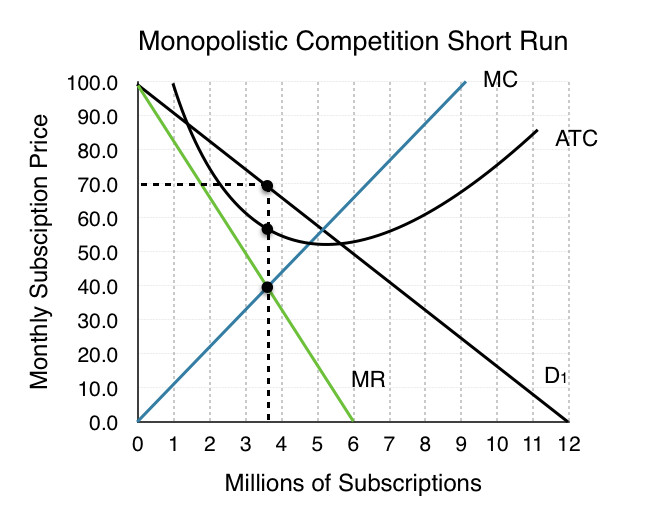
Monopolistic competition, short-run profit
Output is where MR intersects MC. Price is found by going up to the demand curve at that quantity. Because price is above ATC at that output, the firm earns economic profit.
Three Short-Run Outcomes
| Situation | Relationship | What It Means |
|---|---|---|
| Profit | Rectangle = | |
| Break-even | Normal profit | |
| Loss | Loss = |
You should be comfortable calculating these areas from a graph or table. If price is 18 dollars, ATC is 14 dollars, and output is 200 units, profit equals dollars.
Surplus and Deadweight Loss
- Consumer surplus = area under demand above price
- Producer surplus = area above MC below price
- Deadweight loss = triangle between demand and MC for units not produced
Efficient output occurs where P = MC. The firm instead produces where MR = MC, which means output is too low and price is too high.
That’s why imperfectly competitive prices don’t fully coordinate society’s resources.
3. Entry, Exit, and the Long Run
Low barriers drive the adjustment.
If Firms Earn Profit
- New firms enter
- More close substitutes exist
- Each firm’s demand and MR shift left
- Profit shrinks
If Firms Earn Losses
- Firms exit
- Fewer substitutes
- Demand shifts right
- Loss shrinks
Long-Run Equilibrium
In the long run:
- Demand is tangent to ATC
- → zero economic profit
- Still produces where MR = MC
- Not at minimum ATC
The tangency occurs on the downward-sloping part of ATC, not at its minimum. That is why the firm earns zero economic profit but still has excess capacity.
4. Inefficiency and Excess Capacity
Two inefficiencies remain in the long run.
Allocative Inefficiency
- Deadweight loss persists
Productive Inefficiency
- Firm does not produce at minimum ATC
- Produces a smaller output level
- Creates excess capacity
Excess capacity = difference between:
- Output at minimum ATC
- Actual long-run output
Firms could produce more at lower average cost, but demand for their specific differentiated product is limited.
5. Non-Price Competition and Product Differentiation
Because firms sell close substitutes, price is only part of the battle.
Common strategies:
- Brand identity (Nike swoosh)
- Customer service (Chick-fil-A reputation)
- Product attributes (quality, design)
- Advertising
Advertising typically:
- Shifts demand right
- Can make demand more elastic
- Creates temporary profit → entry → long-run zero profit again
On FRQs, advertising is usually shown as a rightward shift of demand and MR.
Key Takeaways
Monopolistic Competition
An imperfect market with many firms selling differentiated products and easy entry and exit.
Characteristics of Monopolistic Competition
Many firms, differentiated products, some price-setting power, low entry barriers, and non-price competition.
Product Differentiation
Selling similar goods with real or perceived differences in quality, style, branding, or service.
Non-Price Competition
Competing through advertising, branding, packaging, location, or service instead of lower prices.
Short-Run Equilibrium in Monopolistic Competition
Output is where MR equals MC, and price is found on the demand curve.
Short-Run Profit, Loss, and Break-Even in Monopolistic Competition
Profit if price exceeds ATC, loss if price is below ATC, and break-even if price equals ATC.
Long-Run Equilibrium in Monopolistic Competition
Entry and exit lead firms to earn zero economic profit where demand is tangent to ATC.
Entry and Exit Adjustment in Monopolistic Competition
Profits attract firms and shift each firm's demand left; losses cause exit and shift demand right.
Demand and Marginal Revenue in Monopolistic Competition
Both slope downward, with marginal revenue below demand because firms have some market power.
More Elastic Demand Than Monopoly
Firm demand is relatively elastic because many close substitutes are available from rival sellers.
Allocative Inefficiency in Monopolistic Competition
Price exceeds marginal cost, so too little is produced relative to the socially efficient amount.
Deadweight Loss in Monopolistic Competition
The lost total surplus from producing less than the socially efficient output where price exceeds marginal cost.
Consumer Surplus and Producer Surplus in Monopolistic Competition
Consumer surplus is below demand and above price; producer surplus is above supply-like cost and below price.
Calculating Profit or Loss on the Graph
Find quantity at MR equals MC, price on demand, then multiply quantity by price minus ATC.
Calculating Deadweight Loss on the Graph
Find the triangle between demand and MC over the units between actual and efficient output.
Excess Capacity and Productive Inefficiency
Firms produce below minimum ATC in the long run, leaving unused productive capacity.
Notes
Monopolistic Competition
An imperfect market with many firms selling differentiated products and easy entry and exit.
Characteristics of Monopolistic Competition
Many firms, differentiated products, some price-setting power, low entry barriers, and non-price competition.
Product Differentiation
Selling similar goods with real or perceived differences in quality, style, branding, or service.
Non-Price Competition
Competing through advertising, branding, packaging, location, or service instead of lower prices.
Short-Run Equilibrium in Monopolistic Competition
Output is where MR equals MC, and price is found on the demand curve.
Short-Run Profit, Loss, and Break-Even in Monopolistic Competition
Profit if price exceeds ATC, loss if price is below ATC, and break-even if price equals ATC.
Long-Run Equilibrium in Monopolistic Competition
Entry and exit lead firms to earn zero economic profit where demand is tangent to ATC.
Entry and Exit Adjustment in Monopolistic Competition
Profits attract firms and shift each firm's demand left; losses cause exit and shift demand right.
Demand and Marginal Revenue in Monopolistic Competition
Both slope downward, with marginal revenue below demand because firms have some market power.
More Elastic Demand Than Monopoly
Firm demand is relatively elastic because many close substitutes are available from rival sellers.
Allocative Inefficiency in Monopolistic Competition
Price exceeds marginal cost, so too little is produced relative to the socially efficient amount.
Deadweight Loss in Monopolistic Competition
The lost total surplus from producing less than the socially efficient output where price exceeds marginal cost.
Consumer Surplus and Producer Surplus in Monopolistic Competition
Consumer surplus is below demand and above price; producer surplus is above supply-like cost and below price.
Calculating Profit or Loss on the Graph
Find quantity at MR equals MC, price on demand, then multiply quantity by price minus ATC.
Calculating Deadweight Loss on the Graph
Find the triangle between demand and MC over the units between actual and efficient output.
Excess Capacity and Productive Inefficiency
Firms produce below minimum ATC in the long run, leaving unused productive capacity.
