Topic 1.6 Notes – Marginal Analysis and Consumer Choice
1. Marginal Analysis and the MB = MC Rule
Marginal analysis means comparing the marginal benefit (MB) of one more unit to the marginal cost (MC) of that unit.
- Marginal benefit (MB) = extra benefit from one more unit
- Marginal cost (MC) = extra cost from one more unit
The decision rule:
- If MB > MC → do more
- If MB < MC → do less
- If MB = MC → you’re at the optimal level
This applies to everyone:
- A consumer deciding how many slices of pizza to buy
- A firm deciding how many units to produce
The Optimal Quantity
The optimal quantity happens where:
- MB = MC, and
- Total net benefit (TB − TC) is maximized
Graphically, it’s where the two curves intersect. In the example below, marginal benefit slopes downward and marginal cost slopes upward as hours studied increase. The optimal number of hours is where the two lines cross, around 3 hours of studying.
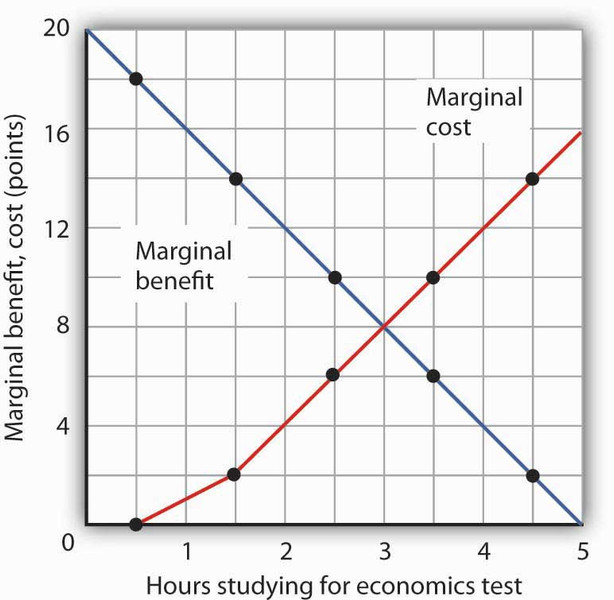
Marginal benefit and marginal cost intersection
In a table, it’s the last unit where MB ≥ MC.
Sunk Costs Do Not Matter
A sunk cost is a cost that already happened and can’t be recovered.
Example: You paid 15 dollars for a concert ticket. Halfway through, you’re bored. The 15 dollars is gone either way. Your decision to stay or leave should depend only on future MB and MC.
AP questions love testing this. If you see past costs mentioned, ignore them unless they affect future marginal cost.
2. Utility and the Law of Diminishing Marginal Utility
For consumers, marginal benefit = marginal utility (MU).
- Utility = satisfaction
- Total utility (TU) = total satisfaction from all units
- Marginal utility (MU) = change in total utility
Law of Diminishing Marginal Utility
As you consume more of a good:
- MU eventually falls
- TU increases at a decreasing rate
- MU can reach zero or become negative
Think about slices of pizza:
- 1st slice → high MU
- 4th slice → much lower MU
- 6th slice → maybe negative MU
This explains why demand curves slope downward. Because MU falls, you’re only willing to buy additional units if the price falls.
3. How Consumers Maximize Utility with a Budget Constraint
Consumers face a budget constraint. Income is limited, choices are not.
The standard assumptions:
- Consumers are rational.
- They aim to maximize total utility.
- They experience diminishing marginal utility.
- They spend all income.
- The model uses two goods (you won’t use indifference curves on the AP exam).
Because income is limited, every purchase has an opportunity cost. Buying more of one good means buying less of another.
4. The Utility Maximization Rule MU₁/P₁ = MU₂/P₂
Consumers maximize utility when the marginal utility per dollar is equal across goods.
Think of MU/P as “bang for your buck.”
- If → buy more of good 1
- If → buy more of good 2
- When equal → utility is maximized
This is just MB = MC in disguise:
- MB = MU
- MC = Price
So maximizing utility means allocating income so that the last dollar spent on each good gives the same additional satisfaction.
5. Solving Utility Maximization Problems
You’ll usually see a table on quizzes or FRQs.
Case 1: Given Total Utility
- Calculate MU (change in TU).
- Compute MU/P for each unit.
- Buy the unit with the highest MU/P.
- Subtract its price from income.
- Repeat until income is exhausted.
Your final combination must:
- Use all income
- Have equal MU/P for the last units purchased
Case 2: Given MU and Prices Only
If the last units purchased have:
- Equal MU/P → already maximizing
- Unequal MU/P → shift spending toward the higher MU/P good
Common trap: Students forget to divide by price. Equal MU does not mean equal MU/P.
Key Takeaways
Marginal Analysis
Comparing the additional benefit and additional cost of one more unit of an activity.
Sunk Costs / Fixed Costs in Marginal Decisions
Past or unchangeable costs that should not affect the current optimal choice.
Utility
The satisfaction or happiness a consumer receives from consuming goods and services.
Total Utility
The total satisfaction gained from consuming a given quantity of a good or goods.
Consumer Constraints
Limits on choices caused by scarce income, prices, and available purchasing power.
Law of Diminishing Marginal Utility
As more units are consumed, the extra satisfaction from each additional unit usually falls.
Marginal Utility Per Dollar
Marginal utility divided by price, showing satisfaction gained from each dollar spent.
Utility-Maximizing Rule for Two Goods
Spend income so the last dollar on each good gives equal marginal utility per dollar.
If MU1/P1 Does Not Equal MU2/P2
Buy more of the good with higher utility per dollar and less of the other.
Marginal Benefit, Marginal Cost, and the Optimal Quantity Rule
The best choice occurs where the additional benefit of one more unit equals its additional cost.
Marginal Utility
The extra satisfaction from one more unit consumed, which can eventually become negative.
Rational Consumer Choice Assumptions
Consumers maximize total utility subject to budget constraints by comparing marginal utility per dollar.
Rational Consumer
A buyer assumed to make choices that maximize total utility within a budget.
Notes
Marginal Analysis
Comparing the additional benefit and additional cost of one more unit of an activity.
Sunk Costs / Fixed Costs in Marginal Decisions
Past or unchangeable costs that should not affect the current optimal choice.
Utility
The satisfaction or happiness a consumer receives from consuming goods and services.
Total Utility
The total satisfaction gained from consuming a given quantity of a good or goods.
Consumer Constraints
Limits on choices caused by scarce income, prices, and available purchasing power.
Law of Diminishing Marginal Utility
As more units are consumed, the extra satisfaction from each additional unit usually falls.
Marginal Utility Per Dollar
Marginal utility divided by price, showing satisfaction gained from each dollar spent.
Utility-Maximizing Rule for Two Goods
Spend income so the last dollar on each good gives equal marginal utility per dollar.
If MU1/P1 Does Not Equal MU2/P2
Buy more of the good with higher utility per dollar and less of the other.
Marginal Benefit, Marginal Cost, and the Optimal Quantity Rule
The best choice occurs where the additional benefit of one more unit equals its additional cost.
Marginal Utility
The extra satisfaction from one more unit consumed, which can eventually become negative.
Rational Consumer Choice Assumptions
Consumers maximize total utility subject to budget constraints by comparing marginal utility per dollar.
Rational Consumer
A buyer assumed to make choices that maximize total utility within a budget.
