Topic 3.6 Notes – Firms’ Short-Run Decisions to Produce and Long-Run Decisions to Enter or Exit a Market
1. Short-Run Production Decision and the Shut-Down Rule
In the short run, at least one input is fixed. That means the firm must pay fixed costs (FC) even if output is zero. The question becomes: produce something, or shut down temporarily?
In perfect competition:
- Firms are price takers
- MR = P
- Profit-maximizing output is where MR = MC
After you find the MR = MC quantity, you apply the shut-down rule.
The Shut-Down Rule
A firm produces if:
Equivalent idea:
- TR ≥ TVC
A firm shuts down if:
Why AVC?
Because fixed costs are unavoidable. Variable costs are avoidable. If price does not cover variable cost, producing makes the loss worse.
Three Short-Run Outcomes at MR = MC
At the profit-maximizing quantity:
| Situation | Condition | What the Firm Does | Profit or Loss |
|---|---|---|---|
| Economic Profit | Produces | Profit = | |
| Economic Loss, Operate | Produces | Loss = | |
| Shut Down | Loss = Total Fixed Cost |
Important distinction:
- Operating with a loss can still be better than shutting down if some fixed costs are covered.
- Shutting down means zero output, not going out of business forever.
Here’s what that looks like on a graph. The firm produces where MR = MC at Q*. Price is below ATC at that quantity but above AVC, so the firm continues to operate with a loss.
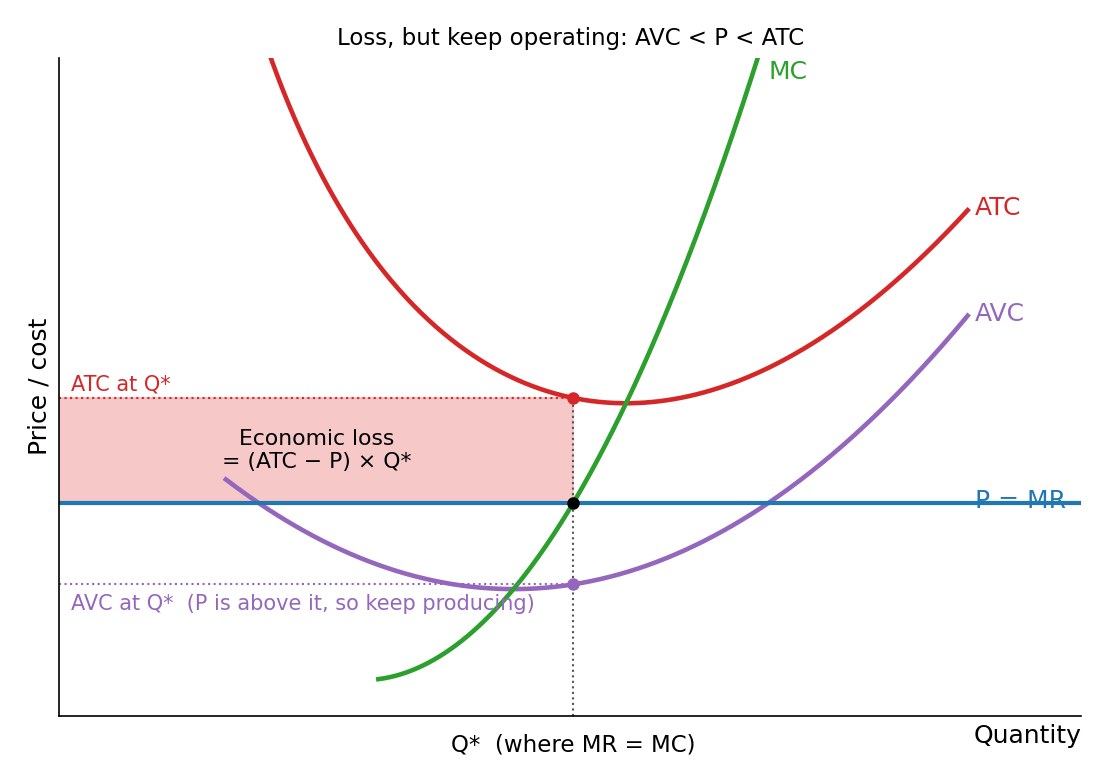
Economic loss but continue operating: AVC < P < ATC at the MR = MC quantity
The shaded rectangle represents the economic loss, calculated as .
On tests, they love asking:
- Is the firm producing?
- Is it making profit, loss, or shutting down?
- What is the size of that profit or loss?
Always find MR = MC first. Then compare price to AVC and ATC.
2. Long-Run Entry and Exit Decisions
In the long run, all inputs are variable. There are no fixed costs. Firms can completely avoid costs by exiting.
The decision rule is simpler:
- Economic profit (P > ATC) → firms enter
- Economic loss (P < ATC) → firms exit
No one stays in a market long term if they’re losing money.
This only works because perfect competition assumes:
- Many sellers
- Low barriers to entry and exit
Think agriculture or basic commodities. If corn farming is profitable, new farmers can enter. If it’s unprofitable, farmers shift resources elsewhere.
Short run vs long run:
- Short run uses P vs AVC
- Long run uses P vs ATC
Students mix this up constantly.
3. How Entry and Exit Change the Market
Since firms are price takers, price comes from market supply and demand.
When Firms Earn Profit
- New firms enter
- Market supply shifts right
- Price falls
- Each firm’s MR = P falls
- Profits shrink
- Stops when
When Firms Earn Losses
- Firms exit
- Market supply shifts left
- Price rises
- Each firm’s MR = P rises
- Losses shrink
- Stops when
Here’s the side-by-side picture you need to recognize. Focus on the left panel for the market shift and the right panel for the individual firm.
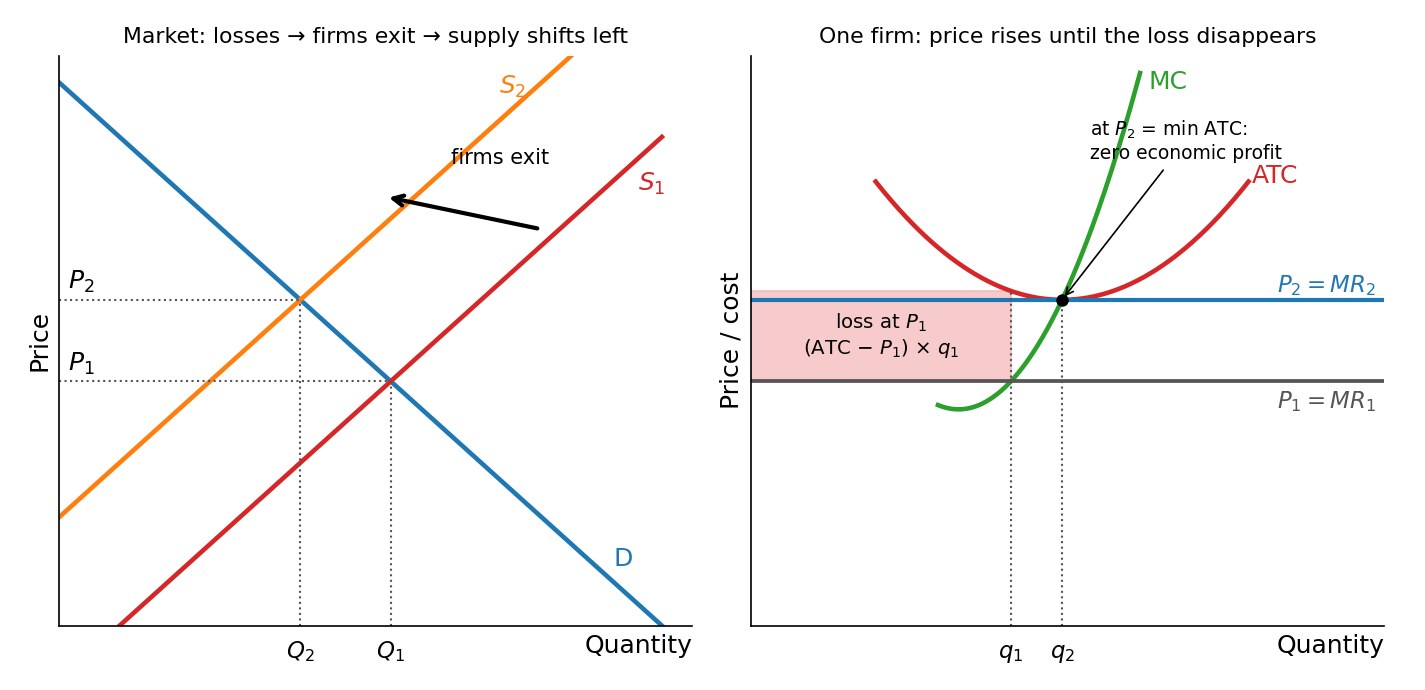
Losses lead to exit: market supply shifts left and price rises until each firm earns zero economic profit
On the AP exam, they often describe profits in words and expect you to show:
- Supply shifting
- Price changing
- Profit disappearing
4. Long-Run Equilibrium in Perfect Competition
In long-run equilibrium:
Firms earn zero economic profit, also called normal profit.
Zero economic profit means:
- Opportunity costs are covered
- Resources earn their next best alternative
- Firms stay in the market
It does NOT mean:
- Zero accounting profit
- Firms shut down
The market self-corrects through entry and exit. That’s the core idea of perfect competition.
Key Takeaways
Short-Run Operate or Shut Down Decision
Operate if total revenue covers total variable cost; otherwise produce zero output.
Fixed Costs in the Short Run
Costs that must be paid even when output is zero.
Why a Firm May Produce at a Loss in the Short Run
It keeps operating when revenue covers variable costs and losses are smaller than fixed costs.
Economic Profit, Loss, and Normal Profit
Profit means TR exceeds TC; loss means TR is below TC; normal profit means zero economic profit.
Short Run vs. Long Run for Firm Decisions
In the short run some costs are fixed; in the long run all inputs and costs are variable.
No Barriers to Entry or Exit
Firms can freely join or leave the market without major legal, financial, or structural obstacles.
Market Effects of Entry and Exit
Entry shifts supply right and lowers price; exit shifts supply left and raises price.
Price Taker
A firm that accepts the market price because its own output cannot affect price.
Long-Run Equilibrium in Perfect Competition
Entry and exit continue until firms earn zero economic profit at the market price.
Shut-Down Rule
Produce in the short run when price covers AVC, or equivalently when total revenue covers total variable cost.
Long-Run Entry and Exit Rule
With no barriers, firms enter for economic profit and exit when they expect economic losses.
Notes
Short-Run Operate or Shut Down Decision
Operate if total revenue covers total variable cost; otherwise produce zero output.
Fixed Costs in the Short Run
Costs that must be paid even when output is zero.
Why a Firm May Produce at a Loss in the Short Run
It keeps operating when revenue covers variable costs and losses are smaller than fixed costs.
Economic Profit, Loss, and Normal Profit
Profit means TR exceeds TC; loss means TR is below TC; normal profit means zero economic profit.
Short Run vs. Long Run for Firm Decisions
In the short run some costs are fixed; in the long run all inputs and costs are variable.
No Barriers to Entry or Exit
Firms can freely join or leave the market without major legal, financial, or structural obstacles.
Market Effects of Entry and Exit
Entry shifts supply right and lowers price; exit shifts supply left and raises price.
Price Taker
A firm that accepts the market price because its own output cannot affect price.
Long-Run Equilibrium in Perfect Competition
Entry and exit continue until firms earn zero economic profit at the market price.
Shut-Down Rule
Produce in the short run when price covers AVC, or equivalently when total revenue covers total variable cost.
Long-Run Entry and Exit Rule
With no barriers, firms enter for economic profit and exit when they expect economic losses.
