Topic 4.3 Notes – Price Discrimination
1. What Price Discrimination Is
A uniformly pricing monopoly charges one price to everyone. It chooses output where MR = MC, then uses the demand curve to find the price.
Quick reminder of why this matters:
- For a monopoly, MR lies below demand (D > MR).
- The firm restricts output.
- Result: P > MC, some consumer surplus remains, and there is deadweight loss.
Perfect (First-Degree) Price Discrimination
With perfect price discrimination, the firm charges each consumer their maximum willingness to pay.
That changes everything:
- Since the firm can capture each buyer’s willingness to pay, Demand becomes marginal revenue → D = MR.
- The firm produces where
- Output increases to the socially efficient level.
- Consumer surplus becomes zero.
- Deadweight loss becomes zero.
- Producer surplus expands dramatically.
This only works if three conditions hold:
- The firm has market power.
- It can separate buyers by willingness to pay (segment the market).
- Resale is prevented so consumers cannot arbitrage.
Real-World Anchors
These show up constantly in textbooks:
- Airlines charging different fares depending on booking time or travel date. This is called intertemporal price discrimination.
- Universities charging different net tuition through financial aid.
- Car dealerships negotiating individually.
- Movie theaters offering child and senior discounts.
- Professional sports teams charging different seat prices in the same stadium section.
The idea is always the same. Capture more surplus from people willing to pay more.
2. Uniform Monopoly vs Perfect Price Discrimination
| Uniform Monopoly | Perfect Price Discrimination | |
|---|---|---|
| Demand & MR | D > MR | D = MR |
| Output Rule | MR = MC | P = MC |
| Price | Single price | Different price for each buyer |
| Consumer Surplus | Some remains | Zero |
| Producer Surplus | Large | Maximized (captures all surplus) |
| Deadweight Loss | Present | Zero |
| Efficiency | Allocatively inefficient | Allocatively efficient |
Important nuance:
Even though perfect price discrimination is allocatively efficient, it is still productively inefficient if the firm is not producing at minimum ATC.
The AP likes asking whether something is efficient and who benefits. Efficiency and fairness are separate ideas.
3. Graphing and Calculating Surplus
Here is the standard visual comparison. Focus on the right panel for a uniform monopoly and the left panel for perfect price discrimination.
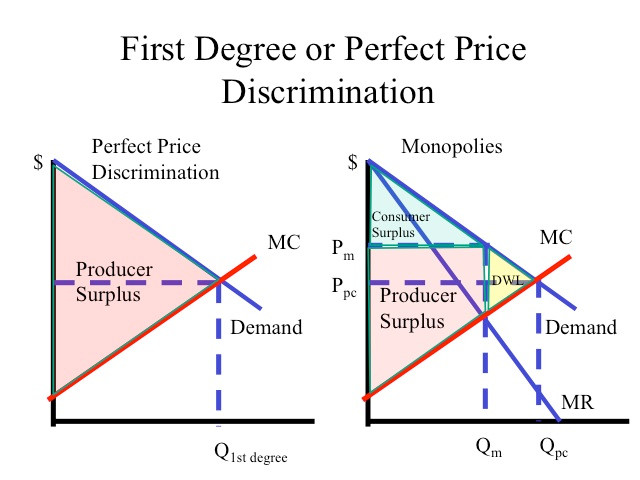
Uniform monopoly vs. perfect price discrimination
Uniform Monopoly
On the right-hand graph:
- Find MR = MC → that gives monopoly quantity .
- Go up to the demand curve → monopoly price .
- Identify:
- Consumer surplus, the triangle above and below demand.
- Producer surplus, the area below and above MC up to .
- Deadweight loss, the triangle between demand and MC from to the efficient quantity.
If price is 40 dollars, ATC is 25 dollars, and quantity is 80:
Area questions on tests are usually triangles or rectangles:
- Triangle =
- Rectangle = base × height
Perfect Price Discrimination
On the left-hand graph:
- Produce where D = MC, at the efficient quantity.
- Consumer surplus = 0.
- Deadweight loss = 0.
- Producer surplus equals the entire area under demand above MC.
If you see “perfect price discrimination” in an FRQ, your brain should immediately jump to:
Output increases. DWL disappears. Consumers get nothing.
4. Why Imperfect Competition Doesn’t Coordinate the Market
In perfect competition:
- All mutually beneficial trades happen.
- Resources go to their highest valued use.
In a uniform monopoly:
- Output is restricted.
- Some trades that would benefit both sides do not occur.
- Result: deadweight loss.
With perfect price discrimination:
- The firm produces at , just like perfect competition.
- But the entire surplus goes to the firm.
This ties directly to the big theme of Unit 4:
Market structure shapes outcomes.
More market power → more ability to capture surplus.
If a question asks whether prices in imperfectly competitive markets coordinate all participants, the answer is no. When , some beneficial exchanges are left on the table.
Key Takeaways
Price Discrimination
Charging different buyers different prices for the same good based on willingness to pay.
Perfect Price Discrimination / First-Degree Price Discrimination
Charging each unit at each consumer's maximum willingness to pay.
Conditions for Price Discrimination
Market power, ability to identify buyers' willingness to pay, and prevention of resale or arbitrage.
Uniformly Pricing Monopoly
A single seller charging one price to all buyers at the quantity where marginal revenue equals marginal cost.
Demand and Marginal Revenue Under Perfect Price Discrimination
Demand equals marginal revenue because each additional unit is sold at its own reservation price.
Output Rule Under Perfect Price Discrimination
Produce the quantity where demand, or price, equals marginal cost.
Consumer and Producer Surplus Under Perfect Price Discrimination
Consumer surplus becomes zero, and all economic surplus is captured as producer surplus.
Deadweight Loss Under Perfect Price Discrimination
It is eliminated because output expands to the allocatively efficient quantity where price equals marginal cost.
Allocative Efficiency and Productive Efficiency in Perfect Price Discrimination
Allocatively efficient at P = MC, but not productively efficient unless output also occurs at minimum average total cost.
Profit in a Price-Discriminating Monopoly
Economic profit rises because the firm converts consumer surplus into additional revenue.
Graphing Profit Under Perfect Price Discrimination
Revenue is the area under demand up to output, and profit equals that area minus total cost.
Notes
Price Discrimination
Charging different buyers different prices for the same good based on willingness to pay.
Perfect Price Discrimination / First-Degree Price Discrimination
Charging each unit at each consumer's maximum willingness to pay.
Conditions for Price Discrimination
Market power, ability to identify buyers' willingness to pay, and prevention of resale or arbitrage.
Uniformly Pricing Monopoly
A single seller charging one price to all buyers at the quantity where marginal revenue equals marginal cost.
Demand and Marginal Revenue Under Perfect Price Discrimination
Demand equals marginal revenue because each additional unit is sold at its own reservation price.
Output Rule Under Perfect Price Discrimination
Produce the quantity where demand, or price, equals marginal cost.
Consumer and Producer Surplus Under Perfect Price Discrimination
Consumer surplus becomes zero, and all economic surplus is captured as producer surplus.
Deadweight Loss Under Perfect Price Discrimination
It is eliminated because output expands to the allocatively efficient quantity where price equals marginal cost.
Allocative Efficiency and Productive Efficiency in Perfect Price Discrimination
Allocatively efficient at P = MC, but not productively efficient unless output also occurs at minimum average total cost.
Profit in a Price-Discriminating Monopoly
Economic profit rises because the firm converts consumer surplus into additional revenue.
Graphing Profit Under Perfect Price Discrimination
Revenue is the area under demand up to output, and profit equals that area minus total cost.
