Topic 1.4 Notes – Comparative Advantage and Trade
1. Absolute Advantage and Comparative Advantage
Scarcity forces choices. Every production decision has an opportunity cost, which is what you give up to get something else. Comparative advantage is built entirely on that idea.
Absolute Advantage
An individual, firm, or country has absolute advantage when it can:
- Produce more output with the same resources, or
- Use fewer resources to produce the same output
How to spot it:
- In output tables (maximum quantities), look for the larger number.
- In input tables (hours per unit), look for the smaller number.
A country can have absolute advantage in:
- One good
- Both goods
- Neither good
Comparative Advantage
Comparative advantage means producing a good at a lower opportunity cost.
That’s it. Not higher output. Not better technology. Lower opportunity cost.
In a two-country, two-good model:
- Each country will have comparative advantage in one good only.
- Even if one country has absolute advantage in both goods, trade can still benefit both.
This is the insight from David Ricardo’s theory of comparative advantage, which explains why countries like the U.S. and China both gain from trade, even if one is more productive overall.
2. How to Calculate Opportunity Cost and Identify Advantage
This is mechanical on quizzes and the AP exam. You need to be fast and accurate.
Output Problems
Used when you’re given maximum quantities.
Example:
| Country | Corn | Steel |
|---|---|---|
| A | 80 | 40 |
| B | 60 | 30 |
Step-by-step
- Use:
Opportunity Cost = Other Good Over - For Country A:
1 corn costs steel
1 steel costs corn - For Country B:
1 corn costs steel
1 steel costs corn
They have identical opportunity costs, so no comparative advantage exists. That means no gains from trade in this simple model.
Quick memory trick: OOO = Output Other Over
- Absolute advantage → highest output
- Comparative advantage → lowest opportunity cost
If two countries have the same opportunity cost, trade does not create gains. That shows up in multiple choice sometimes.
Input Problems
Used when given resources per unit.
Example:
| Country | 1 Car (hours) | 1 Computer (hours) |
|---|---|---|
| X | 2 | 8 |
| Y | 4 | 6 |
Step-by-step
- Use:
Opportunity Cost = Input Other Under - For Country X:
1 car costs computers (the 2 hours spent on a car could have made 2/8 of a computer)
1 computer costs cars - For Country Y:
1 car costs computers
1 computer costs cars
Comparative advantage:
- X has it in cars (0.25 < 0.67)
- Y has it in computers (1.5 < 4)
Mnemonic: IOU = Input Other Under
Absolute advantage here:
- X uses fewer hours for cars
- Y uses fewer hours for computers
3. Specialization According to Comparative Advantage
Countries should specialize in the good where they have comparative advantage, then trade.
- Export what you have comparative advantage in
- Import what you do not
Even if one country has absolute advantage in both goods, specialization still increases total output.
The diagram below shows two countries moving from production and consumption on their PPCs to points outside their own PPCs after specialization and trade.
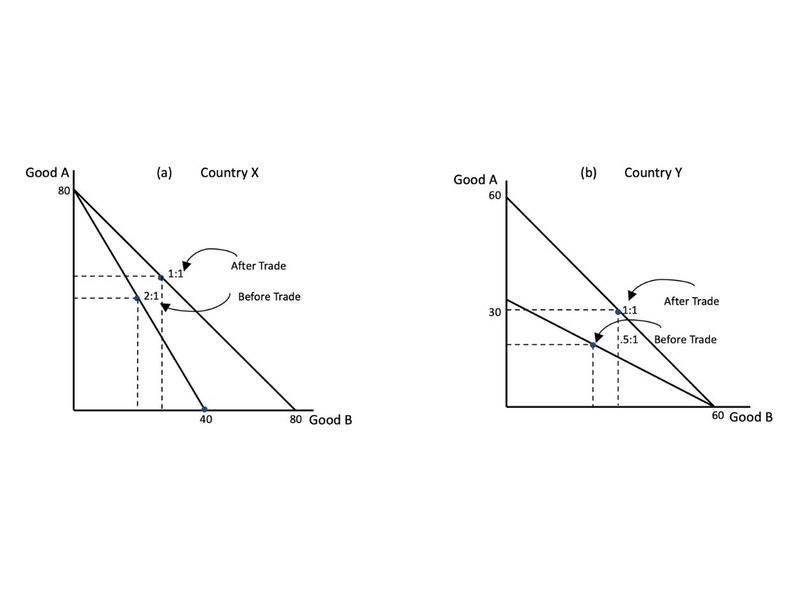
Specialization and gains from trade for Country X and Country Y
In each panel, the point labeled “Before Trade” lies on the PPC. After specializing in the good with comparative advantage and trading at a mutually beneficial rate such as 1:1, the country consumes at a point labeled “After Trade” that lies outside its own PPC.
Without trade:
- Consumption must be on or inside the PPC.
With specialization and trade:
- Consumption can occur outside the PPC.
- That represents gains from trade.
Real-world anchor:
- The U.S. specializes in high-tech and capital-intensive goods.
- Countries like Bangladesh specialize in labor-intensive textiles.
- Agreements like NAFTA (now USMCA) reflect this principle of specialization and exchange.
Most economists support free trade because it increases total output and overall welfare, even though distributional effects can create losers within a country.
4. Terms of Trade and Gains from Trade
Terms of Trade
Terms of trade are the rate at which one good exchanges for another.
For trade to be mutually beneficial:
- The trading ratio must fall between the two opportunity costs.
Example:
If:
- Country A’s OC of wine = 2 cloth
- Country B’s OC of wine = 5 cloth
Acceptable terms of trade:
If wine trades for 3 cloth, both gain.
If it’s outside that range, one country refuses.
Gains from Trade
A country gains if:
- Export price > its opportunity cost
- Import price < its opportunity cost
When that happens, both countries consume beyond their PPC and total surplus rises.
Key Takeaways
Absolute Advantage
The ability to produce more output or use fewer resources than another producer.
Comparative Advantage
The ability to produce a good or service at a lower opportunity cost.
Opportunity Cost
The value of the next best alternative given up when a choice is made.
Specialization
Concentrating production on the good with the lowest opportunity cost.
Gains From Trade
Increased consumption beyond a producer's PPC after specializing and exchanging.
Exports And Imports Under Comparative Advantage
A producer exports the good with lower opportunity cost and imports the other good.
Terms Of Trade
The exchange rate between goods that must fall between both producers' opportunity costs.
Output Vs. Input Problems
Comparative advantage questions use either maximum output data or resource-per-unit input data.
Output Vs. Input Problem Rules
Output uses higher production, while input uses fewer resources and different opportunity-cost formulas.
Notes
Absolute Advantage
The ability to produce more output or use fewer resources than another producer.
Comparative Advantage
The ability to produce a good or service at a lower opportunity cost.
Opportunity Cost
The value of the next best alternative given up when a choice is made.
Specialization
Concentrating production on the good with the lowest opportunity cost.
Gains From Trade
Increased consumption beyond a producer's PPC after specializing and exchanging.
Exports And Imports Under Comparative Advantage
A producer exports the good with lower opportunity cost and imports the other good.
Terms Of Trade
The exchange rate between goods that must fall between both producers' opportunity costs.
Output Vs. Input Problems
Comparative advantage questions use either maximum output data or resource-per-unit input data.
Output Vs. Input Problem Rules
Output uses higher production, while input uses fewer resources and different opportunity-cost formulas.
