Topic 1.1 Notes – What Is a Business?
What a Business Is
A business is an organization or entity that produces and distributes products.
That definition is broader than a lot of students first think. A product can be:
- a good
- a tangible item you can touch
- examples include clothing, food, and computers
- a service
- an activity or benefit provided to someone
- examples include tutoring, transportation, repair, and cloud storage
- or both together
- a restaurant gives you food and service
- a tech company may sell a device and software/support
A business also does two connected jobs:
- Produce
- make the good, or organize the resources and work needed to deliver the service
- Distribute
- make the product available to customers through a store, delivery, retailer, website, app, or another channel
So the core idea is simple. A business turns resources into a product and gets that product to customers. The diagram pulls those steps together in one flow.
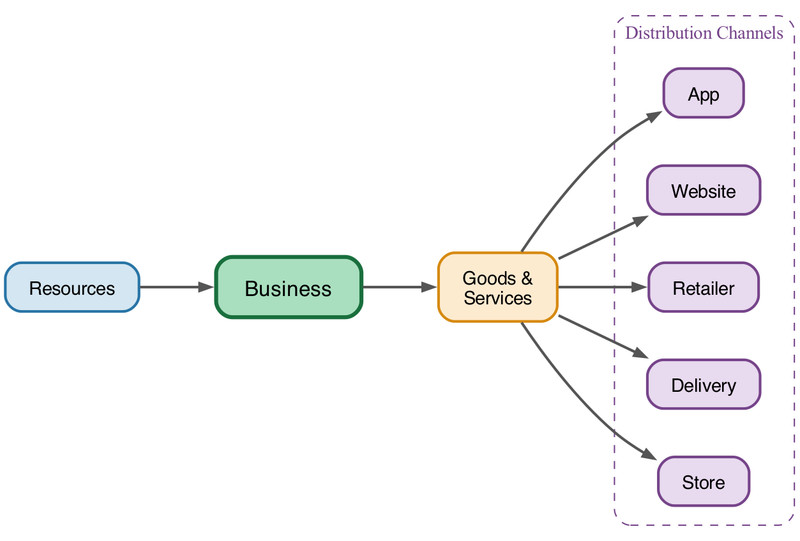
Business production and distribution flow
Size and reach
Businesses can be very different in size. Size can be described by:
- geographic reach
- local, regional, national, or global
- number of employees
- revenue
- the money earned from sales
Those measures do not always line up neatly.
- A business might have a small staff but sell worldwide online.
- A business might have many employees but only operate in one city or region.
Businesses can serve customers:
- face-to-face
- virtually
- hybrid using both
Customers, Consumers, and Market Opportunities
A lot of questions in this unit come down to identifying the right person in the scenario.
- Customer = the person or business that purchases
- Consumer = the individual who uses
Sometimes they are the same person.
- You buy and drink your own juice. You are both.
Sometimes they are different.
- A parent buys a backpack and the child uses it.
- A company buys software and employees use it.
That difference matters because the buyer and the user may care about different things.
- A school buying software may care about cost, security, and controls.
- Students using it may care about ease of use and engagement.
On multiple-choice questions, this is a common trap. The exam may ask about value for the customer, but the scenario may spend more time describing the consumer.
Problems, needs, and wants
Businesses look for market opportunities by identifying customer problems, needs, and wants.
- Problem
- a difficulty or inconvenience
- examples include long waits, poor fit, unreliable transportation
- Need
- something important to function or reach a goal
- examples include secure data storage or dependable transportation
- Want
- a preference or desire
- examples include premium features, a certain style, or a brand name
A market opportunity exists when a business can address one of those with a product customers will buy.
But a problem alone is not enough. The business still has to decide:
- who has the problem
- which group to serve
- what product to offer
- which benefits to emphasize
- which customers or concerns not to prioritize
Businesses cannot serve everyone. That idea shows up again and again in AP Business.
Problem-solution Fit and How Businesses Create Value
Problem-solution fit happens when a business’s product meaningfully addresses the selected customers’ problem, need, or want.
Here’s the chain:
- A group has a problem, need, or want.
- The business chooses that group and issue.
- The business develops a product.
- The product’s features lead to benefits the customer cares about.
That features-versus-benefits difference matters.
- Feature = what the product has or does
- Benefit = why that matters to the customer
Example:
- Waterproof coating = feature
- Keeps equipment usable in rain = benefit
A feature only creates value if it helps the chosen customer in a way they care about.
Value creation
Value means the worth or benefit of a product to customers. It is about what the customer gains, not the price tag.
Value creation happens when the business provides a product that responds to customers’ problems, needs, or wants.
Common ways businesses create value:
- solve a practical problem
- save time or money
- increase convenience
- improve quality, comfort, reliability, or performance
- reduce risk
- provide enjoyment or status
- support a cause or identity important to the customer
This is one of the biggest distinctions in the topic. A business can create value without being profitable. Customers may benefit a lot, but the business may still fail if it does not bring in enough money.
Value Capture and the Basic Business Logic
Value capture is the business side of the exchange. It happens when the business charges a price higher than the cost to produce the product.
Example:
So if a product sells for $15 and costs $9 to produce, the business captures $6 per unit.
Keep the two ideas separate:
- Value creation = benefit for the customer
- Value capture = amount the business keeps above production cost
A business might:
- create value but capture too little
- useful product, but free or priced below cost
- capture value for a while but create weak value
- customers buy at first, but weak benefits hurt future sales
A strong business usually needs both. The full sequence from customer need to business payoff looks like this.
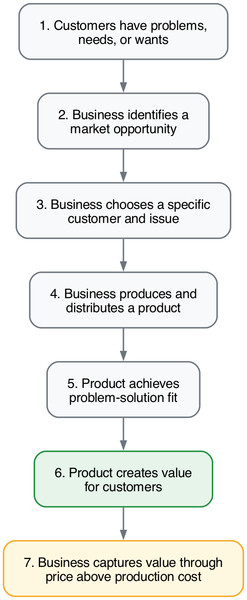
Basic business logic from customer need to value capture
This topic stops at the basic logic. Detailed profit analysis, competition, and finance come later.
Bombas as the Model Example
Bombas shows what this whole topic looks like in a real business.
The founders identified that socks were among the most requested items in homeless shelters. That mattered because:
- socks wear out quickly
- they matter for comfort and foot health
- used socks usually cannot be donated
So Bombas found a specific unmet need, not just a vague idea that people need clothing.
They built a response with a one-for-one model.
- For each item purchased, one item is donated.
They also learned from partner organizations and changed the donated products to fit real use conditions:
- darker colors
- reinforced construction
- antimicrobial treatment
That is a great example of turning features into benefits.
- darker colors → more practical
- reinforced construction → lasts longer
- antimicrobial treatment → better for foot health and repeated wear
Bombas also helps with the customer-consumer distinction.
- Paying purchasers are customers
- People receiving donated socks are consumers, but not customers
Bombas creates value for paying customers through:
- comfort
- quality
- social impact
It creates value for donation recipients through:
- durable, practical socks suited to real conditions
It still has to capture value. A social mission can raise perceived value, but it does not remove the need to charge enough to cover costs and keep operating.
Key Takeaways
Business
An organization or entity that produces and distributes products and may operate at any size, face-to-face, virtually, or both
Product
A good, a service, or a combination of the two produced and distributed by a business
Good
A tangible product, such as food, clothing, or a computer
Service
An activity or benefit provided to a customer
Customer
An individual or business that purchases a good or service
Consumer
An individual who uses a good or service, whether or not that individual purchased it
Problem
A difficulty, obstacle, inconvenience, or unsatisfactory condition experienced by a customer
Need
Something required or considered important for a person or business to function or accomplish an objective
Want
A preference or desire that is not necessarily required to accomplish a basic objective
Market Opportunity
A possible opening to provide a product addressing a customer problem, need, or want that customers will purchase
Problem-Solution Fit
The condition in which a proposed good or service meaningfully addresses the selected customers' problem, need, or want
Value
The worth or benefit of a product to customers
Value Creation
Providing a product that responds to customers' problems, needs, or wants and produces benefits for them
Value Capture
Charging a product price above its production cost; amount captured per unit = price per unit − production cost per unit
Notes
Business
An organization or entity that produces and distributes products and may operate at any size, face-to-face, virtually, or both
Product
A good, a service, or a combination of the two produced and distributed by a business
Good
A tangible product, such as food, clothing, or a computer
Service
An activity or benefit provided to a customer
Customer
An individual or business that purchases a good or service
Consumer
An individual who uses a good or service, whether or not that individual purchased it
Problem
A difficulty, obstacle, inconvenience, or unsatisfactory condition experienced by a customer
Need
Something required or considered important for a person or business to function or accomplish an objective
Want
A preference or desire that is not necessarily required to accomplish a basic objective
Market Opportunity
A possible opening to provide a product addressing a customer problem, need, or want that customers will purchase
Problem-Solution Fit
The condition in which a proposed good or service meaningfully addresses the selected customers' problem, need, or want
Value
The worth or benefit of a product to customers
Value Creation
Providing a product that responds to customers' problems, needs, or wants and produces benefits for them
Value Capture
Charging a product price above its production cost; amount captured per unit = price per unit − production cost per unit
