Topic 1.4 Notes – How Do Business Ideas Originate?
What Makes a Business Idea a Real Opportunity
An entrepreneur is a person who creates a new business and accepts the risk and possible reward that come with it. That matters here because a cool idea is only the beginning. What counts is whether the idea connects to a real customer situation.
You’ve already seen problem-solution fit earlier in Unit 1. That just means a product lines up with a real customer problem, need, or want.
A product idea becomes a real business opportunity when all four pieces connect:
- a customer problem, need, or want
- a possible product that addresses it
- customers willing to value and buy it
- a business able to provide it
A product can be:
- a good like a lunch container
- a service like floral event design
- a combination of both
And that product can either:
- launch a new business, or
- become a new offering inside an existing business
A few distinctions here get tested a lot:
- Problem statement means what the customer is experiencing.
- Product idea means the proposed solution.
- Problem validation means proving the problem exists, is clear, and affects multiple potential customers.
- Idea validation means testing whether the proposed solution seems useful.
- Market gap means customers need something current options do not meet well. It does not automatically mean profit.
Ways Businesses and Entrepreneurs Generate Ideas
Most ideas come from evidence, not guessing. Businesses and entrepreneurs commonly generate ideas through:
- observing customers
- interviewing customers
- surveying customers
- market research
- technical research
- experimentation
Observing potential customers
Observation means watching what people actually do. This can reveal:
- frustration with current options
- workarounds people invent on their own
- delays in getting something done
- waste of time or materials
- repeated inconvenience
This is useful because customers do not always explain their own behavior clearly. Still, one observation is only a clue. It does not prove a broad opportunity.
Interviewing and surveying
Interviews help you understand why the problem happens.
Better early questions sound like:
- “How often does this happen?”
- “What do you do now?”
- “What’s most annoying about it?”
Weaker questions sound like:
- “Would you buy my product?”
That kind of question pushes the solution too early and often gets polite answers.
Surveys ask the same questions to a larger group. They help show whether the problem is shared by multiple potential customers. The trap is thinking survey interest equals real demand. It doesn’t.
Market research, technical research, experimentation
Market research looks for a market gap by checking:
- competitor products
- complaints and reviews
- purchasing patterns
- trends
Be careful here. If there is no strong competitor, that might mean opportunity, or it might mean weak demand.
Technical research asks whether the solution is feasible. That includes materials, software, equipment, production methods, and scientific developments. A product can be technically possible and still have weak customer interest.
Experimentation creates new knowledge or capabilities. Sometimes a business discovers a product idea because it can suddenly do something new. Even failed experiments help if they stop bigger losses later.
Malama ia Floral Design
Malama ia Floral Design shows this whole process in action. The entrepreneur identifies a market opportunity, validates it with customer evidence, and develops a product around that opportunity. The point of the case is not “someone had a passion for flowers.” The point is that the idea was shaped through validation.
The Design-Thinking Process for Validating an Idea
This topic’s main process is design thinking. Keep the full sequence in mind as you move through the steps below, especially the feedback loops that send businesses back to earlier stages.
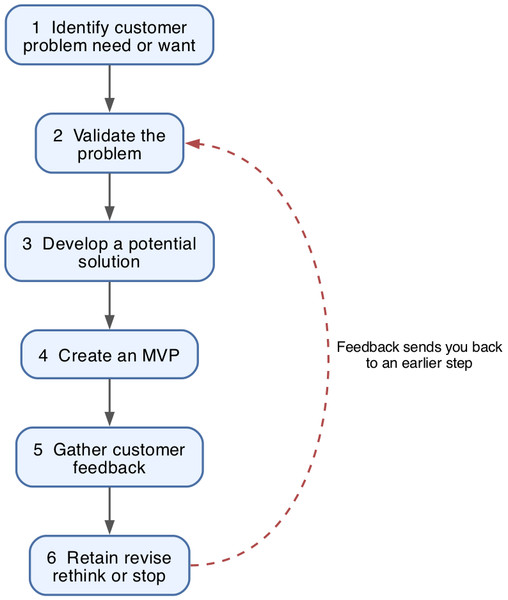
Entrepreneurial design-thinking process
The full sequence is:
- Identify a possible customer problem, need, or want
- Validate the problem
- Develop a potential solution
- Create an MVP
- Gather customer feedback
- Retain, revise, rethink, or stop
Validating the problem
Problem validation usually begins with observing, interviewing, and/or surveying customers.
Validation means evidence that the problem:
- exists
- can be clearly defined
- is experienced by multiple potential customers
A strong problem statement says:
- who has the problem
- what the problem is
- why current options fall short
Vague statements are weak. Statements that jump straight to the solution are also weak.
Developing the solution and the MVP
Once the problem is validated, the business develops a possible solution through:
- brainstorming
- sketching
- prototyping
- testing features
An MVP or minimum viable product is the simplest version with only the core features needed to get feedback. It might be a:
- sketch
- description
- model
- demo
- stripped-down product or service
“Minimum” does not mean low quality. It means only the central value is included.
A prototype becomes an MVP when customers actually use it or react to it for feedback.
Gathering feedback
The feedback stage asks whether the MVP is:
- understandable
- useful
- responsive to the validated problem
Possible results include:
- continue with the core idea
- revise a feature
- redefine the problem
- test a different solution
- stop pursuing it
Why the Process Is Iterative and Why That Matters
Design thinking is iterative. Feedback can send you back to the problem, the solution, or the MVP itself.
That matters because it prevents:
- getting attached to a weak idea
- spending too much too early
- confusing positive comments with real demand
Three things students often mix up:
- Evidence for the problem is not evidence for the solution.
- Customer interest is not the same as actual purchases.
- An MVP is not the final product.
The floral-design case shows this pattern clearly. The entrepreneur spots an opportunity, gets evidence, shapes the product, tests it, and revises before making a bigger commitment.
Risk and Why People Still Take It
Bringing a new product to market is risky because the business commits resources before success is known. There is no guarantee the product will earn enough revenue to cover costs or create profit.
The resources at risk are:
- Financial resources
Money spent on research, design, materials, labor, testing, production, and launch - Physical resources
Equipment, materials, inventory, tools, facilities, and prototypes - Human resources
Time, labor, skill, and attention from founders and workers
Cost means what the business spends.
Risk means uncertainty about whether the outcome will justify that spending.
Why accept that risk?
- Potential future profits
- Satisfaction from solving a problem
- Pursuit of a passion
Those motives are real, but passion and satisfaction do not replace validation. Design thinking reduces uncertainty and lowers the cost of learning early. It reduces risk. It never eliminates it.
Key Takeaways
Entrepreneur
An individual who develops a new business and assumes its risks and potential rewards
Business Opportunity
A plausible connection among a customer problem, a product that addresses it, customers willing to buy it, and a business able to provide it
Customer Observation
Examining what potential customers actually do to identify difficulties, workarounds, frustration, or unmet needs
Customer Interviews
Detailed conversations used to understand the reasons, nature, and context behind potential customers’ problems
Customer Surveys
Consistent questions given to a larger group to determine whether multiple potential customers experience a problem
Market Research
Research into products, competitors, complaints, purchasing patterns, and trends to identify inadequately addressed customer needs
Market Gap
A customer problem, need, or want that existing products do not adequately address
Technical Research
Investigation of materials, equipment, software, processes, or scientific knowledge to discover possibilities or assess whether a solution can work
Developing Capabilities Through Experimentation
Testing approaches to create new knowledge, skills, processes, or technologies that make new product ideas possible
Entrepreneurial Design-Thinking Process
Identify and validate a customer problem, develop a solution, represent it as an MVP, gather feedback, and retain, revise, or reconsider the idea
Problem Validation
Gathering evidence that a customer problem, need, or want exists, can be clearly defined, and is experienced by multiple potential customers
Idea Validation
Gathering feedback from potential customers on whether an MVP’s core solution appears to address the validated problem
Minimum Viable Product (MVP)
The simplest version of a product idea containing only its core features and used to gather initial feedback from potential customers
Risk
Uncertainty that a product’s outcome will not justify the financial, physical, and human resources committed to bringing it to market
Notes
Entrepreneur
An individual who develops a new business and assumes its risks and potential rewards
Business Opportunity
A plausible connection among a customer problem, a product that addresses it, customers willing to buy it, and a business able to provide it
Customer Observation
Examining what potential customers actually do to identify difficulties, workarounds, frustration, or unmet needs
Customer Interviews
Detailed conversations used to understand the reasons, nature, and context behind potential customers’ problems
Customer Surveys
Consistent questions given to a larger group to determine whether multiple potential customers experience a problem
Market Research
Research into products, competitors, complaints, purchasing patterns, and trends to identify inadequately addressed customer needs
Market Gap
A customer problem, need, or want that existing products do not adequately address
Technical Research
Investigation of materials, equipment, software, processes, or scientific knowledge to discover possibilities or assess whether a solution can work
Developing Capabilities Through Experimentation
Testing approaches to create new knowledge, skills, processes, or technologies that make new product ideas possible
Entrepreneurial Design-Thinking Process
Identify and validate a customer problem, develop a solution, represent it as an MVP, gather feedback, and retain, revise, or reconsider the idea
Problem Validation
Gathering evidence that a customer problem, need, or want exists, can be clearly defined, and is experienced by multiple potential customers
Idea Validation
Gathering feedback from potential customers on whether an MVP’s core solution appears to address the validated problem
Minimum Viable Product (MVP)
The simplest version of a product idea containing only its core features and used to gather initial feedback from potential customers
Risk
Uncertainty that a product’s outcome will not justify the financial, physical, and human resources committed to bringing it to market
