Topic 5.2 Notes – Managing Personal Risk
What Insurable Personal Risk Is
Risk management means reducing the financial harm from bad events. Insurance helps with that, but it does not prevent a crash, illness, fire, or theft. It shifts part of the money loss from you to an insurance company.
You still pay some costs yourself, including:
- deductibles
- losses above coverage limits
- excluded losses the policy does not cover
- risks you never insured in the first place
An insurable risk is a possible loss caused by chance, like an accident, illness, theft, fire, or weather event. For insurers to cover it, two things have to be true:
- Quantifiable means the loss can be estimated in dollars.
- Statistically predictable means insurers can use data from large groups to estimate how likely the loss is and what it usually costs.
That is why insurance works best for uncertain, potentially large losses. Small, predictable expenses usually make more sense to pay from income or savings.
Deliberately causing a loss is different. If someone fakes a theft, stages a crash, or lies about damage, that is insurance fraud.
The three types
A lot of questions come down to sorting risk into the right bucket. This three-part breakdown is the one to keep in mind as you classify examples.
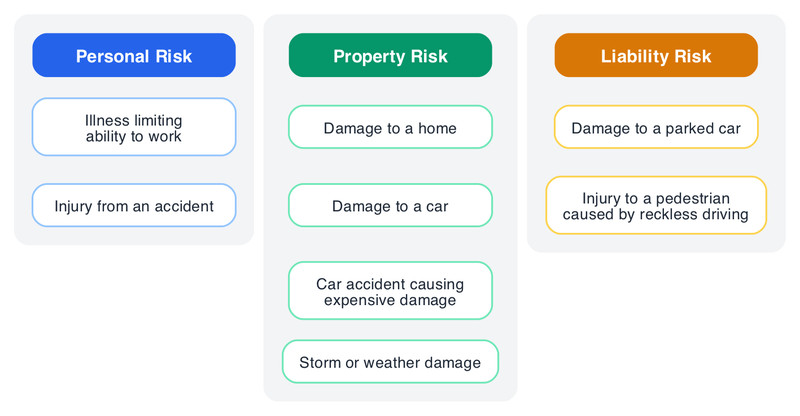
Types of personal risk
- Personal risk
- Harm to your health or well-being
- Financial effects include medical bills, lost income, disability, and death-related costs
- Examples include an illness that limits your ability to work and an injury from an accident
- Property risk
- Loss of or damage to your property
- Examples include damage to a home, damage to a car, expensive car accident damage, and storm or weather damage
- Liability risk
- Risk that you are legally responsible for harm to someone else or their property
- Examples include damaging a parked car or injuring a pedestrian through reckless driving
The quickest way to classify an event is to ask Whose body? Whose property? Who is legally responsible? One accident can create all three at once.
How Insurance Policies Work
Insurance is a contract. The insurer agrees to pay for certain covered losses, up to certain amounts, if the rules of the policy are met.
Core policy terms
- Premium = the amount you pay for the policy
- often monthly, semi-annual, or annual
- Coverage = what the policy protects against and how much it may pay
- Claim = your request for payment or reimbursement after a covered loss
- Deductible = the amount you pay before or alongside insurer payment
- Coverage limit = the maximum the insurer will pay
- Beneficiary = the person who receives life insurance money
Basic claim logic
- A covered loss happens.
- The policyholder files a claim.
- The insurer checks whether the loss is covered.
- The deductible, limits, and exclusions are applied.
- The insurer pays only the covered amount.
A common test mistake is assuming “has insurance” means “everything gets paid.” It does not.
Example:
- Covered loss = $6,000
- Deductible = $1,000
- You pay $1,000
- Insurer pays $5,000
More protection usually costs more:
- Higher coverage, higher limits, lower deductibles → higher premiums
- Lower coverage, lower limits, higher deductibles → lower premiums, but more out-of-pocket risk
Types of Insurance Individuals Use
Different policies protect different risks, and some cover more than one kind.
| Insurance type | Main protection |
|---|---|
| Health insurance | Personal risk from medical costs |
| Auto insurance | Property, personal, and liability risk |
| Homeowner’s insurance | Home and belongings, plus liability |
| Renter’s insurance | Tenant belongings, plus liability |
| Life insurance | Financial support for survivors |
| Extended warranties/service contracts | Limited repair or replacement protection |
Health insurance
Health insurance pays for medically necessary care and sometimes preventive care. It may come through an employer, and the employer may pay some or all of the premium. Coverage can be individual or family. It mainly protects against personal risk.
Auto insurance
Auto insurance can cover:
- damage to your own vehicle, which is property risk
- injuries, which is personal risk
- damage or injury you cause to others, which is liability risk
Most U.S. states require auto liability insurance. The big exam trap here is that the legal minimum may be enough to drive legally, but still far too low for a serious crash. A good driving record can reduce premiums.
Homeowner’s and renter’s insurance
Homeowner’s insurance usually covers the home, often belongings, and commonly liability protection. Mortgage lenders usually require it because the home secures the loan.
Renter’s insurance matters because the landlord’s policy covers the building, not your stuff.
- Renter’s insurance often covers:
- furniture
- clothing
- electronics
- liability for covered damage or injury
Life insurance
Life insurance pays designated beneficiaries when the insured dies. Its main uses are to:
- replace lost income
- pay funeral or end-of-life expenses
- pay debts
- support dependents
- fund future needs like education
Need is highest when someone depends on that person financially or practically.
Extended warranties and service contracts
These are insurance-like protections on expensive purchases such as cars and appliances. You evaluate them the same way you would insurance:
- what is covered?
- how long does it last?
- what is excluded?
- are there repair or replacement limits?
- could savings cover the loss instead?
Choosing the Right Coverage
Good coverage matches the household’s real risks and budget.
A solid recommendation usually works through these steps:
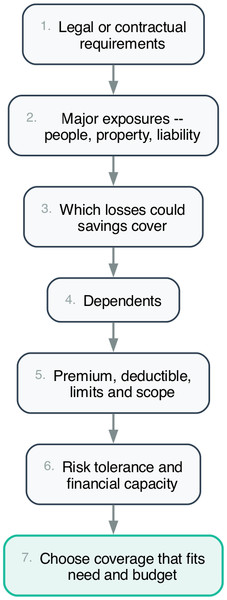
Steps for choosing insurance coverage
- Check legal or contractual requirements. Most states require auto liability insurance. Mortgage lenders require homeowner’s or property insurance. Legal requirements also vary between nations.
- Identify major exposures. Think people, property, and possible liability to others.
- Ask which losses savings could handle and which would be financially devastating.
- Consider dependents.
- Compare premium, deductible, coverage limits, and scope of coverage.
- Think about risk tolerance and financial capacity.
- Choose protection that fits both need and budget.
What changes the amount of insurance someone needs:
- Risk tolerance
- low risk tolerance often means wanting more complete coverage or a lower deductible
- high risk tolerance may mean accepting less coverage or a higher deductible
- Financial capacity
- someone can be comfortable with risk and still not have cash for a high deductible
- Dependents
- more dependents often means more family health coverage, more vehicle coverage, and more life insurance
- Life changes
- marriage, children, moving, job benefits, income changes, savings changes, and new debt can all change insurance needs
Behavior also affects premiums. Good driving and not smoking often lower costs, including lower life insurance premiums for nonsmokers. A lower premium is not automatically better if it comes from weaker protection.
Insurance fraud is intentional deception for unlawful financial gain. By buyers, this includes lying on an application, staging a loss, exaggerating damage, or filing a false claim. By sellers, it includes misrepresenting policy terms or benefits. Consequences can include denied claims, canceled coverage, fines, and criminal penalties.
Protecting Yourself From Financial Fraud
Some risks are not solved by insurance. These include predatory lending, phishing, identity theft, and online scams.
- Predatory lending
- uses deception, hidden or confusing terms, or aggressive pressure
- protection includes comparing loan terms from multiple sources, resisting urgency, and seeking advice from nonprofit credit counselors before signing a loan agreement
- Phishing
- a fake message, text, call, or email pretending to be a trusted organization
- red flags include urgency, account problem warnings, prize claims, and requests for personal or financial information
- verify through official channels, not the message’s link or phone number
- Identity theft and online scams
- can involve stolen personal info, fake investments, fake shopping sites, impersonation, romance scams, or false job offers
- do not share passwords, account numbers, authentication codes, or government ID information under pressure
- monitor accounts and evaluate credibility independently
A credit freeze makes it harder for thieves to open new credit in your name. You can use it before or after fraud. If you are victimized, keep records, contact financial institutions, and seek legal aid if needed.
Key Takeaways
Managing Personal Risk (Risk Management)
Identifying possible losses and deciding how to reduce, retain, or transfer their financial consequences
Insurance
An arrangement that transfers specified financial risks to an insurer in exchange for a premium
Insurable Risk
A potential loss caused by chance that is quantifiable and statistically predictable
Personal Risk
Insurable risk involving the insured person’s health or well-being, such as injury, illness, disability, or death
Property Risk
Insurable risk involving loss of or damage to property owned or used by an individual
Liability Risk
The risk of being legally responsible for injury to another person or damage to another person’s or entity’s property
Insurance Policy
A contract stating the losses an insurer covers and the conditions under which it will pay
Policyholder
The person who owns or purchases an insurance policy
Insured
The person or property protected by an insurance policy
Insurer
The company that assumes covered financial risk and pays eligible claims
Premium
The price paid for an insurance policy, commonly monthly, semi-annually, or annually
Coverage
The policy’s protection, including the losses covered and the amount the insurer may pay
Claim
A request for payment or reimbursement after a covered loss
Deductible
The portion of a covered loss the policyholder must pay before or alongside the insurer’s payment
Coverage Limit
The maximum amount an insurer will pay for a particular loss or category of loss
Beneficiary
A designated recipient entitled to receive life insurance proceeds after the insured person’s death
Health Insurance
Insurance covering medically necessary health care and, under some policies, preventive care
Auto Insurance
Insurance that may cover losses to an insured vehicle, injuries, and liability for harm caused to others
Auto Liability Insurance
Auto coverage for covered injuries or property damage the insured causes to others; most states require it
Homeowner’s Insurance
Insurance covering specified losses to a home and belongings and commonly providing liability protection
Renter’s Insurance
Insurance protecting a tenant’s personal property against covered losses and potentially providing liability protection
Life Insurance
Insurance that pays designated beneficiaries when the insured person dies, often to replace income or support dependents
Extended Warranty or Service Contract
A limited form of insurance under which a provider agrees to repair, replace, or service a purchase under specified conditions
Risk Tolerance
An individual’s willingness to accept uncertain financial losses
Insurance Fraud
Intentional deception by an insurance buyer, claimant, insurer, or seller for unlawful financial benefit
Predatory Lending
Unfair or deceptive lending practices that exploit borrowers through misleading terms, manipulation, or aggressive pressure
Phishing
An attempt to obtain personal or financial information by impersonating a trusted person or organization
Identity Theft
Unauthorized use of another person’s identifying information to access accounts, make purchases, or obtain credit
Online and Other Financial Scams
Fraudulent offers or schemes, often marked by urgency, secrecy, threats, guaranteed returns, or demands for money or information
Credit Freeze
A restriction on access to a person’s credit file that makes opening new fraudulent credit accounts more difficult
Determining Appropriate Insurance Coverage
Identify requirements and exposures, assess losses the household can absorb, consider dependents and risk tolerance, compare policy costs and terms, and select protection for losses the household cannot reasonably bear
Notes
Managing Personal Risk (Risk Management)
Identifying possible losses and deciding how to reduce, retain, or transfer their financial consequences
Insurance
An arrangement that transfers specified financial risks to an insurer in exchange for a premium
Insurable Risk
A potential loss caused by chance that is quantifiable and statistically predictable
Personal Risk
Insurable risk involving the insured person’s health or well-being, such as injury, illness, disability, or death
Property Risk
Insurable risk involving loss of or damage to property owned or used by an individual
Liability Risk
The risk of being legally responsible for injury to another person or damage to another person’s or entity’s property
Insurance Policy
A contract stating the losses an insurer covers and the conditions under which it will pay
Policyholder
The person who owns or purchases an insurance policy
Insured
The person or property protected by an insurance policy
Insurer
The company that assumes covered financial risk and pays eligible claims
Premium
The price paid for an insurance policy, commonly monthly, semi-annually, or annually
Coverage
The policy’s protection, including the losses covered and the amount the insurer may pay
Claim
A request for payment or reimbursement after a covered loss
Deductible
The portion of a covered loss the policyholder must pay before or alongside the insurer’s payment
Coverage Limit
The maximum amount an insurer will pay for a particular loss or category of loss
Beneficiary
A designated recipient entitled to receive life insurance proceeds after the insured person’s death
Health Insurance
Insurance covering medically necessary health care and, under some policies, preventive care
Auto Insurance
Insurance that may cover losses to an insured vehicle, injuries, and liability for harm caused to others
Auto Liability Insurance
Auto coverage for covered injuries or property damage the insured causes to others; most states require it
Homeowner’s Insurance
Insurance covering specified losses to a home and belongings and commonly providing liability protection
Renter’s Insurance
Insurance protecting a tenant’s personal property against covered losses and potentially providing liability protection
Life Insurance
Insurance that pays designated beneficiaries when the insured person dies, often to replace income or support dependents
Extended Warranty or Service Contract
A limited form of insurance under which a provider agrees to repair, replace, or service a purchase under specified conditions
Risk Tolerance
An individual’s willingness to accept uncertain financial losses
Insurance Fraud
Intentional deception by an insurance buyer, claimant, insurer, or seller for unlawful financial benefit
Predatory Lending
Unfair or deceptive lending practices that exploit borrowers through misleading terms, manipulation, or aggressive pressure
Phishing
An attempt to obtain personal or financial information by impersonating a trusted person or organization
Identity Theft
Unauthorized use of another person’s identifying information to access accounts, make purchases, or obtain credit
Online and Other Financial Scams
Fraudulent offers or schemes, often marked by urgency, secrecy, threats, guaranteed returns, or demands for money or information
Credit Freeze
A restriction on access to a person’s credit file that makes opening new fraudulent credit accounts more difficult
Determining Appropriate Insurance Coverage
Identify requirements and exposures, assess losses the household can absorb, consider dependents and risk tolerance, compare policy costs and terms, and select protection for losses the household cannot reasonably bear
